




























Views
Downloads

Needs of Animals Worksheet: Dog vs Wolf | Grade 2 Essential

Paste this activity's link or code into your existing LMS (Google Classroom, Canvas, Teams, Schoology, Moodle, etc.).
Students can open and work on the activity right away, with no student login required.
You'll still be able to track student progress and results from your teacher account.
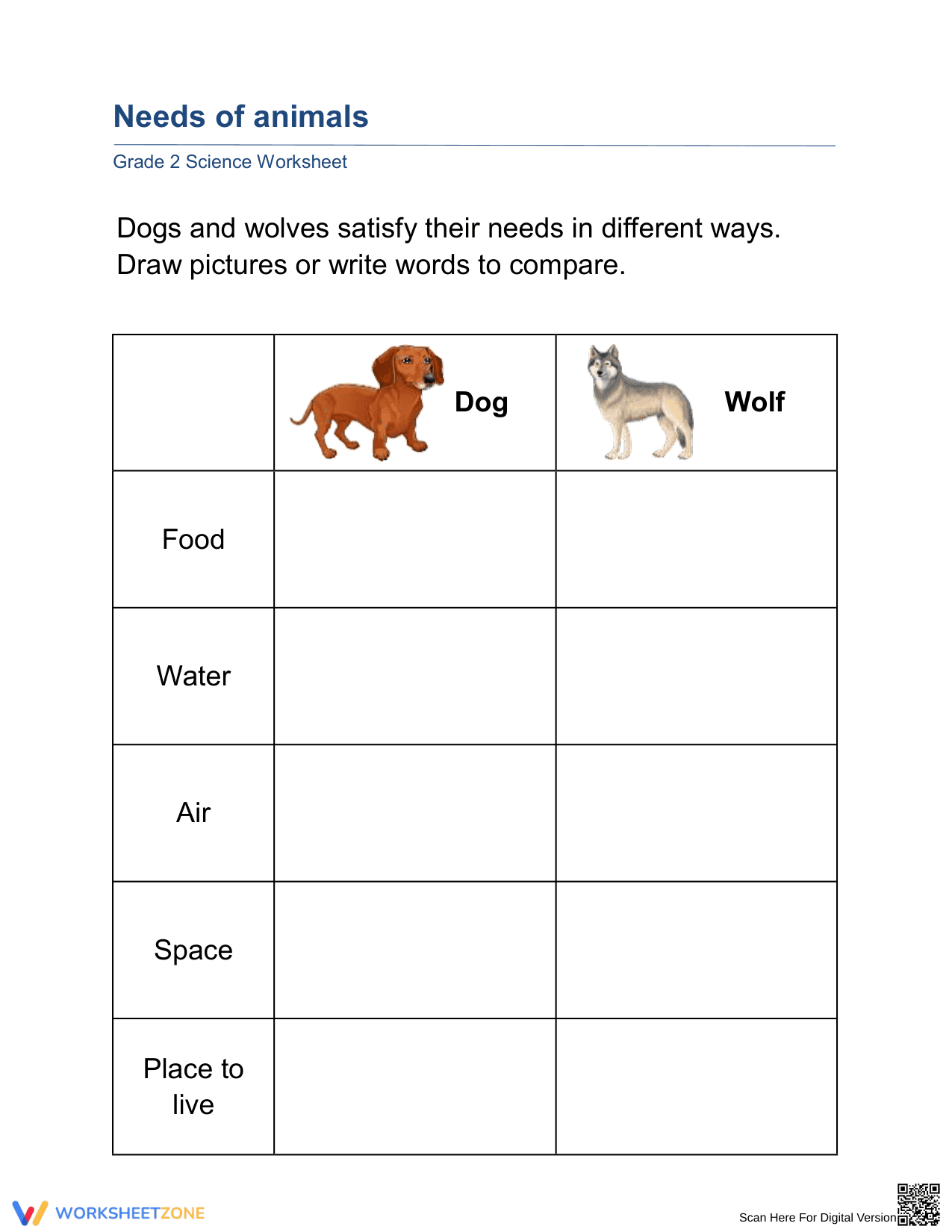
This Grade 2 Science worksheet provides a structured framework for students to compare the survival needs of a domestic dog and a wild wolf. Learners use observation to identify how these animals satisfy requirements for food, water, air, and shelter, reinforcing foundational biological concepts through active comparison and critical thinking.
At a Glance
- Grade: 2 · Subject: Science
- Standard:
K-LS1-1— Use observations to describe what animals need to survive.- Skill Focus: Comparing Animal Needs
- Format: 2 pages · 10 comparison points · Answer key included · PDF
- Best For: Independent practice, science centers, or sub plans
- Time: 15–20 minutes
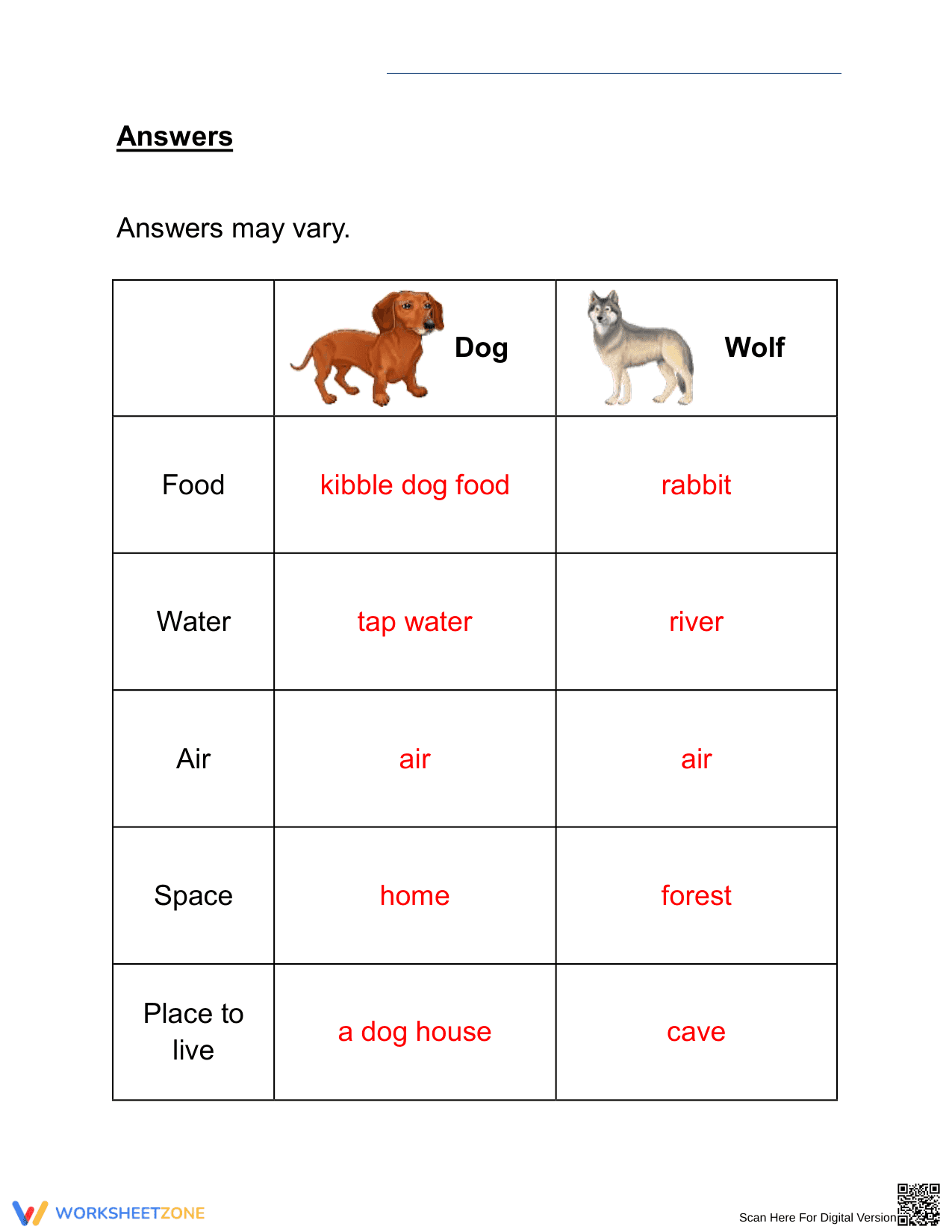
The resource includes a two-page PDF file containing a single-page student worksheet and a corresponding answer key. The worksheet features a clean two-column table where students compare a dog and a wolf across five survival categories. This layout supports either written responses or labeled drawings, offering flexible ways for students to demonstrate their scientific understanding.
This worksheet is designed for maximum efficiency with a three-step workflow. First, print the single-page handout for each student (less than 1 minute). Second, distribute the worksheet for independent or partner work during your life science block (1 minute). Finally, review the answers as a class or have students self-correct using the provided key (5 minutes). The total teacher preparation and execution time is under 10 minutes, making it an ideal resource for sub plans, quick transitions, or a focused formative assessment.
This activity directly supports standard K-LS1-1, which requires students to use observations to describe patterns of what plants and animals need to survive. While labeled for Grade 2, it effectively reinforces these foundational concepts, ensuring students can articulate that all animals share predictable survival needs regardless of environment. This standard code can be copied directly into lesson plans, IEP goals, or district curriculum mapping tools.
This worksheet is perfect for use after an introductory lesson on animal habitats or basic needs. It functions as a powerful formative assessment tool. For an observation tip, check if students can differentiate between a general need (water) and a specific source (tap water vs. river), which shows a deeper understanding of environmental context. The activity is designed to take between 15 and 20 minutes, fitting easily into a science center rotation.
While created for Grade 2 students, this resource works well as a review for Grade 3 learners or an extension for advanced Grade 1 students exploring life science. It pairs effectively with a non-fiction read-aloud about canines or an anchor chart detailing differences between wild and domestic animals. For differentiation, challenge advanced students to add a third column to compare another animal, like a cat.
This worksheet provides targeted practice for standard K-LS1-1, where students use observations to describe what animals need to survive. By comparing a domestic dog and a wild wolf, learners engage in comparative analysis, a key scientific practice that builds critical thinking skills. This approach, which moves from concrete observation to identifying abstract patterns, aligns with research on effective science instruction in primary grades. Studies have shown that activities requiring students to organize and compare information lead to more durable learning and better schema formation for complex biological topics (Fisher & Frey, 2014). This simple, print-and-go resource helps students master a core life science concept by actively constructing knowledge, providing a solid foundation for future learning in ecology and animal adaptation. It ensures students identify that while needs remain constant, the methods of procurement vary significantly across species, requiring just 15 minutes of focused class time.


