


























Views
Plays

NBA Awards Quiz | Essential Grade 6-8 ELA Worksheet
Paste this activity's link or code into your existing LMS (Google Classroom, Canvas, Teams, Schoology, Moodle, etc.).
Students can open and work on the activity right away, with no student login required.
You'll still be able to track student progress and results from your teacher account.
This Grade 6-8 NBA Awards and Honors worksheet provides students with 11 structured questions to practice informational recall and research skills. By identifying specific MVPs, Rookies of the Year, and defensive standouts, learners demonstrate their ability to locate and verify factual data within a sports-themed context. It is an engaging way to build literacy.
At a Glance
- Grade: 6-8 · Subject: ELA / Informational Text
- Standard:
CCSS.ELA-LITERACY.RI.6.1— Cite textual evidence to support analysis of what the text says explicitly- Skill Focus: Fact Retrieval & Research
- Format: 2 pages · 11 problems · Answer key included · PDF
- Best For: Sub plans and high-interest reading practice
- Time: 15–20 minutes
What's Inside
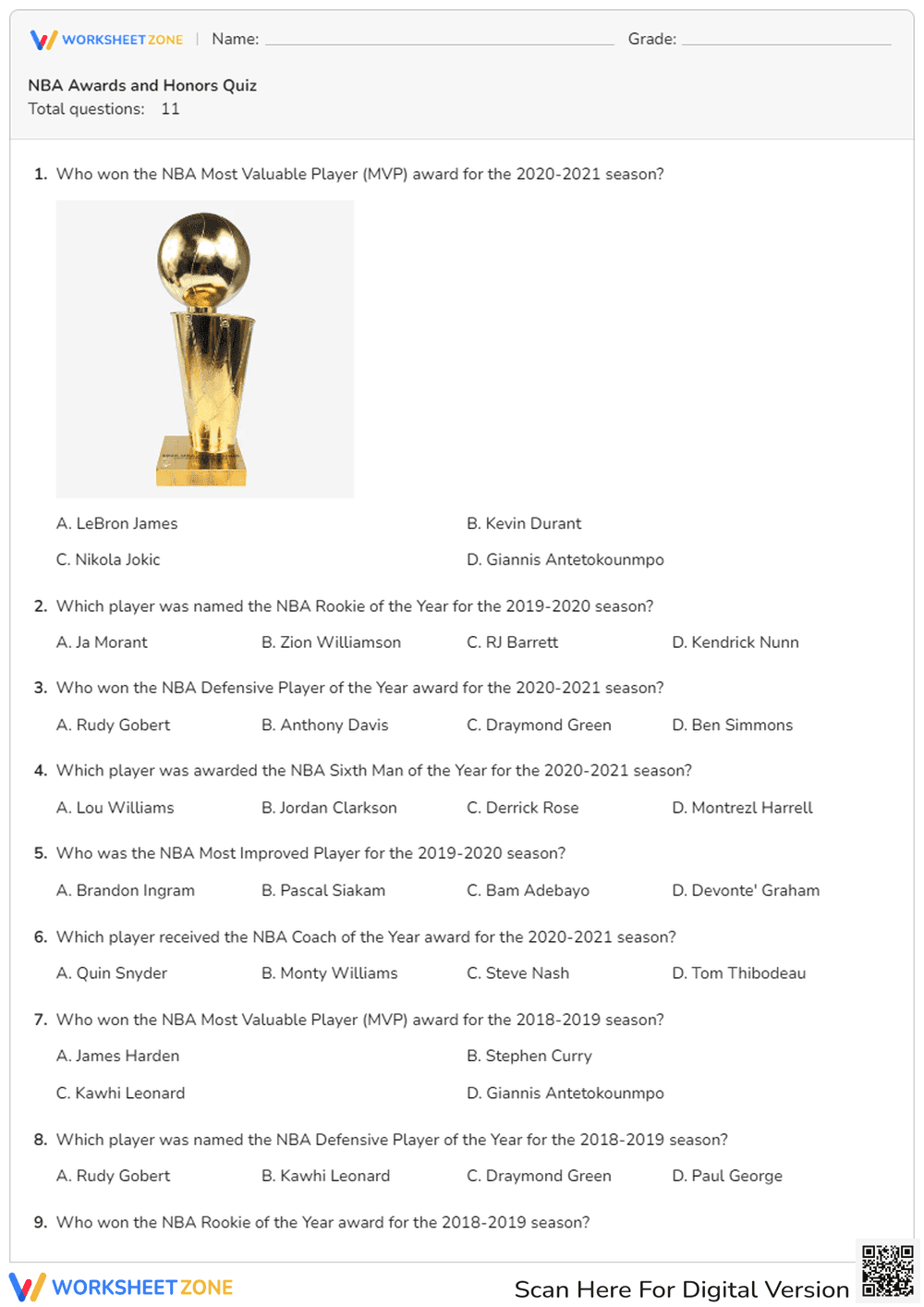
This two-page PDF features 10 multiple-choice questions covering specific NBA seasons (2018-2021) and one open-ended writing prompt. The layout includes visual aids, such as the MVP trophy, to provide context. A clear answer key is provided for rapid grading, and the final question encourages students to synthesize their knowledge by predicting and justifying a future award winner.
Zero-Prep Workflow
- Print: Select the two-page PDF and print enough copies for your class (30 seconds).
- Distribute: Hand out the sheets for independent work or as a partner research activity (1 minute).
- Review: Use the included answer key to provide immediate feedback or peer-grade the results (30 seconds).
Total teacher preparation time is under two minutes, making it an ideal emergency sub plan or Friday activity.
Standards Alignment
The primary standard addressed is CCSS.ELA-LITERACY.RI.6.1, which requires students to cite textual evidence to support analysis of what the text says explicitly. Students must accurately recall or research specific names and dates to answer the multiple-choice items. Both standard codes can be copied directly into lesson plans, IEP goals, or district curriculum mapping tools.
How to Use It
Use this worksheet as a "Bell Ringer" to settle the class or as a high-interest formative assessment after a lesson on informational text features. It works exceptionally well during the independent practice phase of a gradual release model. Teachers should observe if students are guessing or using external research tools to verify their answers, providing a 15-20 minute completion window.
Who It's For
This resource is designed for middle school students in grades 6 through 8, particularly those who benefit from high-interest, sports-related content to stay engaged. It pairs naturally with a lesson on how to use digital databases or sports almanacs to verify historical facts and statistics, providing a bridge between recreational interest and academic rigor.
According to the RAND AIRS 2024 report, high-interest informational texts significantly improve student engagement and retention of research-based skills. This worksheet leverages that principle by focusing on the CCSS.ELA-LITERACY.RI.6.1 standard, which emphasizes the ability to cite specific evidence and recall factual details. By engaging with 11 targeted questions about NBA history, students practice the essential skill of verifying information through structured inquiry. Research from Fisher & Frey (2014) suggests that using familiar, real-world topics like sports allows students to focus on the cognitive load of the task rather than struggling with unfamiliar vocabulary. This resource provides a bridge between recreational interest and academic rigor, ensuring that learners can demonstrate mastery of informational text standards in a format that feels relevant and accessible. The inclusion of both multiple-choice and open-ended items supports a comprehensive assessment of student understanding and evidence-based reasoning.


