


























Views
Downloads

Grade 8 Natural Selection — Printable No-Prep Worksheet
Paste this activity's link or code into your existing LMS (Google Classroom, Canvas, Teams, Schoology, Moodle, etc.).
Students can open and work on the activity right away, with no student login required.
You'll still be able to track student progress and results from your teacher account.
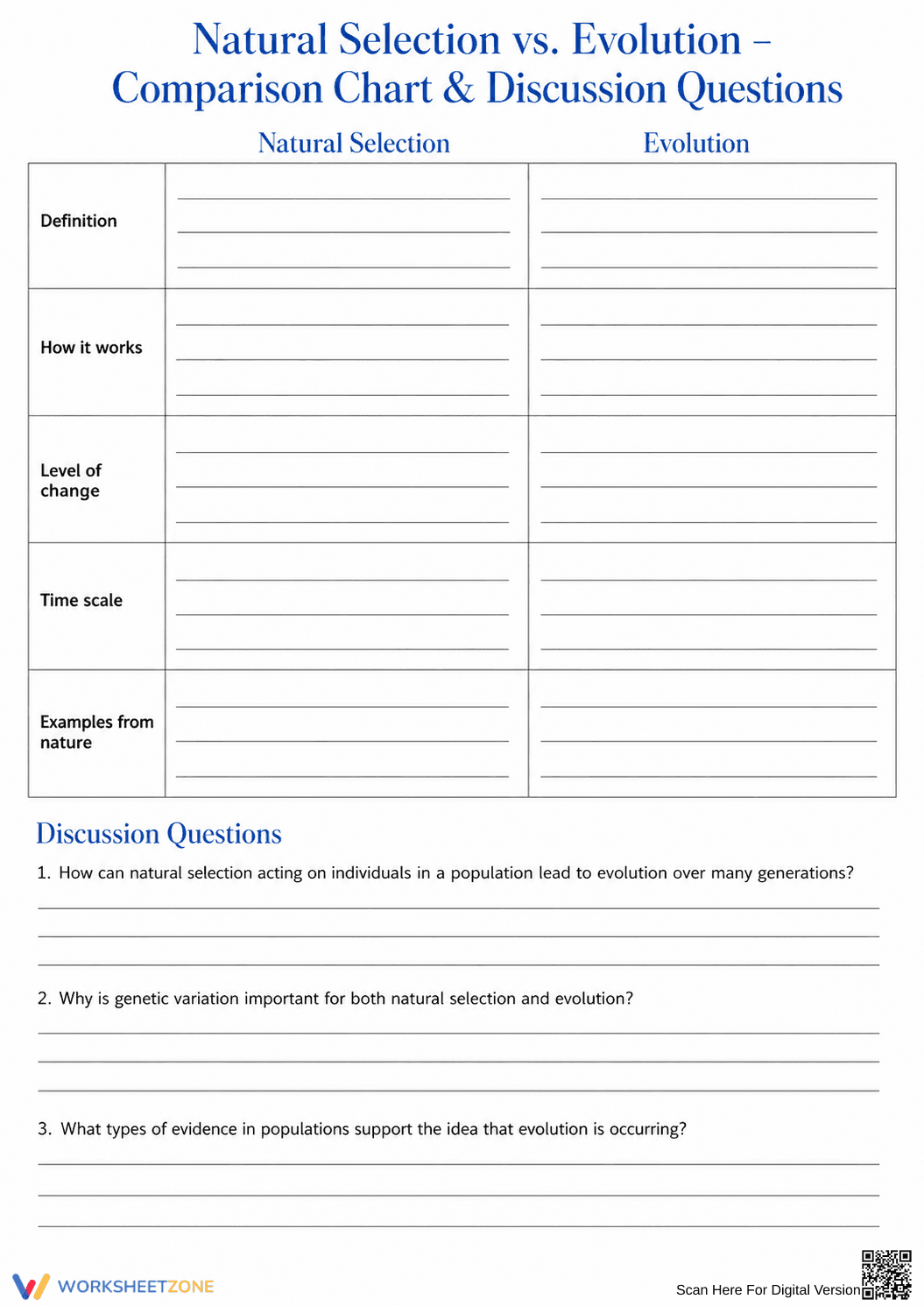
This Grade 8 science worksheet gives students structured practice to distinguish between natural selection and evolution. By completing a detailed comparison chart and answering analytical discussion questions, learners will solidify their understanding of how individual adaptations drive population-level changes over time.
At a Glance
- Grade: 8 · Subject: Science
- Standard:
MS-LS4-4— Explain how genetic variations increase survival probability- Skill Focus: Comparing natural selection and evolution
- Format: 2 pages · 9 problems · Answer key included · PDF
- Best For: Independent practice or review
- Time: 20–30 minutes
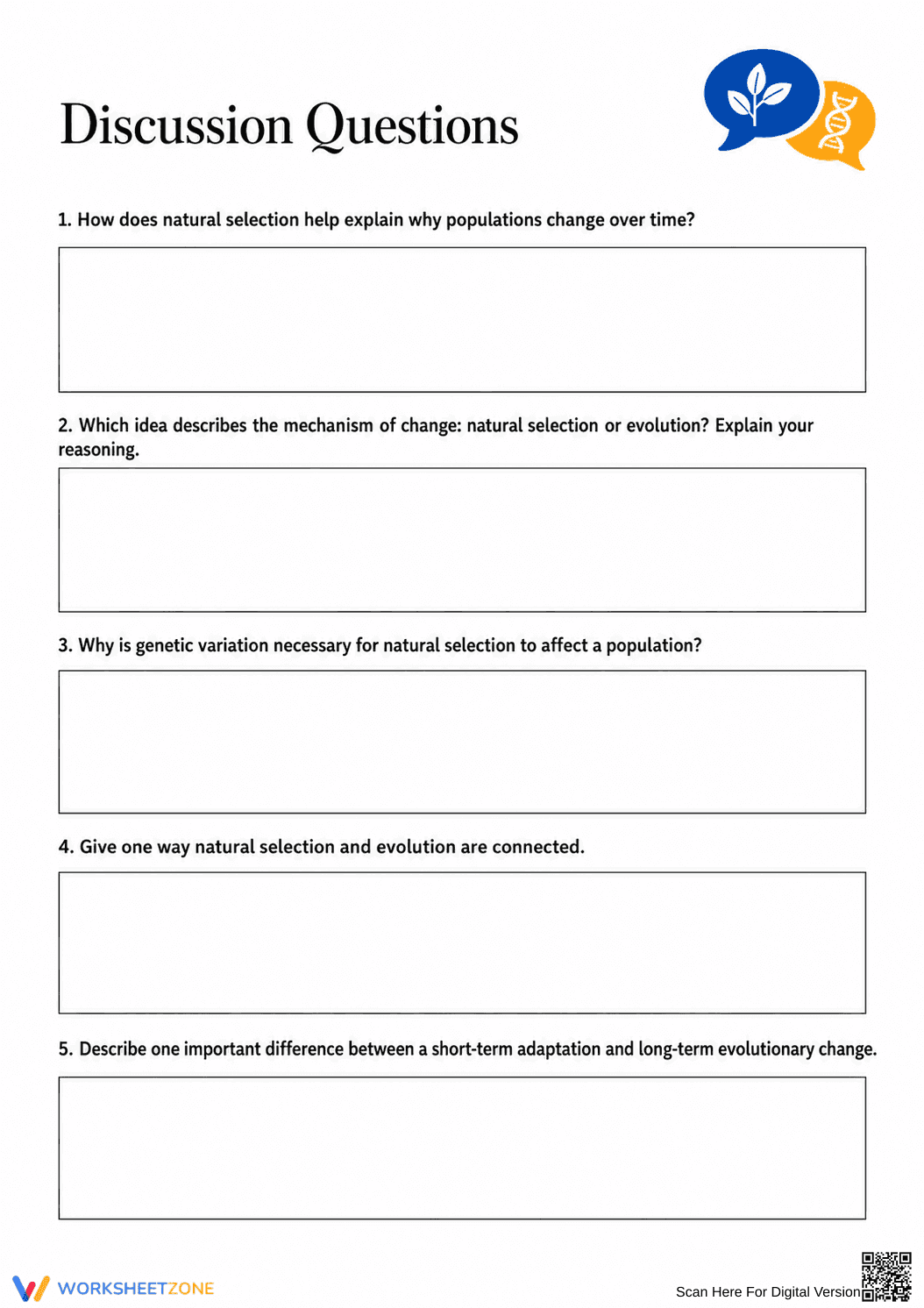
This two-page resource features a comprehensive side-by-side comparison chart where students define and contrast the mechanisms, timescales, and levels of change for both concepts. Following the chart, eight open-ended discussion questions prompt students to apply their knowledge, explain the role of genetic variation, and connect short-term adaptations to long-term evolutionary shifts. A complete answer key is provided for easy grading.
- Print (1 min): Download the PDF and print double-sided for a complete assignment.
- Distribute (1 min): Hand out to students after an introductory lesson on population biology.
- Review (5 mins): Go over the comparison chart together to ensure foundational concepts are clear before students tackle the discussion questions.
With under two minutes of teacher prep time, this worksheet is an excellent zero-prep solution for busy educators or a reliable emergency sub plan.
Aligned to primary standard MS-LS4-4: Construct an explanation based on evidence that describes how genetic variations of traits in a population increase some individuals' probability of surviving and reproducing in a specific environment. It also supports high school progression standards for biological evolution. Both standard codes can be copied directly into lesson plans, IEP goals, or district curriculum mapping tools.
Use this worksheet during direct instruction as a guided practice activity, filling out the comparison chart as a class before assigning the discussion questions for independent work. Alternatively, assign it as a formative assessment exit ticket to gauge comprehension of genetic variation and evolutionary mechanisms. Teachers can quickly review the written responses to identify and address any lingering misconceptions. Expected completion time is 20 to 30 minutes.
Designed for middle and early high school science students, this resource is easily adaptable for diverse learners. The structured chart provides clear scaffolding for students who need visual organization, while the open-ended questions challenge advanced learners to articulate complex biological relationships. It pairs perfectly with a direct instruction lesson on genetic mutations and environmental pressures.
Aligning middle school science instruction to MS-LS4-4 ensures that students can accurately explain how genetic variations increase survival probability in specific environments. According to a recent ScienceDirect TpT Analysis, providing students with structured comparison tools—such as side-by-side charts—significantly improves their ability to differentiate between closely related scientific phenomena. Many learners struggle to separate the immediate, individual-level impacts of natural selection from the long-term, population-level outcomes of evolution. By explicitly contrasting these two mechanisms in a guided format, educators can proactively prevent common conceptual errors that often hinder progress in high school biology. This targeted approach to scientific reasoning not only reinforces foundational vocabulary but also builds the critical thinking skills necessary for advanced coursework. Ultimately, mastering these core biological principles fosters a deeper, more accurate appreciation for the complex mechanisms driving global biodiversity.


