


























Views
Downloads
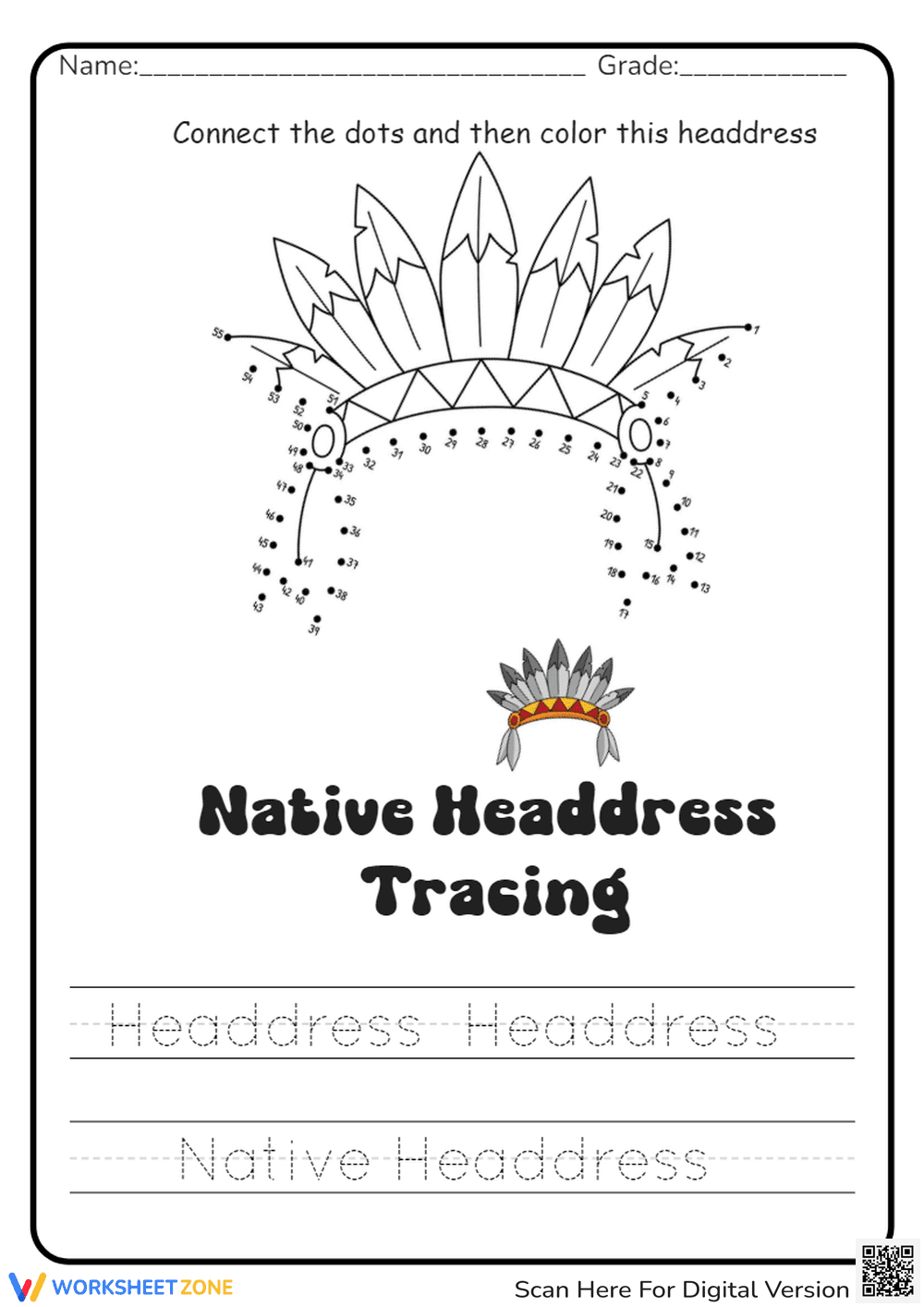

Grade K Counting & Tracing — Printable No-Prep Worksheet
Paste this activity's link or code into your existing LMS (Google Classroom, Canvas, Teams, Schoology, Moodle, etc.).
Students can open and work on the activity right away, with no student login required.
You'll still be able to track student progress and results from your teacher account.
This Kindergarten handwriting and math worksheet helps students master numerical sequencing while refining fine motor skills. By connecting 55 dots to reveal a traditional headdress, learners practice counting in a meaningful context before transitioning to word tracing. This activity ensures students develop the hand-eye coordination required for mathematical accuracy and literacy success.
At a Glance
- Grade: Kindergarten · Subject: Math & Handwriting
- Standard:
CCSS.MATH.CONTENT.K.CC.A.1— Count sequentially to 100 by ones- Skill Focus: Number sequencing and letter tracing
- Format: 1 page · 2 tasks · No answer key · PDF
- Best For: Morning work or independent centers
- Time: 15–20 minutes
The worksheet features a large dot-to-dot illustration of a feather headdress with 55 clearly labeled points. Below the image, students find dedicated handwriting lines featuring the words "Headdress" and "Native Headdress" in a dashed tracing font. This layout provides a clear path from an artistic task to formal writing practice on a single printable page. The inclusion of a name line encourages student ownership and organizational habits.
This zero-prep resource is designed for immediate classroom implementation. First, print the PDF (under one minute). Next, distribute the sheets with pencils or crayons (one minute). Finally, review the instructions by prompting students to follow the sequence from 1 to 55 and trace the vocabulary words below. Total teacher preparation time is under two minutes, making this an ideal solution for busy mornings or unexpected sub plans where instructional continuity is required without complex setup.
This resource aligns with CCSS.MATH.CONTENT.K.CC.A.1, requiring students to count to 100 by ones. It also supports CCSS.ELA-LITERACY.L.K.1.A by providing structured practice for printing letters. Both standard codes can be copied directly into lesson plans, IEP goals, or district curriculum mapping tools.
Use this worksheet during morning routines to settle students with a focused, independent activity before direct instruction begins. It also serves as an effective formative assessment tool; observe students as they connect dots to identify those struggling with number reversals or sequencing gaps. Most Kindergarteners will complete the tracing and coloring within 15 to 20 minutes. Early finishers can add patterns to the feathers to further extend their engagement.
This activity is designed for Kindergarten students but is highly suitable for Preschoolers ready for higher number ranges. It provides essential support for students needing extra fine motor practice or those working on proper pencil grip. Pair this worksheet with a picture book about Native American traditions or a counting anchor chart to provide context. It is particularly effective for English Language Learners who benefit from visual representations of new vocabulary.
Research from the RAND AIRS 2024 report suggests that integrating fine motor activities with core academic skills like counting significantly improves retention in early childhood learners. This worksheet targets CCSS.MATH.CONTENT.K.CC.A.1 by requiring students to sequence numbers to 55 accurately, reinforcing their ability to count sequentially to 100 by ones. By combining tactile tracing with numerical sequencing, educators provide a multi-sensory approach that supports cognitive development and reinforces foundational concepts. Connecting dots and tracing vocabulary words allows students to engage in a dual-tasking exercise that strengthens both mathematical understanding and handwriting proficiency simultaneously. This integrated method ensures that young learners build the necessary hand-eye coordination and muscle memory required for future academic success, making it a highly effective, evidence-based tool for comprehensive early education classrooms.


