




























Views
Downloads
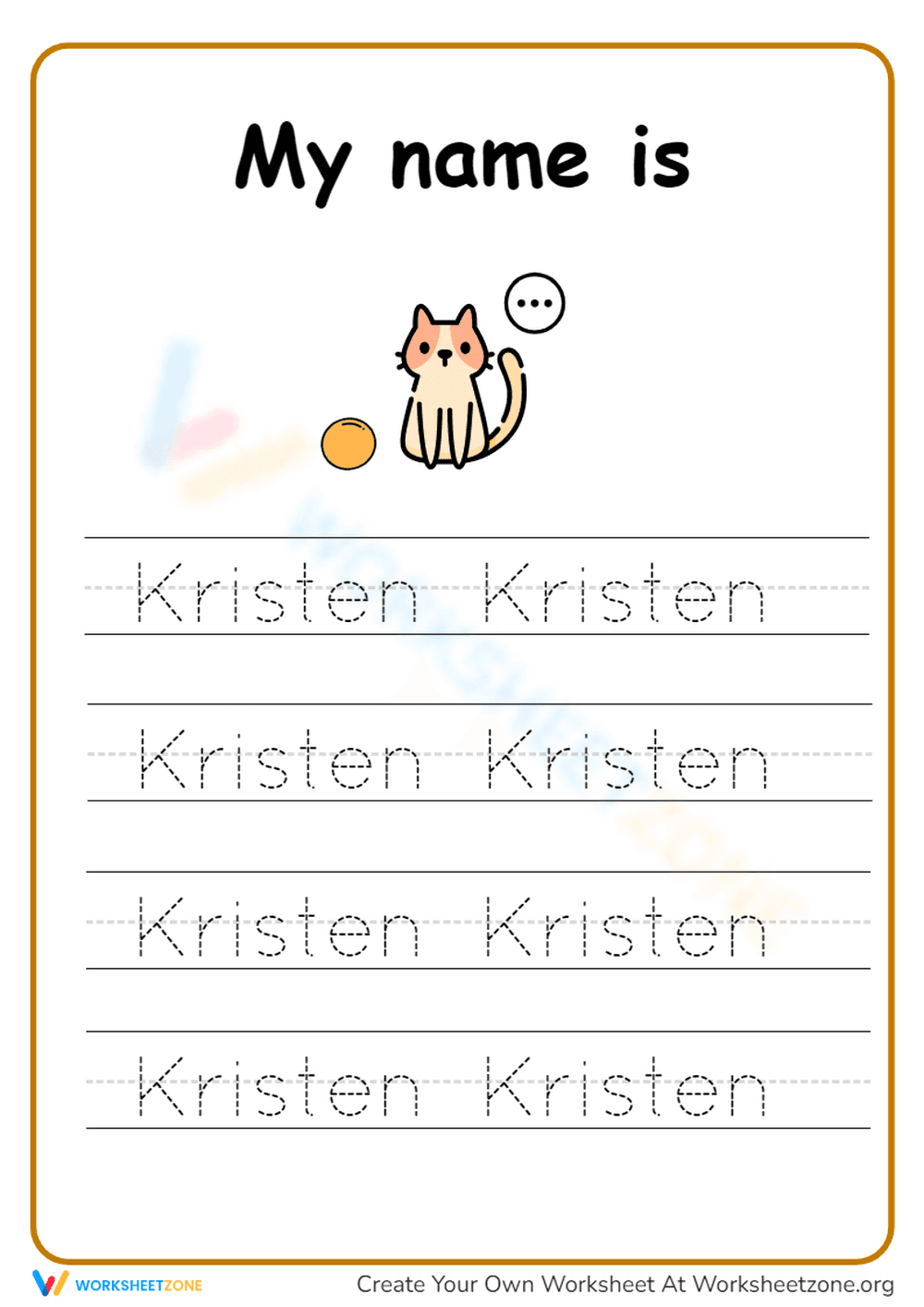

Grade K Name Tracing: Kristen — Printable No-Prep Worksheet

Paste this activity's link or code into your existing LMS (Google Classroom, Canvas, Teams, Schoology, Moodle, etc.).
Students can open and work on the activity right away, with no student login required.
You'll still be able to track student progress and results from your teacher account.
This foundational handwriting worksheet provides structured name tracing practice for students named Kristen, developing essential fine motor control and proper letter formation. By engaging with clear dashed guidelines, early learners transition from basic mark-making to confident print, building the motor memory required for independent writing success.
At a Glance
- Grade: Kindergarten · Subject: English Language Arts
- Standard:
CCSS.ELA-LITERACY.L.K.1.A— Print many upper- and lowercase letters accurately- Skill Focus: Name Tracing and Letter Formation
- Format: 1 page · 8 problems · Answer key included · PDF
- Best For: Independent morning work and handwriting centers
- Time: 10–15 minutes
What's Inside
This single-page printable features eight distinct tracing opportunities for the name Kristen, supported by primary writing gridlines with top, middle dashed, and bottom baselines. Each instance utilizes clear dashed models guiding proper stroke sequences. A welcoming cat illustration engages young learners while the structured layout promotes consistent letter sizing.
Zero-Prep Workflow
This worksheet eliminates preparation friction for teachers and substitute instructors through a rapid three-stage workflow:
- Print (30 seconds): Access the ready-to-print PDF and send it directly to the printer with zero formatting adjustments.
- Distribute (30 seconds): Hand out the single sheet during morning arrival or transition periods.
- Review (1 minute): Inspect student letter formation as they trace, offering immediate feedback on pencil grip.
With total teacher prep time under two minutes, this resource serves as an excellent emergency sub-plan activity.
Standards Alignment
This activity aligns directly with primary standard CCSS.ELA-LITERACY.L.K.1.A, requiring students to print many upper- and lowercase letters. Additionally, it supports CCSS.ELA-LITERACY.RF.K.1 by reinforcing basic features of print and left-to-right progression. Both standard codes can be copied directly into lesson plans, IEP goals, or district curriculum mapping tools.
How to Use It
This resource functions beautifully during two instructional moments: before direct instruction in morning centers to activate fine motor muscles, or as independent practice after direct instruction on pencil grip. Expected completion time is 10 to 15 minutes. For a formative-assessment observation tip, teachers should monitor whether students start their uppercase 'K' at the top baseline or improperly push up from the bottom, allowing for instant corrective modeling.
Who It's For
This worksheet is designed for Kindergarten and first-grade students mastering personal identification and handwriting skills. For differentiation, teachers can support developing writers by highlighting letter starting points with green dots, or challenge advanced learners by having them write independently on the back. This pairs perfectly with a direct instruction lesson on uppercase letter formation.
Establishing automaticity in personal name writing represents a critical milestone in early childhood literacy, directly supported by standard CCSS.ELA-LITERACY.L.K.1.A for printing upper- and lowercase letters. Explicit tracing practice within structured gridlines develops the essential fine motor control and visual-motor integration required for subsequent writing tasks. According to research highlighted in Fisher & Frey (2014), structured guided practice with clear visual scaffolds significantly enhances motor memory retention and early literacy acquisition in foundational educational settings. By providing eight focused tracing repetitions for the name Kristen, this resource bridges the gap between assisted letter formation and independent writing execution. Ensuring students master these foundational mechanics early prevents cognitive overload during complex composition tasks later in their academic journeys, solidifying the vital link between physical handwriting fluency and broader expressive literacy achievement.


