


























Views
Downloads
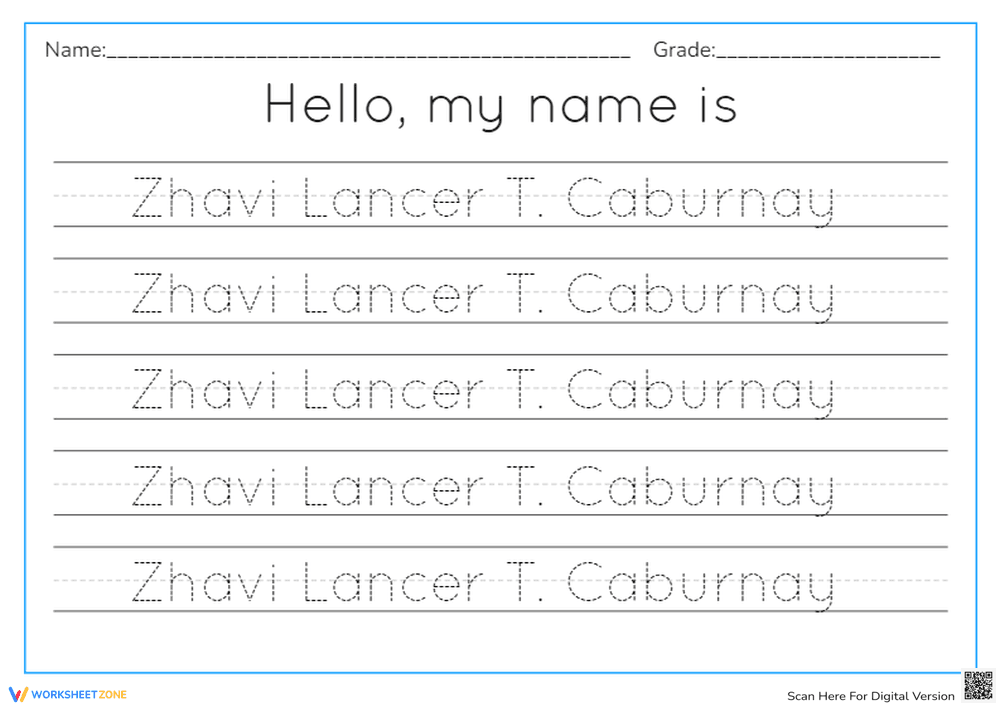

Essential Name Tracing Worksheet | Kindergarten Handwriting
Paste this activity's link or code into your existing LMS (Google Classroom, Canvas, Teams, Schoology, Moodle, etc.).
Students can open and work on the activity right away, with no student login required.
You'll still be able to track student progress and results from your teacher account.
This Kindergarten name tracing worksheet provides immediate practice for early learners to master the specific letters in their name. By following dotted guides, students develop the muscle memory required for fluid handwriting while reinforcing personal identity through literacy. It is a foundational tool for transitioning from scribbling to intentional letter formation.
At a Glance
- Grade: Kindergarten · Subject: Handwriting
- Standard:
CCSS.ELA-LITERACY.L.K.1.A— Print many upper- and lowercase letters accurately- Skill Focus: Name recognition and letter formation
- Format: 1 page · 5 tracing tasks · No answer key needed · PDF
- Best For: Morning work or initial writing practice
- Time: 5–10 minutes
The worksheet features a clean, distraction-free layout designed specifically for young children. It includes five identical rows of the name "Zhavi Lancer T. Caburnay" in a clear, dotted font. Each line is set against standard primary handwriting guides, including a top line, midline, and baseline, to help students understand letter height and placement. The header includes space for the student's name and grade, encouraging administrative organization in the classroom.
This resource is designed for a zero-prep classroom environment. First, print the single-page PDF (30 seconds). Second, distribute the sheets to students during morning arrival or literacy centers (1 minute). Third, provide a quick verbal cue regarding pencil grip and starting points for each letter (30 seconds). Total teacher preparation time is under two minutes, making it an ideal choice for busy mornings or emergency sub plans.
The primary focus is `CCSS.ELA-LITERACY.L.K.1.A`, which requires students to print many upper- and lowercase letters. By tracing a full name, students encounter a variety of letter shapes and cases in a meaningful context. This activity also supports supporting standards regarding recognizing that spoken words are represented in written language by specific sequences of letters. Both standard codes can be copied directly into lesson plans, IEP goals, or district curriculum mapping tools.
Use this worksheet during the first five minutes of the school day to establish a calm, focused routine. It serves as an excellent formative assessment tool; teachers can observe pencil grip and stroke direction as students work. For students struggling with fine motor control, consider having them trace the letters with a finger or a highlighter before using a primary pencil. Completion typically takes between 5 and 10 minutes depending on the student's motor proficiency.
This resource is tailored for Kindergarten and early first-grade students who are beginning their writing journey. It is particularly effective for English Language Learners (ELLs) and students with IEPs focusing on fine motor development. Pair this worksheet with a name-based anchor chart or a direct instruction lesson to reinforce the connection between individual characters and whole words.
Handwriting remains a critical component of early literacy development, as evidenced by the RAND AIRS 2024 report which highlights the correlation between manual letter production and reading fluency. This worksheet aligns with the CCSS.ELA-LITERACY.L.K.1.A standard by providing structured, repetitive practice in printing upper- and lowercase letters. Research from Fisher & Frey (2014) suggests that meaningful repetition, such as tracing one's own name, accelerates the orthographic mapping process in young brains. By focusing on a high-frequency, personal word, students are more likely to engage with the task and retain the motor patterns required for independent writing. This 1-page PDF provides the necessary scaffolding to move students from guided tracing to autonomous letter production, ensuring they meet foundational benchmarks for Grade 1 readiness. The clear visual cues and standard-aligned formatting make it a reliable tool for any early childhood educator seeking to improve student handwriting outcomes.


