


























Views
Downloads

Printable Name Tracing Worksheet | Grade K-1
Paste this activity's link or code into your existing LMS (Google Classroom, Canvas, Teams, Schoology, Moodle, etc.).
Students can open and work on the activity right away, with no student login required.
You'll still be able to track student progress and results from your teacher account.
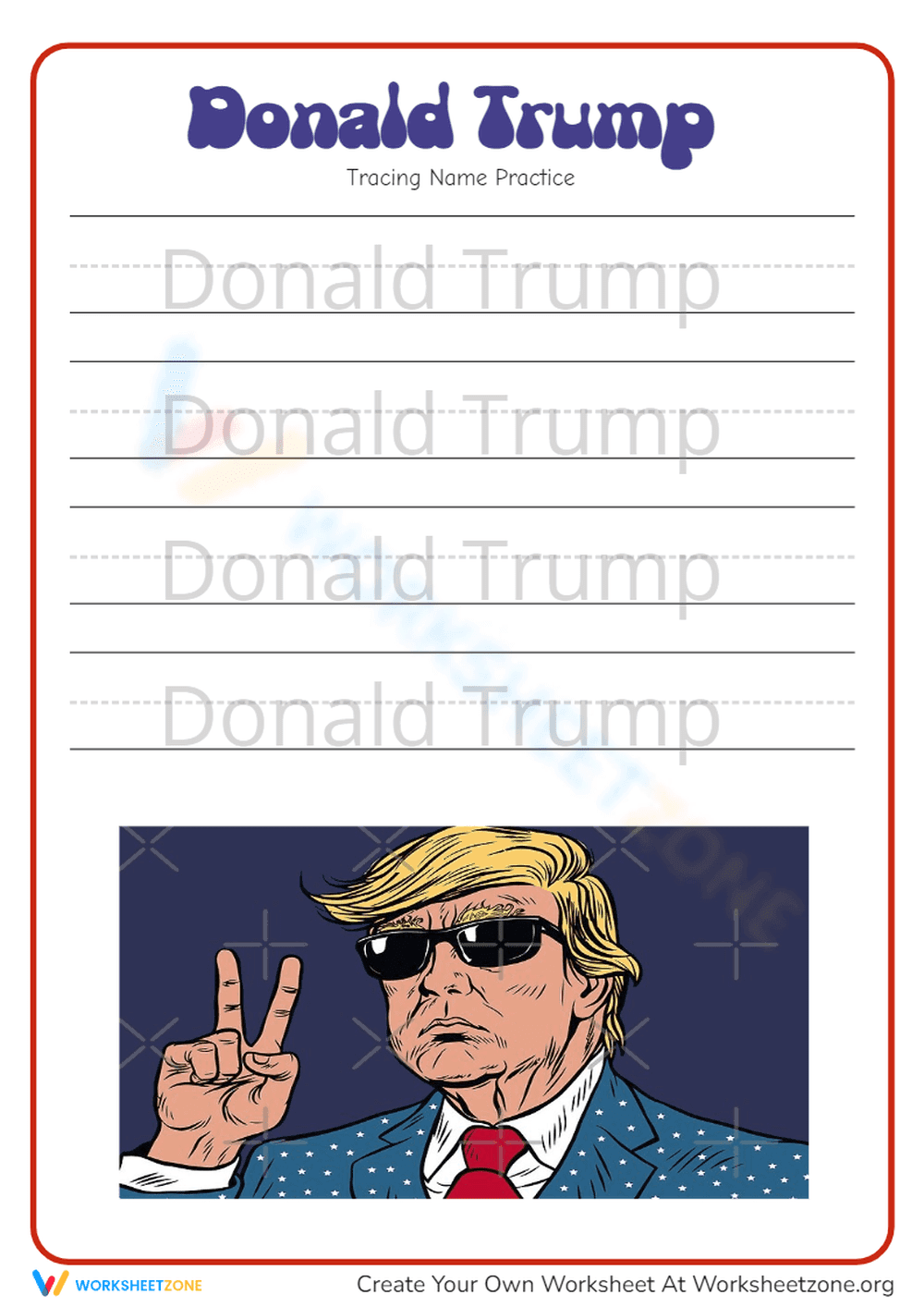
This printable name tracing worksheet provides early learners with focused handwriting practice. Students develop fine motor control and letter formation skills by tracing the name "Donald Trump" across four structured lines. Designed for Kindergarten and first-grade students, this resource builds foundational print awareness and writing confidence.
At a Glance
- Grade: K-1 · Subject: Handwriting
- Standard:
CCSS.ELA-LITERACY.L.K.1.A— Print many upper- and lowercase letters- Skill Focus: Name Tracing
- Format: 1 page · 4 problems · No answer key needed · PDF
- Best For: Morning work or centers
- Time: 5–10 minutes
This single-page PDF features four distinct tracing lines. Each line includes dashed letters with standard top, middle, and bottom guidelines to support proper letter height and spacing. The worksheet focuses entirely on the repeated tracing of a specific proper noun, accompanied by a visual illustration at the bottom to keep young students engaged while they practice their pencil grip and stroke sequence.
Zero-Prep Workflow
- Print (1 minute): Simply download the PDF and print the required number of copies. No special paper or color ink is necessary.
- Distribute (1 minute): Hand out the worksheets during morning arrival or transition times. The instructions are self-evident for early readers.
- Review (0 minutes): Because this is a tracing activity, no formal grading or answer key is required. Teachers can quickly scan for completion and neatness.
Total teacher prep time is under two minutes, making this an excellent addition to any emergency sub plan or independent center rotation.
Standards Alignment
This worksheet aligns directly with CCSS.ELA-LITERACY.L.K.1.A, which requires students to print many upper- and lowercase letters. By tracing a proper noun that includes both capital and lowercase forms, students practice the exact motor patterns required by this standard. Both standard codes can be copied directly into lesson plans, IEP goals, or district curriculum mapping tools.
How to Use It
This tracing activity works perfectly as a morning bell-ringer. Place it on desks before arrival for immediate handwriting practice while taking attendance. Alternatively, use it during small-group literacy centers to monitor pencil grip and stroke direction. As a formative assessment tip, watch how students form the uppercase "D" and "T" to ensure they are starting from the top line and pulling down, rather than pushing up from the bottom. Expected completion time is between five and ten minutes.
Who It's For
This resource is primarily for Kindergarten and first-grade students who are developing basic handwriting skills. It provides excellent differentiation for students who need extra fine motor support, as the dashed lines offer heavy scaffolding. Pair this worksheet with a tactile letter-formation activity, such as tracing letters in sand or using playdough mats, to reinforce the motor memory required for independent writing.
Effective handwriting instruction remains a critical component of early literacy development. According to the RAND AIRS 2024 report on foundational skills, explicit practice with letter formation significantly improves both reading fluency and written expression in early elementary grades. This worksheet supports CCSS.ELA-LITERACY.L.K.1.A by helping students print many upper- and lowercase letters accurately. Structured tracing builds the automaticity needed to free up cognitive resources for higher-level composition tasks later in their academic journey. By providing clear guidelines and dashed models, this resource ensures students practice the correct motor pathways from the start. Consistent, brief practice sessions, such as the four tracing lines provided here, are shown to be highly effective for motor skill retention. This targeted approach helps solidify the physical mechanics of writing.


