


























Views
Downloads
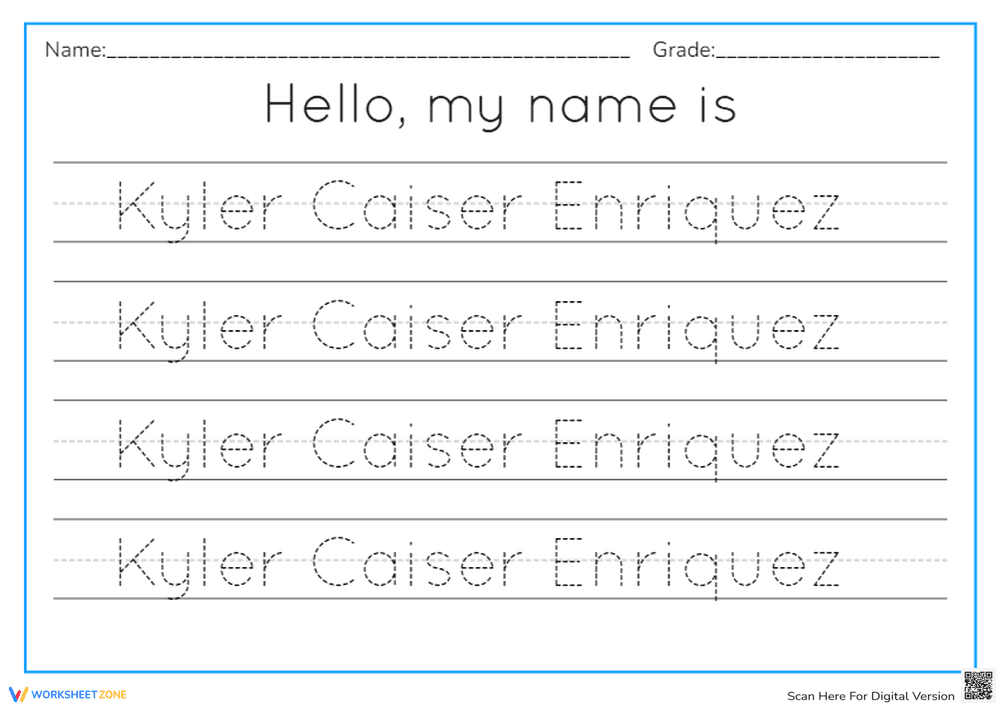


Name Tracing Practice: Kyler | Essential Grade K-1 Worksheet
Paste this activity's link or code into your existing LMS (Google Classroom, Canvas, Teams, Schoology, Moodle, etc.).
Students can open and work on the activity right away, with no student login required.
You'll still be able to track student progress and results from your teacher account.
This Kindergarten and Grade 1 handwriting worksheet provides Kyler with focused, repetitive practice to master the formation of his full name. By using clear, dotted guides, students develop the fine motor control and muscle memory necessary for legible writing. This resource ensures that Kyler can confidently identify and produce the specific letters in his name through structured repetition.
At a Glance
- Grade: Kindergarten · Subject: Handwriting
- Standard:
CCSS.ELA-LITERACY.L.K.1.A— Print many upper- and lowercase letters accurately- Skill Focus: Name tracing and letter formation
- Format: 5 pages · 21 lines · No answer key needed · PDF
- Best For: Personalized morning work or name recognition
- Time: 10–15 minutes
Inside this 5-page packet, you will find multiple rows of dotted-line tracing guides specifically tailored for the name Kyler Caiser Enriquez. The layout includes a "Hello, my name is" header on the first page to establish context and ownership. Each subsequent page offers 4 to 5 lines of tracing practice, providing a total of 21 opportunities for the student to trace their name without unnecessary visual clutter.
The zero-prep workflow for this resource is designed for maximum efficiency in a busy classroom. First, print the 5-page PDF in approximately 30 seconds. Second, distribute the specific pages to the student named Kyler during morning arrival or center rotations. Third, review the completed tracing for proper grip and stroke direction. Total teacher preparation time is under 2 minutes, making this an ideal solution for personalized instruction or emergency sub plans.
This worksheet is directly aligned with `CCSS.ELA-LITERACY.L.K.1.A`, which requires students to print many upper- and lowercase letters. By tracing a full name, the student practices a variety of letter shapes and sizes in a meaningful context. Additionally, it supports fine motor development related to the physical act of writing. This standard code can be copied directly into lesson plans, IEP goals, or district curriculum mapping tools.
Use this worksheet during the arrival phase of the school day as a calming morning work activity. It serves as an excellent formative assessment tool; teachers can observe Kyler's pencil grip and the directionality of his strokes as he completes the lines. Alternatively, assign one page per night as homework to reinforce name recognition and writing consistency. Completion typically takes 10 to 15 minutes depending on the student's current proficiency.
This resource is specifically designed for Kindergarten or Grade 1 students named Kyler who are in the early stages of handwriting development. It is particularly helpful for students requiring additional fine motor support or those who benefit from highly personalized materials. This worksheet pairs naturally with an alphabet anchor chart or a direct instruction lesson on letter formation to provide a comprehensive literacy experience.
According to research by Fisher & Frey (2014) on the gradual release of responsibility, scaffolded practice such as tracing provides the necessary phases of learning before independent writing. This worksheet aligns with CCSS.ELA-LITERACY.L.K.1.A, focusing on the specific motor patterns required for upper- and lowercase letter formation. By repeating the name "Kyler Caiser Enriquez" across 5 structured pages, students internalize the spatial relationships and stroke sequences of each character. This repetitive approach is a cornerstone of early literacy, ensuring that the cognitive load of letter formation is reduced, eventually allowing the student to focus on higher-level composition. Such targeted practice is essential for developing the muscle memory needed for legible handwriting in later primary grades. This resource serves as a foundational tool for personalized literacy instruction in any early childhood classroom or home learning environment.


