


























Views
Downloads

Printable Name Tracing Practice: Nick Jonas Worksheet
Paste this activity's link or code into your existing LMS (Google Classroom, Canvas, Teams, Schoology, Moodle, etc.).
Students can open and work on the activity right away, with no student login required.
You'll still be able to track student progress and results from your teacher account.
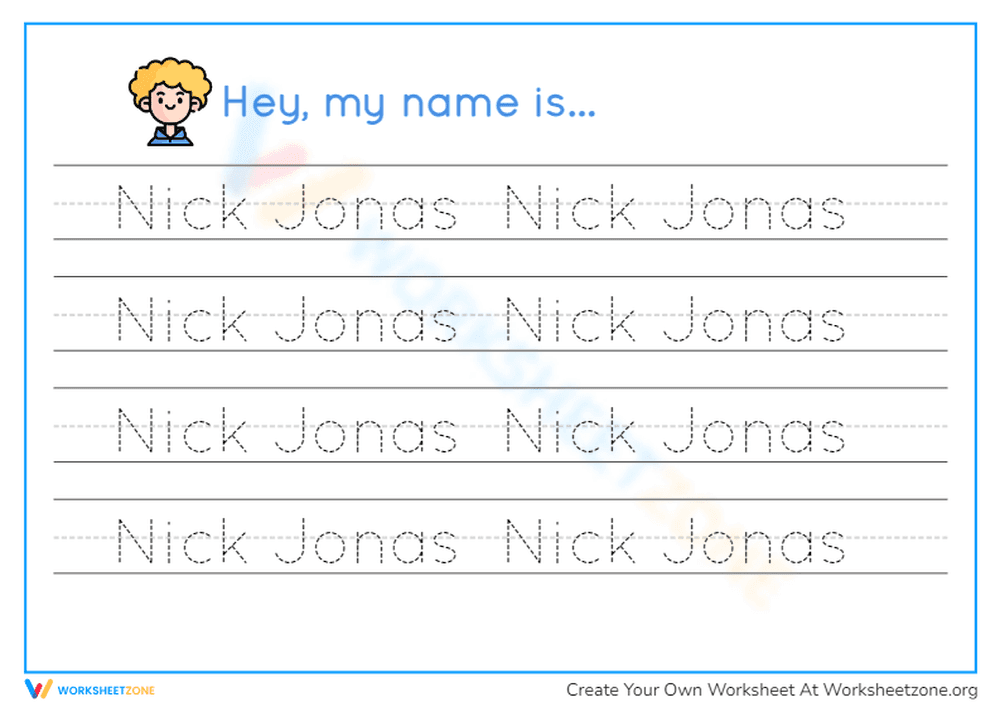
This printable handwriting worksheet helps young learners master fine motor control and letter formation by tracing the name "Nick Jonas." Students build muscle memory and letter recognition through structured repetition, establishing a strong foundation for independent writing. The clear layout ensures immediate engagement and success for early writers.
At a Glance
- Grade: Kindergarten · Subject: Handwriting
- Standard:
CCSS.ELA-LITERACY.L.K.1.A— Print many upper- and lowercase letters- Skill Focus: Name tracing and letter formation
- Format: 2 pages · 18 problems · Answer key not applicable · PDF
- Best For: Morning work and fine motor practice
- Time: 10–15 minutes
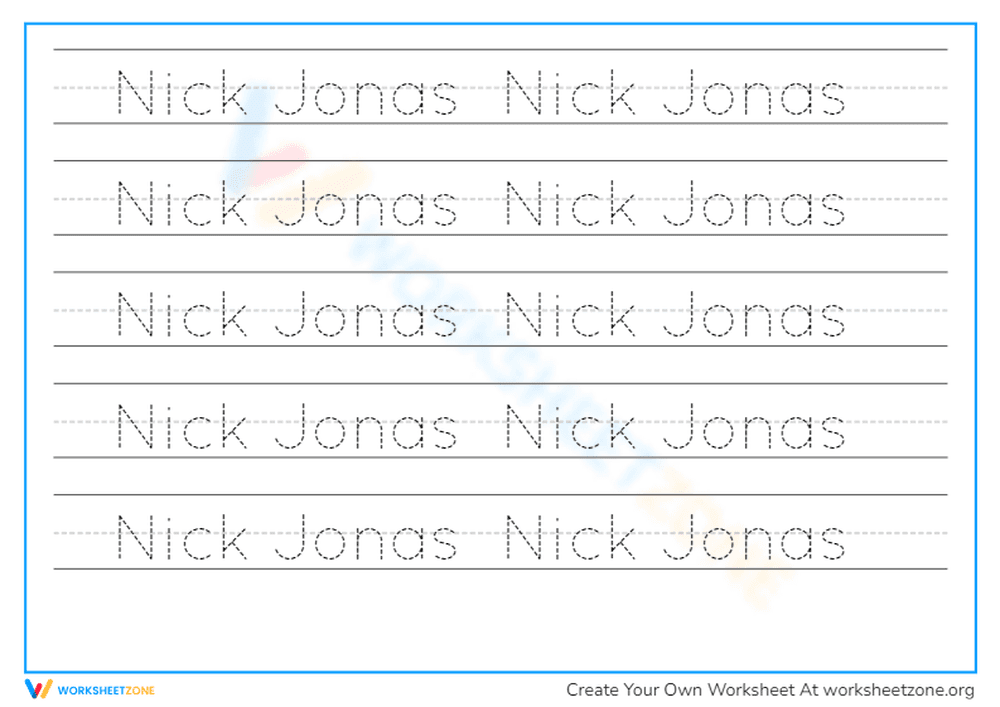
This resource contains two pages of structured handwriting practice. The first page features a friendly greeting header followed by four rows of dotted name tracing guides. The second page provides five additional rows of tracing guides to reinforce learning. The worksheet uses standard primary writing lines with dotted midlines to help students maintain proper letter height and spacing without distracting visual clutter.
This resource fits into a zero-prep classroom workflow. First, print the two pages in under one minute. Second, distribute the sheets to students during morning arrival or transition times, taking less than thirty seconds. Finally, review student progress in under one minute by checking pencil grip and letter stroke direction. The total teacher preparation time is under two minutes, making this an ideal option for emergency sub plans or independent center activities.
This activity aligns directly with the primary standard `CCSS.ELA-LITERACY.L.K.1.A`, which requires students to print upper- and lowercase letters legibly. It also supports standard `CCSS.ELA-LITERACY.RF.K.1.D` by helping students recognize and distinguish specific letter shapes within a meaningful word context. Both standard codes can be copied directly into lesson plans, IEP goals, or district curriculum mapping tools.
Use this worksheet during morning work to establish a calm, focused routine as students enter the classroom. Alternatively, assign it as a quiet independent activity immediately following direct instruction on letter formation. While students work, observe their pencil grip and stroke sequence to identify who needs immediate physical guidance. Most students complete the two pages within ten to fifteen minutes.
This worksheet is designed for kindergarteners and first graders developing early literacy skills. It serves students needing extra fine motor support, as well as English language learners practicing basic English alphabet shapes. Pair this activity with a physical letter-tracing tray or an anchor chart showing proper stroke directions to maximize student success.
Early childhood writing research emphasizes that repetitive tracing activities build the essential muscle memory required for fluent handwriting. According to Fisher & Frey (2014), structured scaffolding, such as dotted guidelines, allows young learners to transition smoothly from guided tracing to independent letter production. This worksheet targets standard `CCSS.ELA-LITERACY.L.K.1.A` by providing eighteen distinct tracing opportunities across two pages. By focusing on a specific name, the activity makes letter formation concrete and engaging for early writers. Regular practice with these structured guides prevents the development of poor writing habits, such as incorrect stroke order or improper pencil grip. Teachers can confidently integrate this resource into daily writing routines to support foundational literacy goals and track individual student progress over time. The clear layout ensures that students remain focused on the physical mechanics of writing without cognitive overload.


