




























Views
Downloads
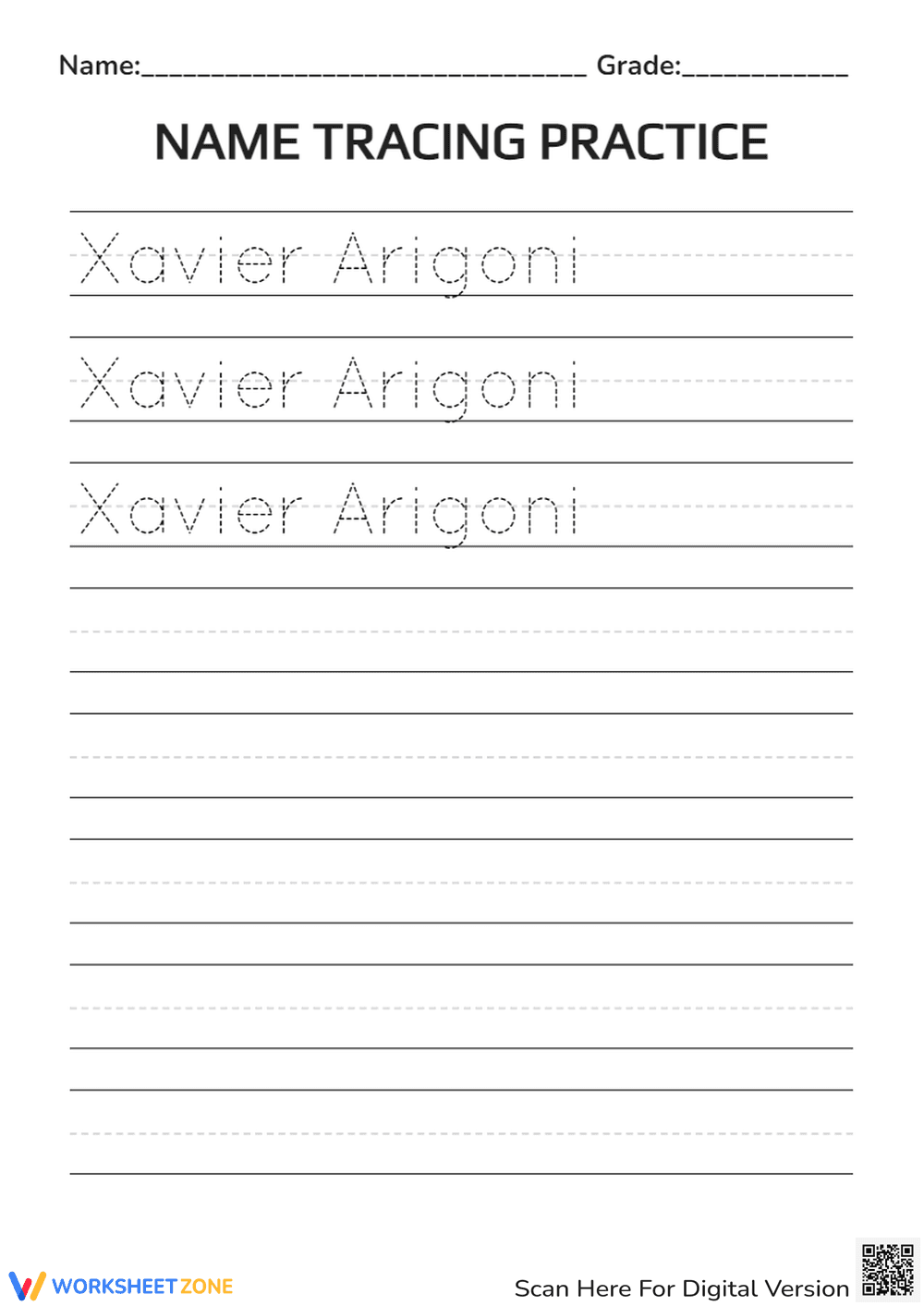

Printable Name Tracing Practice: Xavier Arigoni | Grade K-1

Paste this activity's link or code into your existing LMS (Google Classroom, Canvas, Teams, Schoology, Moodle, etc.).
Students can open and work on the activity right away, with no student login required.
You'll still be able to track student progress and results from your teacher account.
This Grade K-1 name tracing worksheet provides a structured environment for students to master the specific letter formations in the name "Xavier Arigoni." By combining guided tracing with independent writing lines, students develop the muscle memory and fine motor control necessary for legible handwriting. This resource ensures immediate success for early learners by focusing on a high-relevance personal identifier.
At a Glance
- Grade: Kindergarten · Subject: Handwriting
- Standard:
CCSS.ELA-LITERACY.L.K.1.A— Print many upper- and lowercase letters accurately- Skill Focus: Name recognition and letter formation
- Format: 1 page · 10 lines · No answer key needed · PDF
- Best For: Morning work and daily handwriting practice
- Time: 5–10 minutes
This single-page PDF features the name "Xavier Arigoni" in a clear, dotted font designed for easy tracing. The worksheet includes three guided tracing lines to establish correct stroke order and seven additional blank primary lines with a dashed midline for independent practice. This layout encourages students to transition from supported tracing to freehand writing within a single session, reinforcing letter height and spacing.
The workflow for this resource is designed for maximum efficiency. First, print the single-page PDF (30 seconds). Second, distribute the worksheet to the student during morning arrival or a dedicated handwriting block (30 seconds). Third, review the student's letter formation and pencil grip as they complete the 10 lines of practice (1 minute). Total teacher preparation time is under 2 minutes, making it an ideal sub-plan or daily routine.
This worksheet aligns with `CCSS.ELA-LITERACY.L.K.1.A`, which requires students to print many upper- and lowercase letters. By focusing on a specific name, students practice a variety of letter shapes including the complex "X" and "v" alongside common vowels. Both standard codes can be copied directly into lesson plans, IEP goals, or district curriculum mapping tools to track handwriting progress.
Use this worksheet as a consistent morning work activity to build student confidence during the first weeks of school. It also serves as an effective formative assessment tool; observe the student's stroke directionality and spatial awareness as they move from the guided lines to the independent lines. Completion typically takes between 5 and 10 minutes depending on the student's fine motor development and focus.
This resource is specifically tailored for Kindergarten and Grade 1 students named Xavier Arigoni who are beginning their literacy journey. It is particularly helpful for students requiring additional fine motor support or those working on IEP goals related to personal identification. Pair this worksheet with a name-tag anchor chart or a tactile sand-tracing activity to reinforce letter recognition through multiple modalities.
Research by Fisher & Frey (2014) emphasizes the importance of the gradual release of responsibility model in early literacy, moving from highly scaffolded tasks to independent application. This name tracing worksheet implements this model by providing three lines of dotted-font guidance before requiring the student to produce the letters "Xavier Arigoni" on blank primary lines. According to the RAND AIRS 2024 report, repetitive, high-frequency writing tasks like name tracing are foundational for developing the orthographic mapping skills required for later reading fluency. By focusing on a high-relevance word—the student's own name—this worksheet increases engagement and retention. The inclusion of 10 distinct practice opportunities ensures that the student receives sufficient repetition to internalize the specific motor patterns associated with each letter in their name, aligning with evidence-based practices for early childhood handwriting instruction.


