




























Views
Downloads
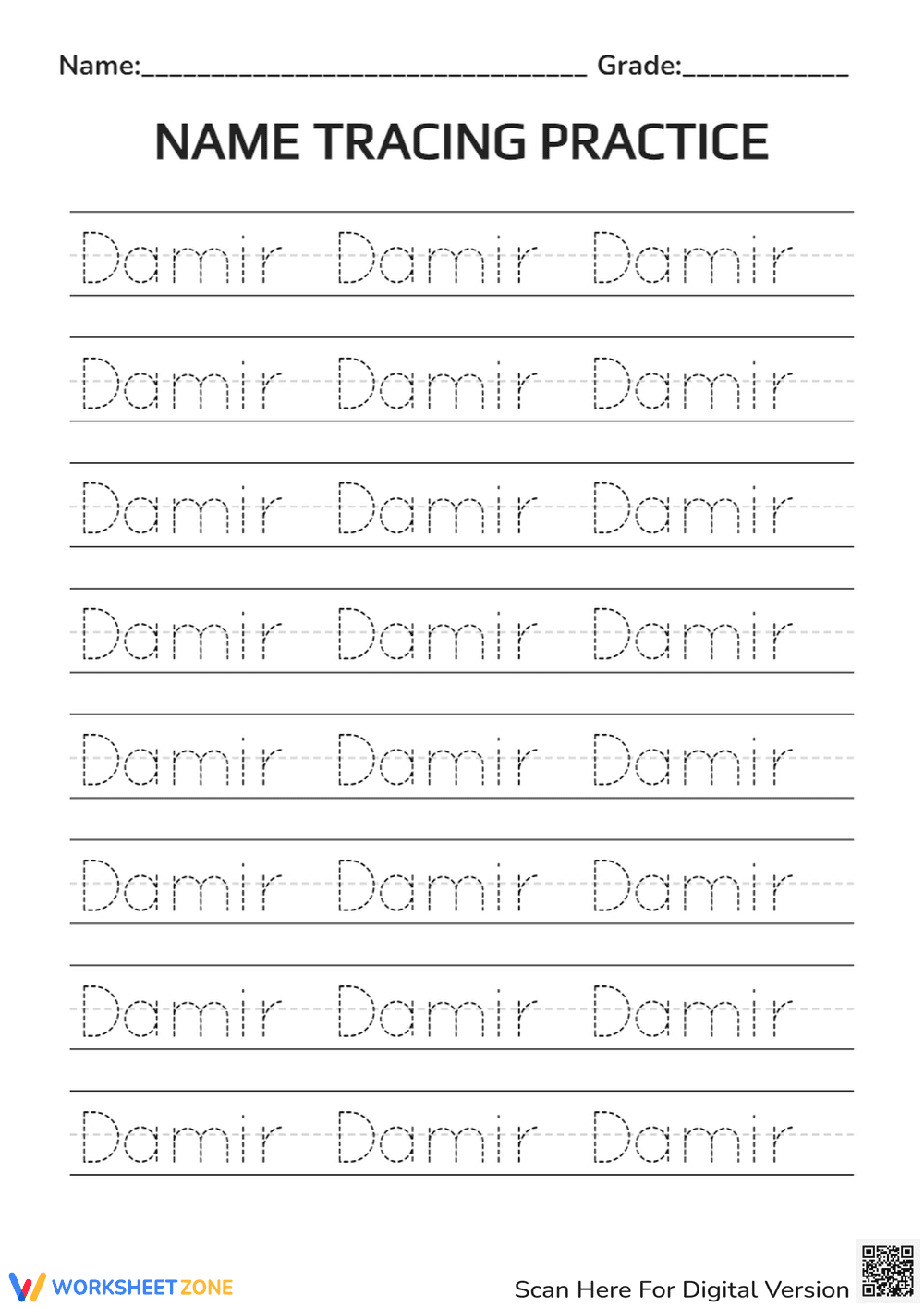

Damir Name Tracing — Printable Grade K-1 Worksheet

Paste this activity's link or code into your existing LMS (Google Classroom, Canvas, Teams, Schoology, Moodle, etc.).
Students can open and work on the activity right away, with no student login required.
You'll still be able to track student progress and results from your teacher account.
This Grade K-1 handwriting worksheet provides targeted practice for students learning to write the name Damir. By tracing the dotted letters, young learners develop the muscle memory required for fluid letter formation and proper spacing. This resource ensures students gain confidence in their personal identity through repetitive, successful writing experiences.
At a Glance
- Grade: K-1 · Subject: Handwriting
- Standard:
CCSS.ELA-LITERACY.L.K.1.A— Print many upper- and lowercase letters correctly during writing tasks- Skill Focus: Name recognition and letter formation
- Format: 1 page · 24 problems · Answer key not required · PDF
- Best For: Morning work or daily sign-in practice
- Time: 5–10 minutes
This single-page PDF features 8 rows of the name "Damir" presented in a clear, dotted tracing font. Each row contains three repetitions, totaling 24 opportunities for practice. The layout includes a dedicated header for the student's name and grade, providing a structured environment for early writers to focus on their specific name-writing goals without distractions.
The workflow for this resource is designed for maximum efficiency in a busy classroom. First, print the single-page PDF (30 seconds). Second, distribute the sheets to students during morning arrival or center rotations (1 minute). Finally, review the student's grip and stroke order as they complete the 24 tracing tasks (2 minutes). Total teacher preparation time is under two minutes, making it an ideal choice for sub plans or emergency filler activities.
The primary standard addressed is CCSS.ELA-LITERACY.L.K.1.A, which requires students to print many upper- and lowercase letters. By focusing on the specific sequence of letters in "Damir," students practice both the capital 'D' and lowercase 'a-m-i-r' in a meaningful context. Both standard codes can be copied directly into lesson plans, IEP goals, or district curriculum mapping tools.
Use this worksheet as a formative assessment during the first week of school to observe pencil grip and fine motor control. It is best assigned during direct instruction on letter formation or as a quiet transition activity after recess. Expect students to complete the full page in approximately 7 to 10 minutes depending on their developmental stage.
This resource is designed for Kindergarten and First Grade students, specifically those named Damir or those learning to recognize this name in a classroom setting. It serves as an excellent Tier 1 intervention for fine motor development and pairs naturally with alphabet anchor charts or tactile sand-writing activities to reinforce letter shapes.
According to the RAND AIRS 2024 report, repetitive tracing exercises are fundamental in developing the graphomotor skills necessary for early literacy success. This worksheet targets CCSS.ELA-LITERACY.L.K.1.A by providing 24 high-frequency repetitions of a specific name, allowing students to bridge the gap between letter recognition and independent production. Research from Fisher & Frey (2014) emphasizes that personalized content, such as a student's own name, increases engagement and retention in early childhood settings. By utilizing a dotted-line scaffold, this resource supports the gradual release of responsibility, moving students from guided tracing toward the eventual goal of freehand writing. The structured layout ensures that students maintain consistent sizing and alignment, which are critical components of legible handwriting as identified by NAEP standards for primary writing proficiency.


