




























Views
Downloads

Name Tracing: L is for Liam — Printable Worksheet

Paste this activity's link or code into your existing LMS (Google Classroom, Canvas, Teams, Schoology, Moodle, etc.).
Students can open and work on the activity right away, with no student login required.
You'll still be able to track student progress and results from your teacher account.
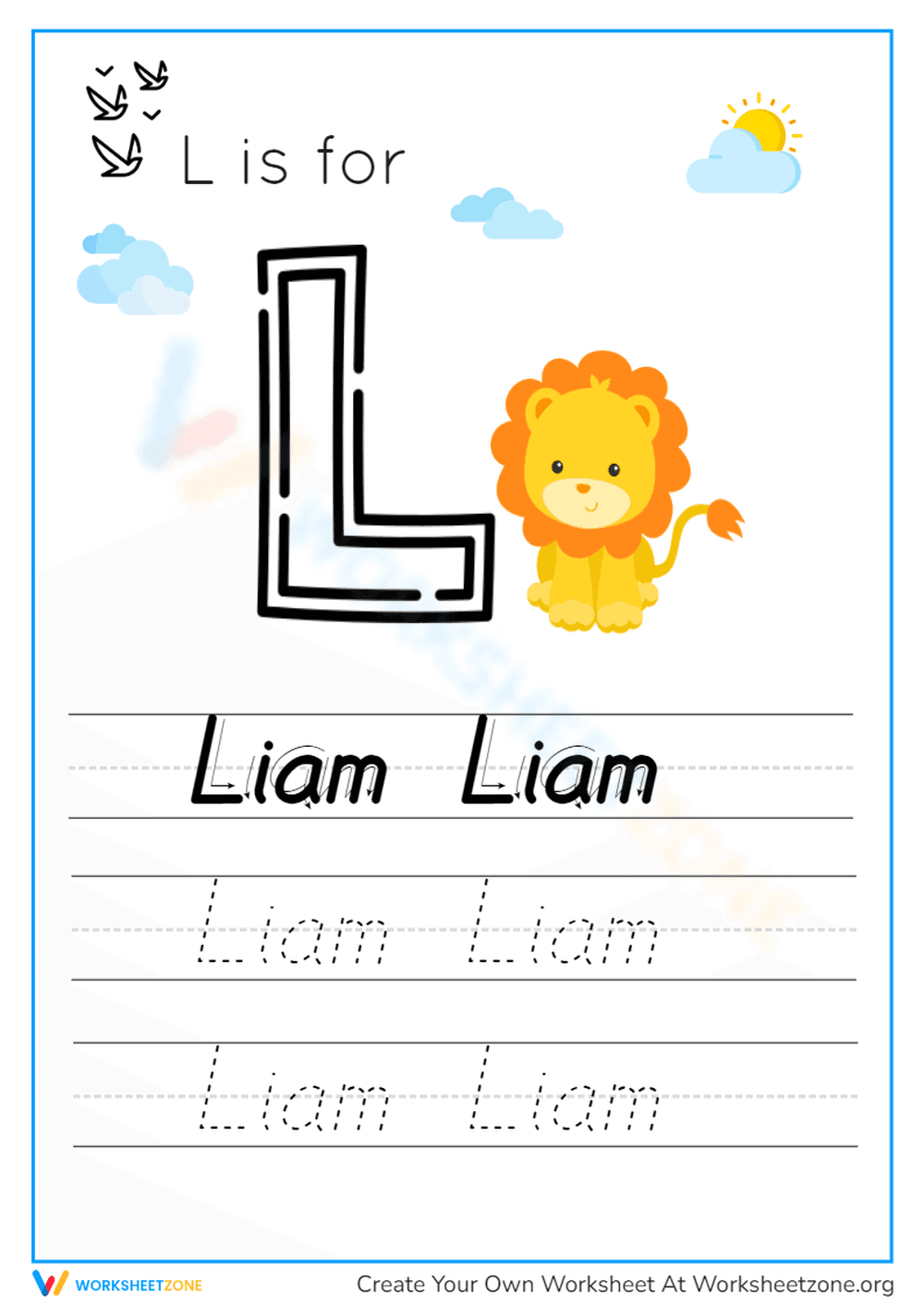
This Grade K–1 handwriting worksheet builds letter formation fluency by guiding students through tracing the uppercase and lowercase letter L and the name Liam. Students complete guided tracing lines that reinforce correct pencil stroke sequence, letter proportion, and left-to-right directionality in a single focused session.
At a Glance
- Grade: Kindergarten–1 · Subject: Handwriting / ELA
- Standard:
CCSS.ELA-LITERACY.L.K.1— Print uppercase and lowercase letters with correct formation- Skill Focus: Letter L formation and name tracing
- Format: 2 pages · 10 tracing tasks · No answer key required · PDF
- Best For: Morning warm-up or handwriting center
- Time: 10–15 minutes
Worksheet spans 2 pages. Page 1 targets isolated letter L tracing — uppercase and lowercase — with dotted guide lines and directional arrows. Page 2 shifts to full name tracing: students trace "Liam" across multiple rows, reinforcing letter sequence and spacing. No coloring sections distract from the core motor task; the layout is clean and print-ready as a PDF.
Zero-Prep Workflow:
- Print — Single click, standard 8.5×11 paper, under 60 seconds.
- Distribute — Hand to students at seats or place in a handwriting station; no verbal setup needed.
- Review — Scan completed sheets in under 2 minutes: check stroke direction on L and letter spacing in "Liam." Total teacher prep time: under 2 minutes. Suitable for substitute plans — no prior lesson context required.
Standards Alignment: Primary standard CCSS.ELA-LITERACY.L.K.1 — "Demonstrate command of the conventions of standard English grammar and usage when writing or speaking," specifically the sub-skill requiring students to print many upper- and lowercase letters. Supporting standard CCSS.ELA-LITERACY.L.1.1 extends this expectation into Grade 1 with increased fluency demands. Both standard codes can be copied directly into lesson plans, IEP goals, or district curriculum mapping tools.
How to Use It: Use before direct handwriting instruction as a diagnostic — observe grip, stroke order, and baseline adherence before teaching. Use after instruction as independent practice to consolidate the L stroke (one vertical pull-down, one horizontal push-right). Formative tip: watch whether students lift the pencil between the vertical and horizontal strokes; consistent lifts signal the stroke sequence is not yet automatic. Expected completion: 10–15 minutes for most Kindergarten students, 8–10 minutes for Grade 1.
Who It's For: Primary audience is Kindergarten and Grade 1 students building foundational print letter formation. Works equally well for preschool students with emerging fine-motor control and for Grade 1 students who need targeted remediation on the letter L. Pairs naturally with an alphabet anchor chart displaying L stroke arrows and a read-aloud featuring a character named Liam to build name recognition before tracing begins.
Aligned to CCSS.ELA-LITERACY.L.K.1, this 2-page name-tracing worksheet targets print letter formation — a foundational literacy skill. Students trace uppercase and lowercase L and the name Liam across 10 structured tasks, reinforcing correct stroke sequence and left-to-right directionality. NAEP data consistently show that early handwriting automaticity frees working memory for higher-order writing composition; students who achieve letter-formation fluency in Kindergarten demonstrate stronger written expression scores by Grade 3. Fisher & Frey (2014) identify structured tracing with immediate visual feedback as an effective scaffold within the gradual-release model for early writers. This worksheet delivers that scaffold in a zero-prep, print-ready format suitable for classroom centers, morning work, or substitute lesson plans, making it a practical tool for Kindergarten and Grade 1 teachers targeting CCSS handwriting standards.


