


























Views
Downloads
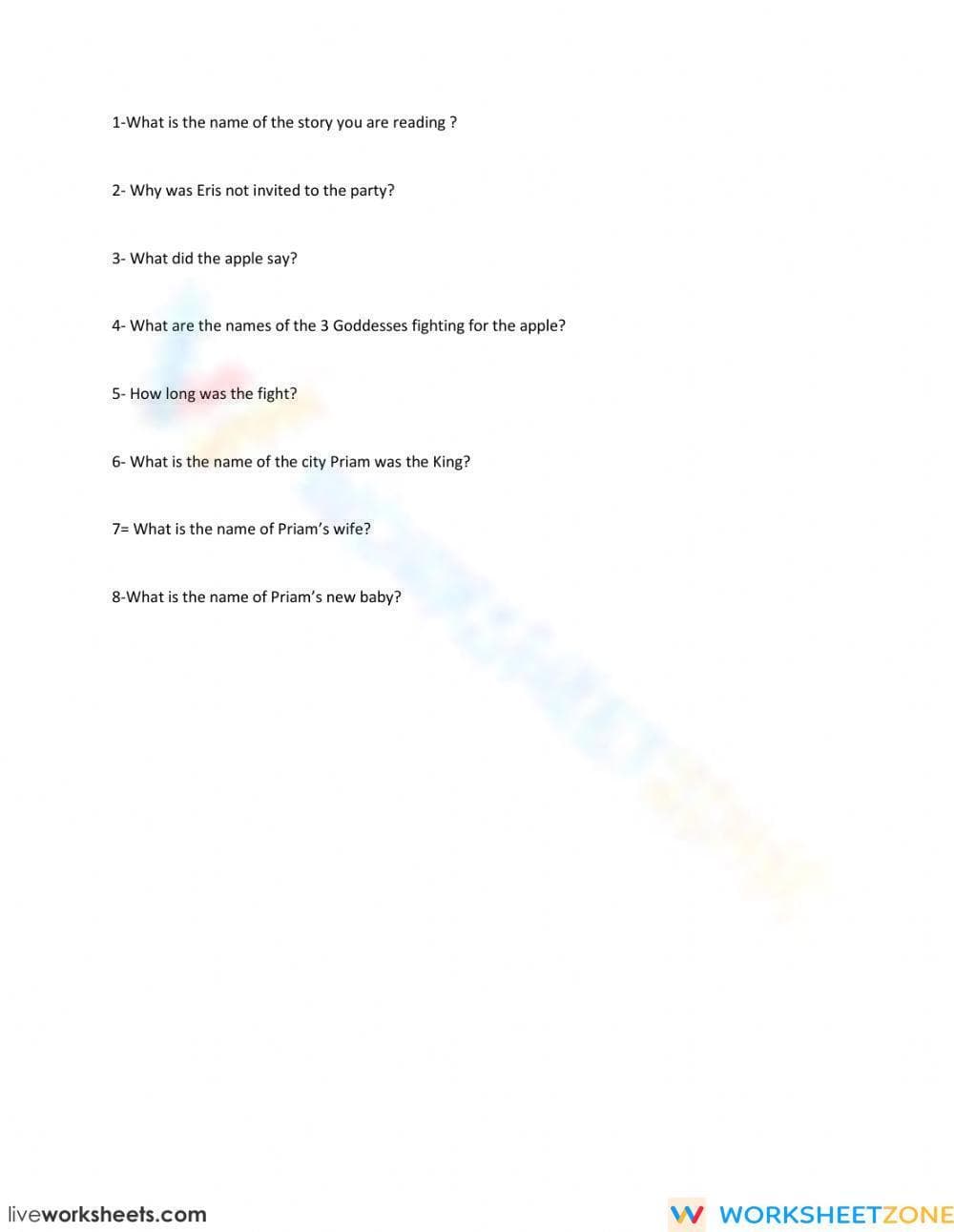

Grade 5 Myth Comprehension — Printable No-Prep Worksheet
Paste this activity's link or code into your existing LMS (Google Classroom, Canvas, Teams, Schoology, Moodle, etc.).
Students can open and work on the activity right away, with no student login required.
You'll still be able to track student progress and results from your teacher account.
This worksheet provides targeted practice in literal comprehension using a classical myth. Grade 5 students will read a short passage and answer eight direct questions to extract specific details, identify key characters, and track events. It builds a foundational skill for analyzing complex narratives and directly supports evidence-based reading.
At a Glance
- Grade: 5 · Subject: English Language Arts
- Standard:
CCSS.ELA-LITERACY.RL.5.1— Quote accurately from a text to explain what it says.- Skill Focus: Reading Comprehension (Mythology)
- Format: 1 page · 8 problems · Answer key included · PDF
- Best For: Independent practice or literacy centers
- Time: 15–20 minutes
This single-page PDF resource contains a set of eight reading comprehension questions based on a brief mythological story. The prompts require students to recall specific names, motivations, and story events. A comprehensive answer key is included to allow for quick grading or student self-correction.
Zero-Prep Workflow
Engineered for maximum classroom efficiency, this resource offers a true zero-prep workflow. 1. Print: Simply print one copy of the single-page PDF for each student (less than 1 minute). 2. Distribute: Hand out the worksheet during a literacy block, as a warm-up, or for a substitute plan (less than 1 minute). 3. Review: Use the provided answer key to review answers as a class or individually for immediate feedback. The entire process requires under two minutes of teacher preparation time.
Standards Alignment
This worksheet is primarily aligned to CCSS.ELA-LITERACY.RL.5.1, which requires students to "quote accurately from a text when explaining what the text says explicitly." It also supports foundational skills for RL.5.2 (determine a theme). Both standard codes can be copied directly into lesson plans, IEP goals, or district curriculum mapping tools.
How to Use It
Use this worksheet as a formative assessment immediately after a lesson or reading of the myth of Eris and the Trojan War. It is ideal for independent practice, literacy centers, or homework. During review, observe whether students can pinpoint the exact information in the text that answers each question. Most students will complete the task in 15-20 minutes.
Who It's For
This resource is designed for Grade 5 students but is also effective for advanced Grade 4 learners ready to tackle mythological texts. The direct-question format provides excellent support for English Language Learners and students who need structured practice in finding textual evidence. Pair this worksheet with an anchor chart of Greek gods and goddesses to provide visual scaffolding.
Developing the capacity for literal comprehension is a critical precursor to higher-order literary analysis. Research from Fisher & Frey (2014) emphasizes that students must first be able to locate and recall explicit information before they can successfully infer themes or analyze author's craft. This worksheet directly supports that instructional sequence by targeting CCSS.ELA-LITERACY.RL.5.1, which focuses on quoting accurately from a text. The format, featuring eight targeted questions about a mythological narrative, provides the structured, repetitive practice needed to build cognitive stamina for evidence-based reading. By requiring students to reference a text for specific details about characters and events, this activity reinforces the fundamental skills outlined in the standard. This approach transforms a simple reading task into a measurable data point for tracking progress toward grade-level literacy benchmarks, making it a valuable tool for any Grade 5 literature curriculum.


