


























Views
Downloads
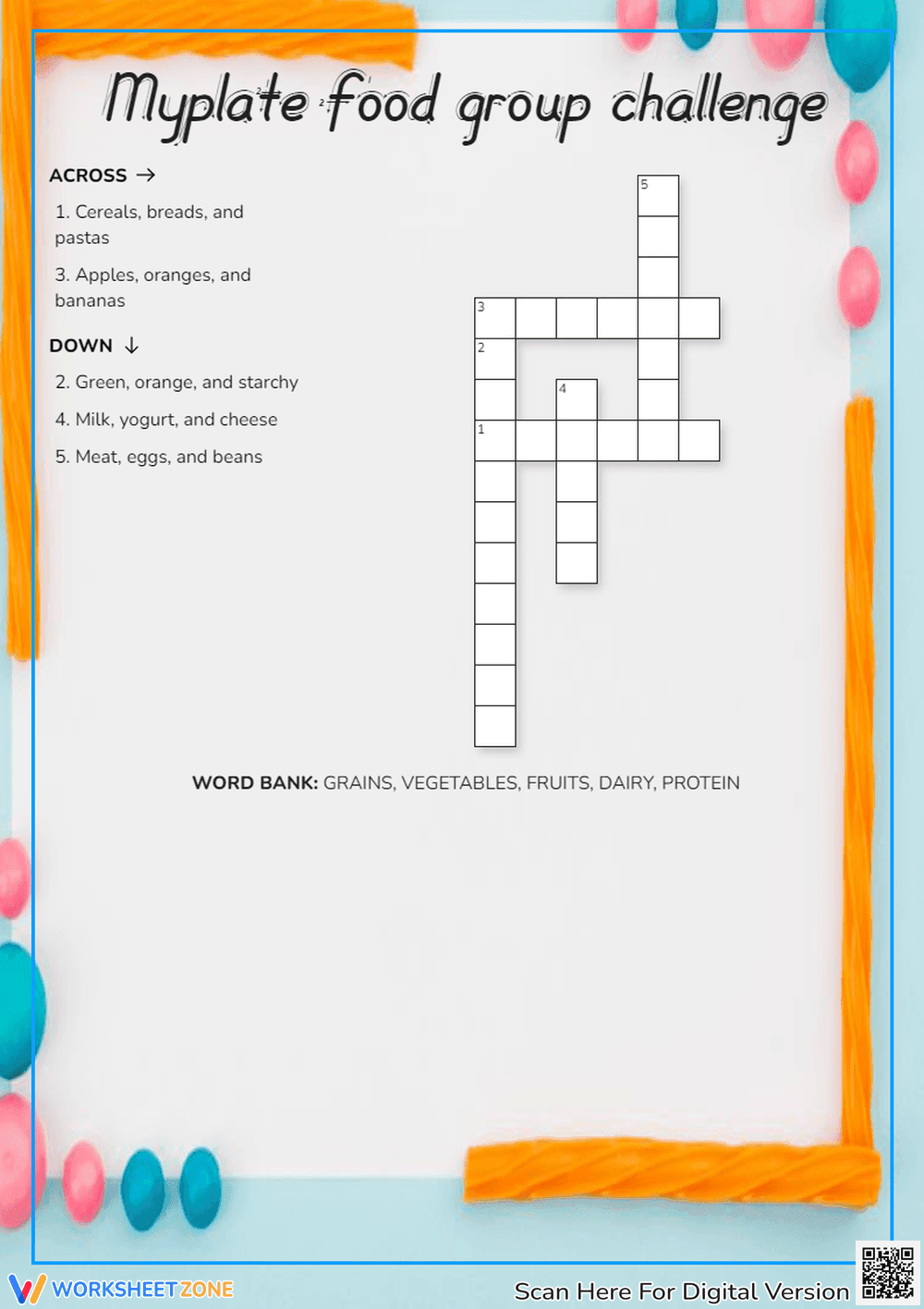

MyPlate Food Group Crossword | Grade 3 Printable
Paste this activity's link or code into your existing LMS (Google Classroom, Canvas, Teams, Schoology, Moodle, etc.).
Students can open and work on the activity right away, with no student login required.
You'll still be able to track student progress and results from your teacher account.
This Grade 3 health and vocabulary worksheet helps students identify the five major MyPlate food groups by matching everyday foods to their correct nutritional categories. By solving this engaging crossword puzzle, learners reinforce essential nutrition concepts, build subject-specific vocabulary, and develop healthier daily eating habits.
At a Glance
- Grade: 3 · Subject: Health & Vocabulary
- Standard:
CCSS.ELA-LITERACY.L.3.4— Determine the meaning of subject-specific words- Skill Focus: Food Group Identification
- Format: 1 page · 5 problems · Answer key included · PDF
- Best For: Independent practice or sub plans
- Time: 10–15 minutes
What's Inside
Inside this single-page resource, educators will find a straightforward crossword puzzle featuring five targeted clues. Students use the provided word bank—which includes grains, vegetables, fruits, dairy, and protein—to fill in the puzzle grid. The clear layout minimizes confusion, while the included answer key ensures quick and accurate grading for teachers.
Zero-Prep Workflow
- Print (1 minute): Simply download the PDF and print a class set. The black-and-white design is ink-friendly and requires no special formatting.
- Distribute (1 minute): Hand out the puzzle as a warm-up activity, early finisher task, or during a dedicated health lesson.
- Review (3 minutes): Go over the answers as a class using the provided key, discussing why specific foods belong to each group.
With a total teacher prep time of under two minutes, this resource is highly suitable for emergency sub plans or spontaneous instructional moments.
Standards Alignment
This activity aligns with CCSS.ELA-LITERACY.L.3.4, requiring students to determine or clarify the meaning of unknown and multiple-meaning words and phrases based on grade-level reading and content. By categorizing foods like 'apples, oranges, and bananas' into the 'fruits' group, students practice context-based vocabulary acquisition. Both standard codes can be copied directly into lesson plans, IEP goals, or district curriculum mapping tools.
How to Use It
Deploy this crossword puzzle after a direct instruction lesson on the MyPlate nutrition guidelines to solidify student understanding. Alternatively, use it as an engaging morning work assignment to activate prior knowledge before a science or health block. As a formative assessment observation tip, watch how students utilize the word bank; students who cross off words as they go demonstrate strong executive functioning skills. The expected completion time ranges from 10 to 15 minutes.
Who It's For
This worksheet is designed for third-grade students, though it serves as an excellent review for fourth graders or a guided activity for second graders. The inclusion of a word bank provides built-in differentiation, supporting English Language Learners and students who struggle with spelling. It pairs naturally with a visual anchor chart of the MyPlate diagram or a hands-on lesson sorting plastic play food into nutritional categories.
Integrating cross-curricular activities like this MyPlate crossword puzzle significantly enhances both vocabulary retention and health literacy. According to research from Fisher & Frey (2014), providing students with structured, context-rich vocabulary practice improves their ability to recall and apply subject-specific terms across different domains. When students determine the meaning of subject-specific words, as outlined in CCSS.ELA-LITERACY.L.3.4, they build a stronger foundation for lifelong learning and academic success. This specific task requires learners to connect everyday food items to broader nutritional categories, reinforcing critical cognitive associations. By utilizing a word bank and clear, concise clues, the worksheet reduces unnecessary cognitive overload, allowing students to focus entirely on the core concepts of healthy eating. Such targeted, low-stakes practice is essential for developing both academic language and practical life skills in elementary education classrooms.


