




























Views
Downloads

My House Reading Comprehension | Essential Grade 1 Printable

Paste this activity's link or code into your existing LMS (Google Classroom, Canvas, Teams, Schoology, Moodle, etc.).
Students can open and work on the activity right away, with no student login required.
You'll still be able to track student progress and results from your teacher account.
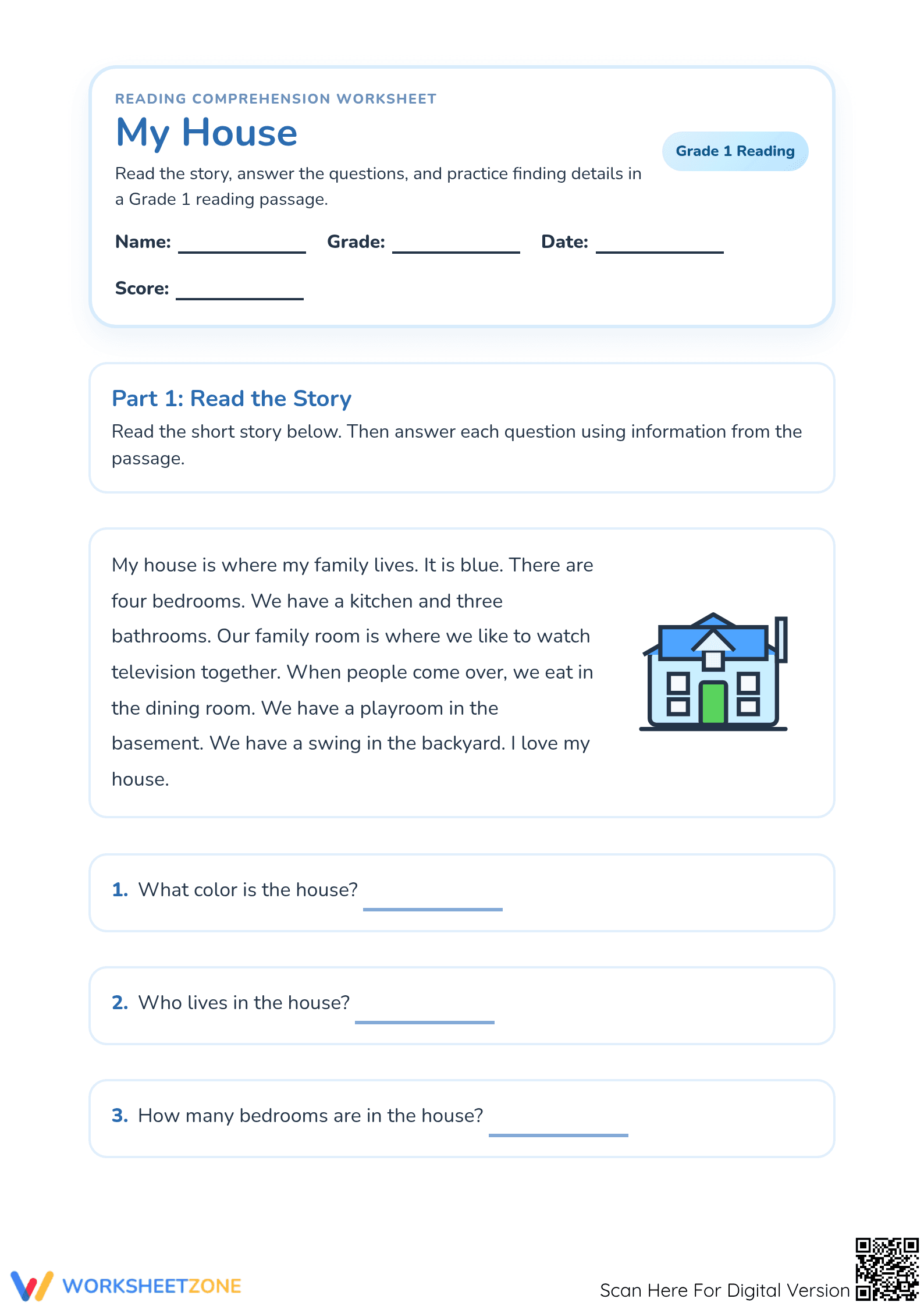
This Grade 1 reading comprehension worksheet helps young learners identify specific details within a short story about a family home. Students read a passage and answer eight targeted questions to demonstrate understanding. By focusing on explicit information, children develop the foundational evidence-based skills required for primary success.
At a Glance
- Grade: 1 · Subject: English Language Arts (ELA)
- Standard:
CCSS.ELA-LITERACY.RI.1.1— Ask and answer questions about key details in a text- Skill Focus: Identifying key details in a short story
- Format: 2 pages · 8 problems · Answer key included · PDF
- Best For: Independent practice or formative assessment
- Time: 15–20 minutes
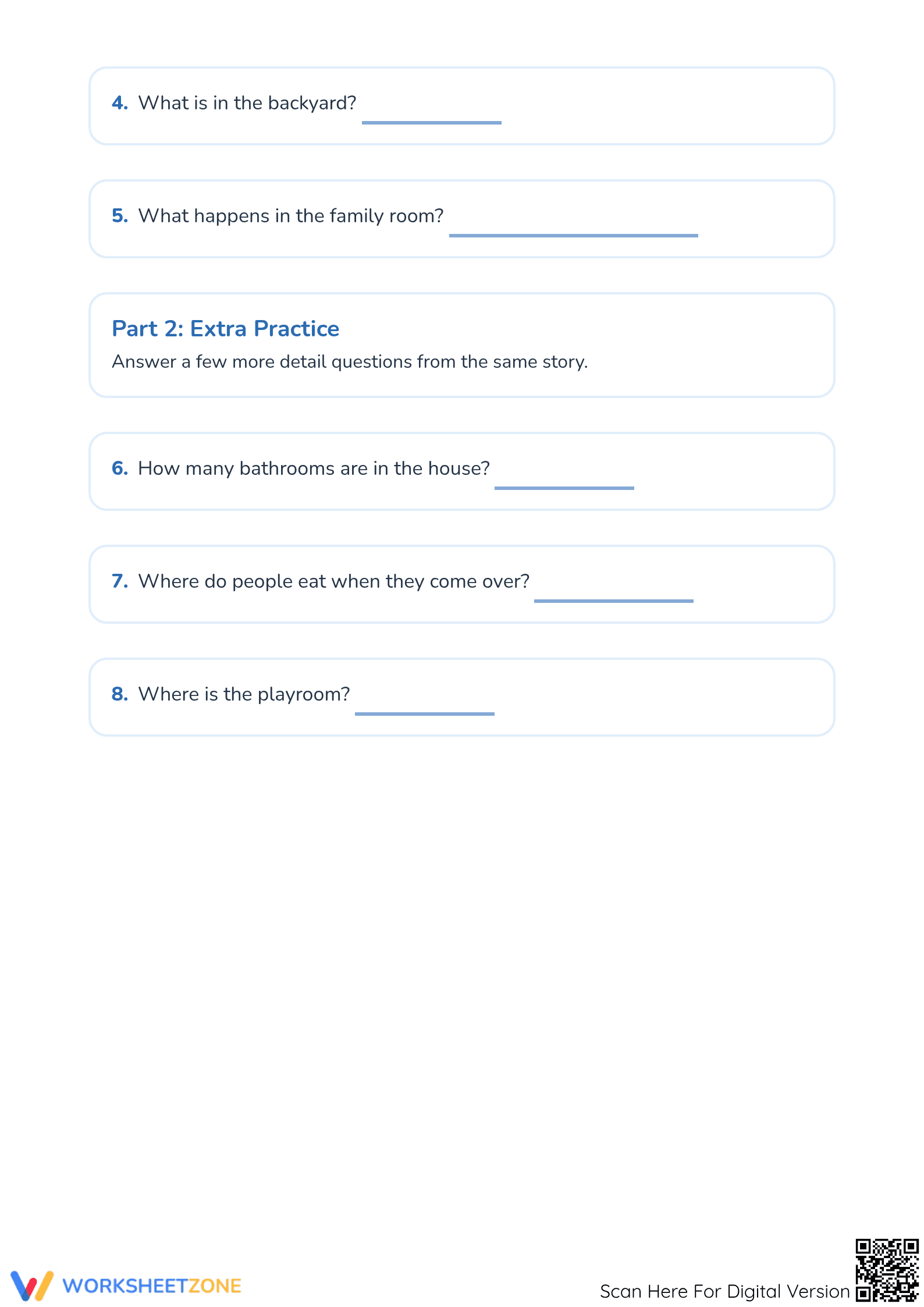
This two-page PDF features a clean, kid-friendly layout. Page one includes the "My House" passage and three questions. Page two provides five "Extra Practice" questions to reinforce the skill. The package includes a complete answer key for quick grading. The text is written at an accessible Grade 1 level with clear sentences and supportive illustrations.
Zero-Prep Workflow
This worksheet requires less than two minutes of teacher preparation. Simply print the two-page document, distribute it, and keep the answer key ready for review. The self-contained nature of the text and questions makes this an ideal resource for substitute plans, morning work, or literacy stations where minimal teacher intervention is necessary. This ensures a smooth classroom flow.
Standards Alignment
The primary alignment is CCSS.ELA-LITERACY.RI.1.1, requiring students to "Ask and answer questions about key details in a text." The worksheet prompts students to retrieve explicit information like colors and locations. This standard code can be copied directly into lesson plans, IEP goals, or district curriculum mapping tools to ensure instructional transparency and alignment.
How to Use It
Use this worksheet during independent practice following a lesson on finding evidence. It serves as an excellent formative assessment to check which students can locate facts within a text. For a collaborative twist, have students pair up to "prove" their answers by underlining the corresponding sentence in the story using colored crayons or highlighters.
Who It's For
This resource is tailored for first-grade students but also works for second-graders needing remedial support. It pairs naturally with anchor charts focused on the "5 W's" (Who, What, Where, When, Why) and can be used alongside a shared reading of any informational book about homes, families, or local communities.
The "My House" worksheet is built on the educational principle that early mastery of key detail identification is a prerequisite for higher-order thinking. By aligning with CCSS.ELA-LITERACY.RI.1.1, this resource ensures that students practice the fundamental skill of asking and answering questions about explicit text features. Research published in the RAND AIRS 2024 report emphasizes that consistent exposure to text-dependent questions in the early grades significantly improves long-term literacy outcomes and reading stamina. This worksheet provides 8 specific tasks that move students from basic recognition to active retrieval, creating a structured path toward reading proficiency. Educators can reliably use this 2-page resource as a benchmark for student progress in evidence-based comprehension. The inclusion of a clear answer key supports the "Instructional Practice Guide" recommendations for providing immediate feedback to young learners, a strategy shown to accelerate skill acquisition in primary English Language Arts settings across diverse classroom environments.


