


























Views
Downloads
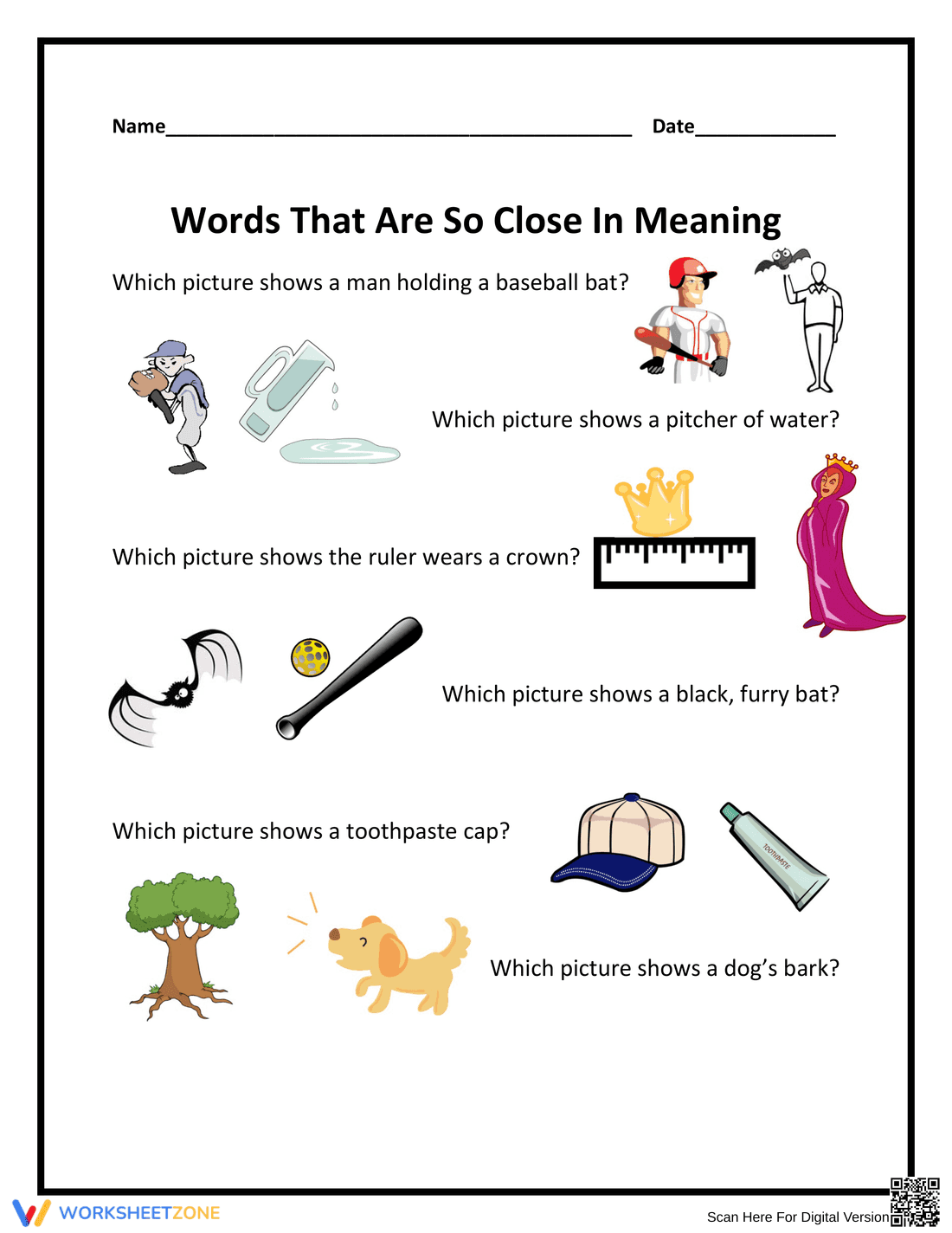

Kindergarten Multiple Meaning Words — Printable Worksheet
Paste this activity's link or code into your existing LMS (Google Classroom, Canvas, Teams, Schoology, Moodle, etc.).
Students can open and work on the activity right away, with no student login required.
You'll still be able to track student progress and results from your teacher account.
This printable vocabulary worksheet helps kindergarten students identify and distinguish between multiple-meaning words using visual cues. Students match common homonyms like bat, ruler, and bark to their correct pictorial representations, building essential early reading comprehension and vocabulary acquisition skills.
At a Glance
- Grade: Kindergarten · Subject: English Language Arts
- Standard:
CCSS.L.K.4.A— Identify new meanings for familiar words and apply them accurately- Skill Focus: Multiple Meaning Words
- Format: 1 page · 6 problems · Answer key included · PDF
- Best For: Independent vocabulary practice and quick assessment
- Time: 10–15 minutes
The worksheet features a single-page layout containing six distinct multiple-choice questions paired with clear, child-friendly illustrations. Each question prompts the learner to identify the correct image corresponding to a specific meaning of a homonym, such as distinguishing a baseball bat from a flying mammal. A complete answer key is provided to facilitate rapid grading.
This resource is designed for an instant, zero-prep classroom workflow. First, print the single-page PDF in under one minute. Next, distribute the sheets to students for a ten-minute independent or guided activity. Finally, review the answers as a class in five minutes using the included key. Total teacher preparation time is less than two minutes, making this sheet an ideal choice for morning work, literacy centers, or emergency sub plans.
This activity directly aligns with the Common Core State Standard `CCSS.L.K.4.A`, which requires students to identify new meanings for familiar words and apply them accurately. Additionally, it supports foundational reading standards by reinforcing word recognition through visual context clues. Both standard codes can be copied directly into lesson plans, IEP goals, or district curriculum mapping tools.
Use this worksheet during direct instruction as a guided practice activity to introduce the concept of homonyms, or assign it after the lesson as a quick formative assessment. While students work, observe whether they struggle to differentiate between the noun and verb forms of words like "bark" or "cap." The activity takes approximately 10 to 15 minutes to complete.
This resource is tailored for kindergarten students learning basic vocabulary, but it also serves as an excellent intervention tool for first-grade struggling readers or English language learners. Pair this worksheet with a read-aloud book featuring homonyms or an anchor chart displaying multiple-meaning words to provide additional visual support for diverse learners.
According to research by Fisher & Frey (2014) on vocabulary acquisition, early learners benefit significantly from dual-coding instruction that pairs visual illustrations with written words. This worksheet targets the core requirements of `CCSS.L.K.4.A` by prompting students to identify multiple meanings of common words through structured visual choices. By engaging with six distinct homonym pairs, young readers build the semantic flexibility necessary for reading comprehension. The structured layout allows educators to quickly evaluate word-meaning acquisition and implement targeted interventions. This resource serves as a reliable tool for developing early literacy skills, ensuring that students transition smoothly from basic word recognition to understanding context-dependent vocabulary variations. Both teachers and curriculum specialists can utilize this structured practice sheet to support systematic vocabulary development in early childhood classrooms.


