


























Views
Downloads

Printable Sentence Scramble Worksheet | Grade 2
Paste this activity's link or code into your existing LMS (Google Classroom, Canvas, Teams, Schoology, Moodle, etc.).
Students can open and work on the activity right away, with no student login required.
You'll still be able to track student progress and results from your teacher account.
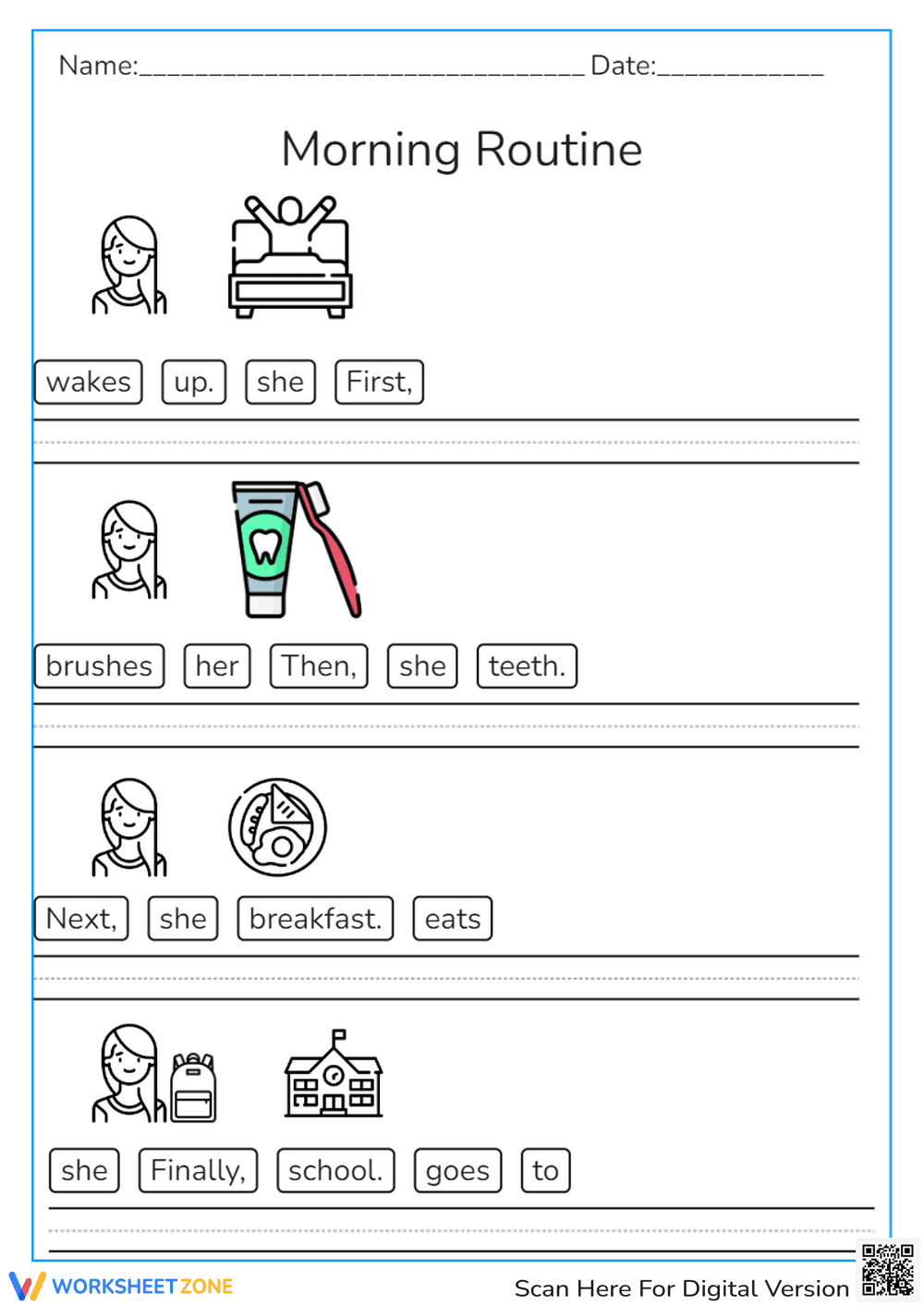
This Grade 2 sentence scramble worksheet helps students practice syntax and temporal transition words by reordering scrambled text into complete sentences. By focusing on a familiar morning routine, learners build confidence in capitalization, punctuation, and logical sequencing while reinforcing essential early writing skills.
At a Glance
- Grade: 2 · Subject: ELA
- Standard:
CCSS.ELA-LITERACY.L.2.1.F— Rearrange complete simple sentences- Skill Focus: Sentence Structure and Sequencing
- Format: 1 page · 4 problems · Answer key included · PDF
- Best For: Morning work or independent practice
- Time: 10–15 minutes
This single-page resource features four distinct sentence-building tasks centered around a relatable morning routine. Each problem includes clear visual cues, such as a girl waking up or brushing her teeth, paired with scrambled word boxes. Students must read the individual words, identify the capitalized starting word and the punctuated ending word, and write the correctly ordered sentence on the provided handwriting lines. A complete answer key is included for quick grading.
Zero-Prep Workflow
Designed for immediate use with minimal setup.
- Print (1 min): Download the PDF and print a class set. The black-and-white design is ink-friendly.
- Distribute (1 min): Hand out during literacy centers. Visual cues make instructions self-evident for second graders.
- Review (2 mins): Use the answer key to quickly check work or project for whole-class self-correction.
With a total teacher prep time of under two minutes, this activity is an excellent addition to any emergency sub plan.
Standards Alignment
This resource is directly aligned to CCSS.ELA-LITERACY.L.2.1.F, which requires students to produce, expand, and rearrange complete simple sentences. By physically reordering the scrambled words to form logical statements, students demonstrate a practical understanding of English grammar conventions. Both standard codes can be copied directly into lesson plans, IEP goals, or district curriculum mapping tools.
How to Use It
Use this as a warm-up activity before a direct instruction lesson on narrative writing or transition words. Teachers can assign it as morning work to settle students into the academic day while reviewing core syntax skills. As a formative assessment tip, observe whether students are actively looking for the capitalized word to start their sentence and the punctuation mark to end it. The expected completion time ranges from 10 to 15 minutes.
Who It's For
This resource is primarily designed for second-grade students developing their foundational writing and grammar skills. The inclusion of visual supports makes it highly accessible for English Language Learners (ELLs) and students requiring additional scaffolding for reading comprehension. It pairs naturally with a classroom anchor chart detailing the steps of a daily routine.
Mastering sentence structure through targeted practice is a critical component of early literacy development in elementary classrooms. This worksheet directly aligns with CCSS.ELA-LITERACY.L.2.1.F, focusing specifically on the student's ability to rearrange complete simple sentences into logical order. According to an EdReports 2024 analysis of foundational literacy programs, instructional materials that provide explicit, scaffolded opportunities to manipulate syntax significantly improve students' overall writing fluency and reading comprehension. By engaging with these scrambled sentences, young learners actively apply grammar rules rather than passively memorizing them. Furthermore, the integration of temporal transition words strengthens their cognitive sequencing abilities, effectively bridging the gap between isolated grammar exercises and cohesive narrative writing. Providing students with consistent, structured tasks like this morning routine activity ensures they build the automaticity required for more complex academic tasks in later grades.


