




























Views
Downloads

Essential Moon Phases Worksheet | Grade 3 Science

Paste this activity's link or code into your existing LMS (Google Classroom, Canvas, Teams, Schoology, Moodle, etc.).
Students can open and work on the activity right away, with no student login required.
You'll still be able to track student progress and results from your teacher account.
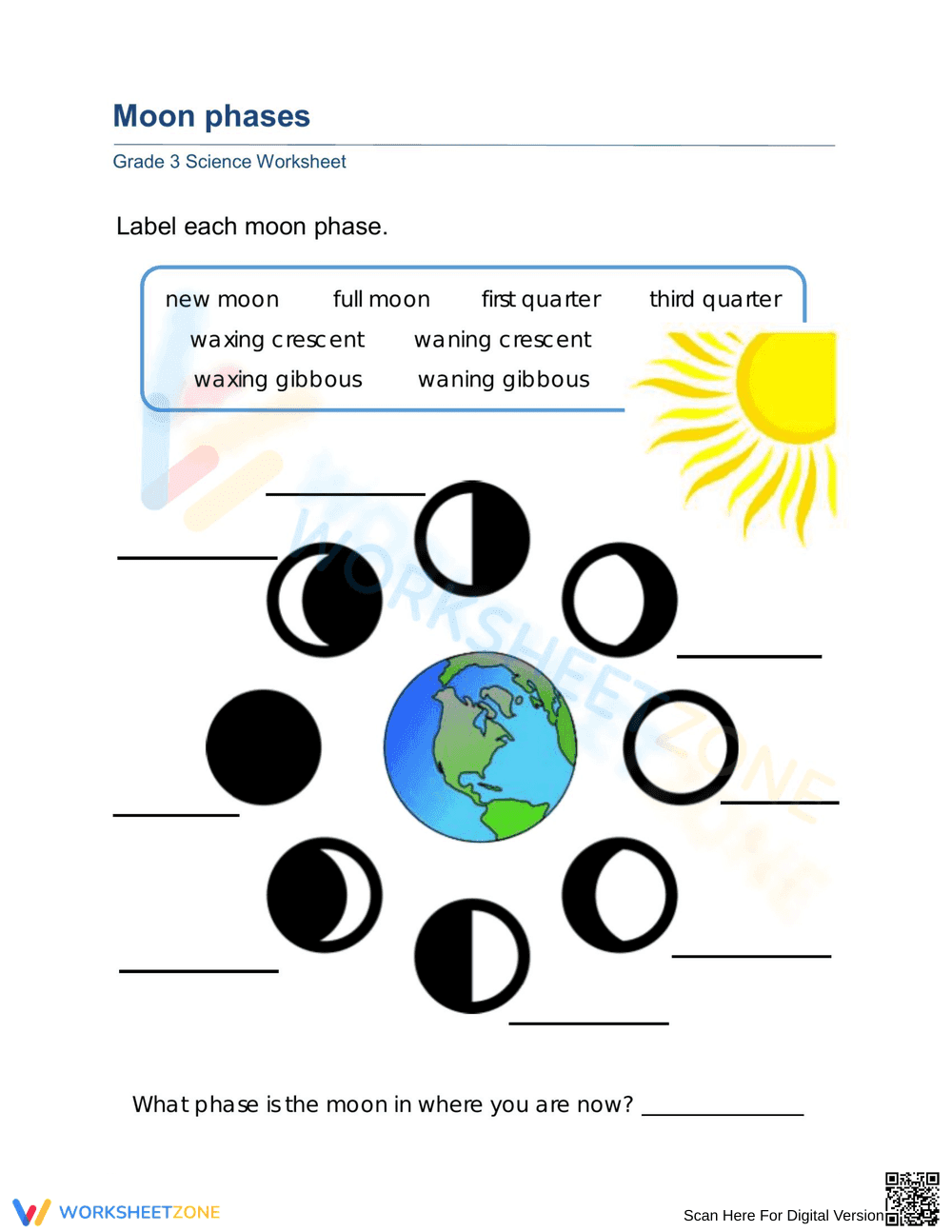
This moon phases worksheet helps Grade 3 students identify and label the eight distinct stages of the lunar cycle. By connecting visual diagrams with specific terminology, learners develop a concrete understanding of how the moon's appearance changes from Earth's perspective. It provides a structured way to master essential celestial patterns through visual observation.
At a Glance
- Grade: 3 · Subject: Science
- Standard:
3-ESS1-1— Identify and label repeating patterns in the moon's monthly appearance- Skill Focus: Lunar phase identification
- Format: 2 pages · 9 problems · Answer key included · PDF
- Best For: Independent science center or quick assessment
- Time: 15–20 minutes
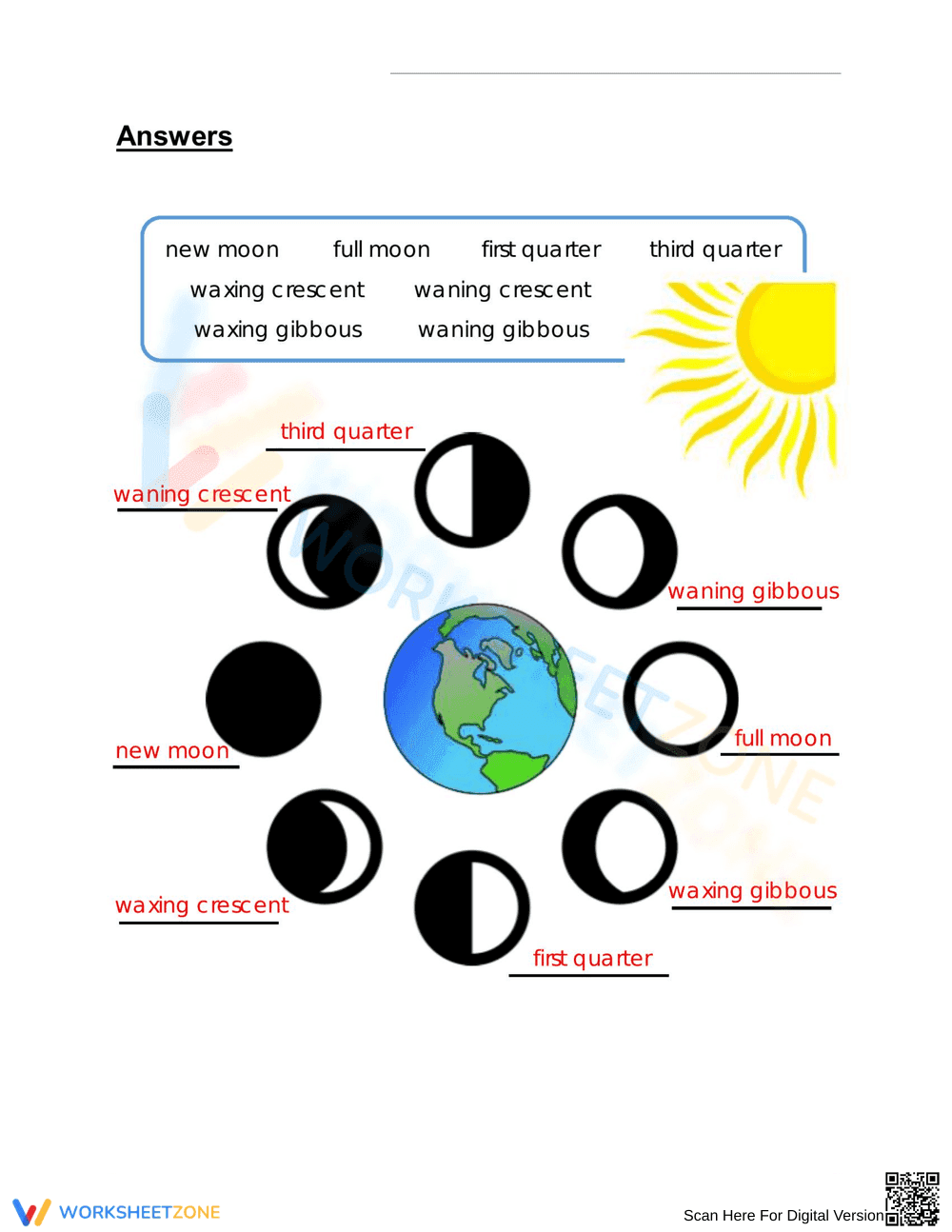
This 2-page PDF includes a comprehensive moon phase diagram centered around Earth, featuring the Sun's relative position for context. The worksheet provides 8 labeling tasks supported by a clear word bank and one reflection question about current moon observations. A full-color answer key is included for immediate student feedback or easy grading.
Teachers can implement this resource with minimal effort. Simply print the single-page worksheet (1 minute), distribute it to students during your space unit (1 minute), and use the included answer key for a rapid check for understanding (1 minute). This streamlined workflow makes it an ideal candidate for emergency sub plans or last-minute science rotations.
This activity is specifically aligned to `3-ESS1-1`, requiring students to represent data to describe typical patterns of objects in the sky. It specifically addresses the predictable cycle of lunar phases caused by the moon's orbit. Both standard codes can be copied directly into lesson plans, IEP goals, or district curriculum mapping tools.
Use this as a formative assessment after an introductory lesson on the Earth-Moon-Sun system to check for misconceptions about waxing and waning. Alternatively, assign it as a "Night Sky" homework activity where students complete the labeling and then step outside to answer the reflection question based on real-world observation.
This resource is designed for Grade 3 students beginning their study of astronomy. It is particularly helpful for visual learners who need to see the spatial relationship between celestial bodies. Pair it with a moon phase calendar or a physical model using a flashlight and a foam ball for a multi-sensory experience.
Aligned to the `3-ESS1-1` standard, this worksheet facilitates the "represent data" component of the NGSS through scientific labeling of the lunar cycle. Research from `Fisher & Frey (2014)` emphasizes that structured visual scaffolds, like the circular moon diagram used here, significantly enhance a student's ability to internalize cyclic patterns in Earth science. By providing a word bank alongside the visual prompts, the worksheet reduces cognitive load while ensuring students use precise scientific vocabulary such as "gibbous" and "crescent." This evidence-based approach supports long-term retention of astronomical concepts and prepares students for more complex orbital mechanics in middle school. The inclusion of a reflection question bridges classroom theory with real-world application, a key strategy for deep conceptual change in young scientists.


