


























Views
Downloads

Printable Monohybrid Cross Worksheet | Grade 9 Biology
Paste this activity's link or code into your existing LMS (Google Classroom, Canvas, Teams, Schoology, Moodle, etc.).
Students can open and work on the activity right away, with no student login required.
You'll still be able to track student progress and results from your teacher account.
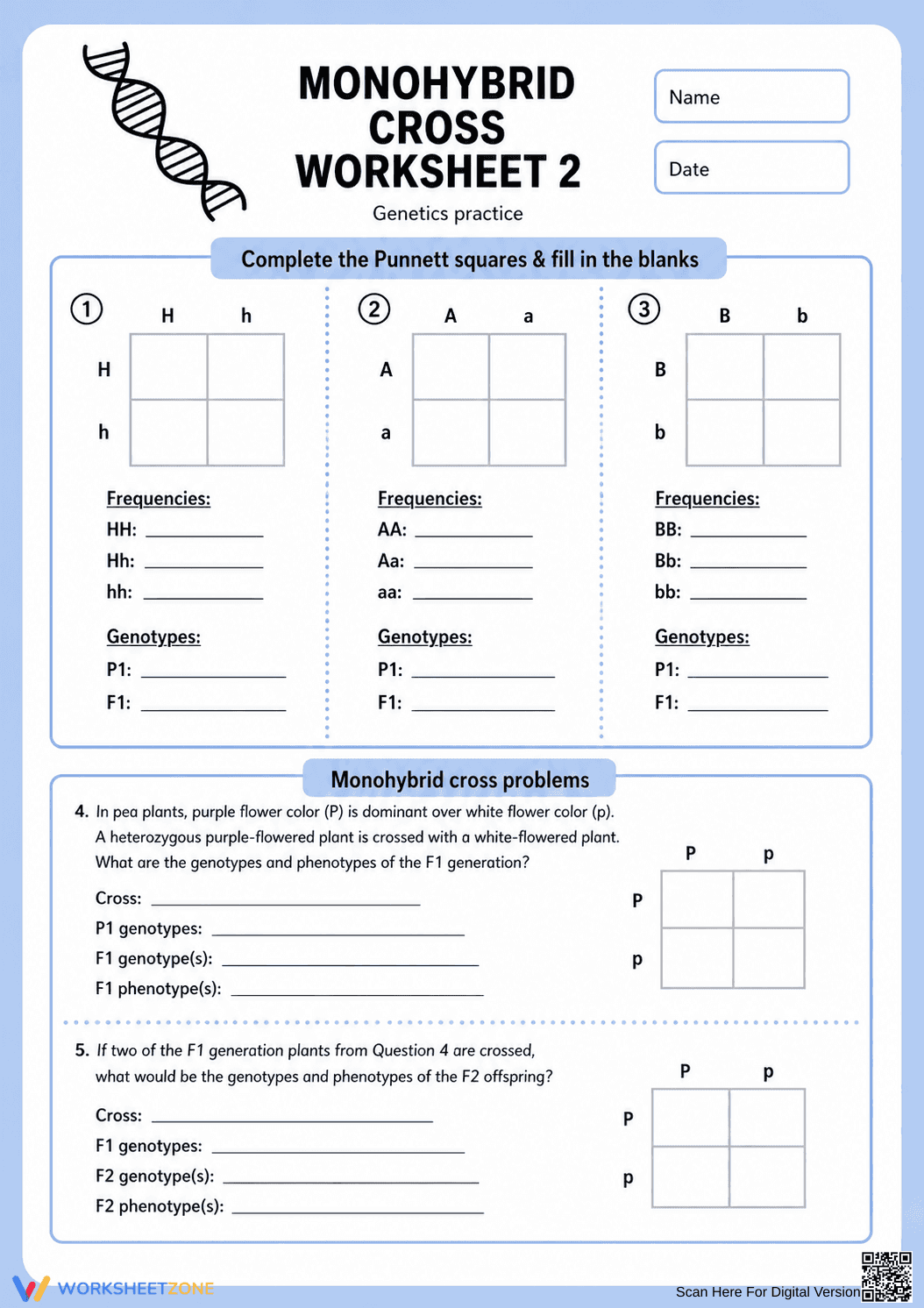
This high school biology worksheet provides focused practice on monohybrid crosses and Mendelian genetics. Students will complete Punnett squares to determine the genotypes, phenotypes, and allele frequencies of offspring. By working through these structured genetics problems, learners build the foundational skills needed to predict trait inheritance across generations.
At a Glance
- Grade: 9 · Subject: Biology
- Standard:
HS-LS3-3— Apply probability to explain the variation of expressed traits.- Skill Focus: Monohybrid Crosses & Punnett Squares
- Format: 1 page · 5 problems · Answer key included · PDF
- Best For: Independent practice
- Time: 15–20 minutes
This single-page resource features five distinct genetics tasks. The first section includes three basic Punnett squares where students calculate frequencies and identify P1 and F1 genotypes from given alleles. The second section presents two word problems involving pea plant flower color, requiring students to extract dominant and recessive trait information, set up their own crosses, and determine F1 and F2 generation outcomes. A complete answer key is provided for quick grading.
- Guided practice: The first three problems provide pre-labeled Punnett squares, allowing students to focus purely on combining alleles and calculating basic genotypic frequencies.
- Supported practice: Problem four introduces a real-world scenario, requiring students to translate text into a heterozygous cross and determine both genotypes and phenotypes.
- Independent practice: The final problem asks students to take the offspring from the previous question and cross them, testing their ability to track inheritance across multiple generations.
This gradual-release approach ensures students build confidence with the mechanics of Punnett squares before applying them to complex word problems.
This worksheet aligns directly with HS-LS3-3: Apply concepts of statistics and probability to explain the variation and distribution of expressed traits in a population. By calculating genotypic and phenotypic frequencies, students demonstrate a mathematical understanding of Mendelian inheritance patterns. Both standard codes can be copied directly into lesson plans, IEP goals, or district curriculum mapping tools.
Deploy this worksheet immediately following direct instruction on Mendelian genetics and Punnett square mechanics. It serves as an excellent in-class independent practice assignment or a targeted homework task. As a formative assessment observation tip, watch how students set up the axes for questions four and five; errors here often indicate a misunderstanding of how alleles segregate during gamete formation. Most students will complete the assignment within 15 to 20 minutes.
This resource is designed for high school biology students learning introductory genetics. The clear, uncluttered layout makes it accessible for students who might struggle with dense text, while the progression to word problems provides adequate rigor for standard-level learners. Pair this worksheet with a visual anchor chart detailing the differences between homozygous and heterozygous alleles to support students who need additional vocabulary reinforcement.
Mastering the mechanics of inheritance requires repeated, structured practice with probability models. This worksheet targets HS-LS3-3, helping students apply probability to explain the variation of expressed traits. According to Fisher & Frey (2014), utilizing a gradual release of responsibility framework—moving from isolated skill drills to applied word problems—significantly improves student retention of complex scientific concepts. By transitioning learners from pre-formatted Punnett squares to multi-generational word problems, this resource builds the cognitive pathways necessary for advanced genetic analysis. The clear visual organization reduces extraneous cognitive load, allowing students to focus entirely on the mathematical relationships between alleles. Educators can rely on this targeted practice to solidify foundational genetics knowledge before introducing more complex topics like dihybrid crosses or non-Mendelian inheritance patterns.


