


























Views
Downloads
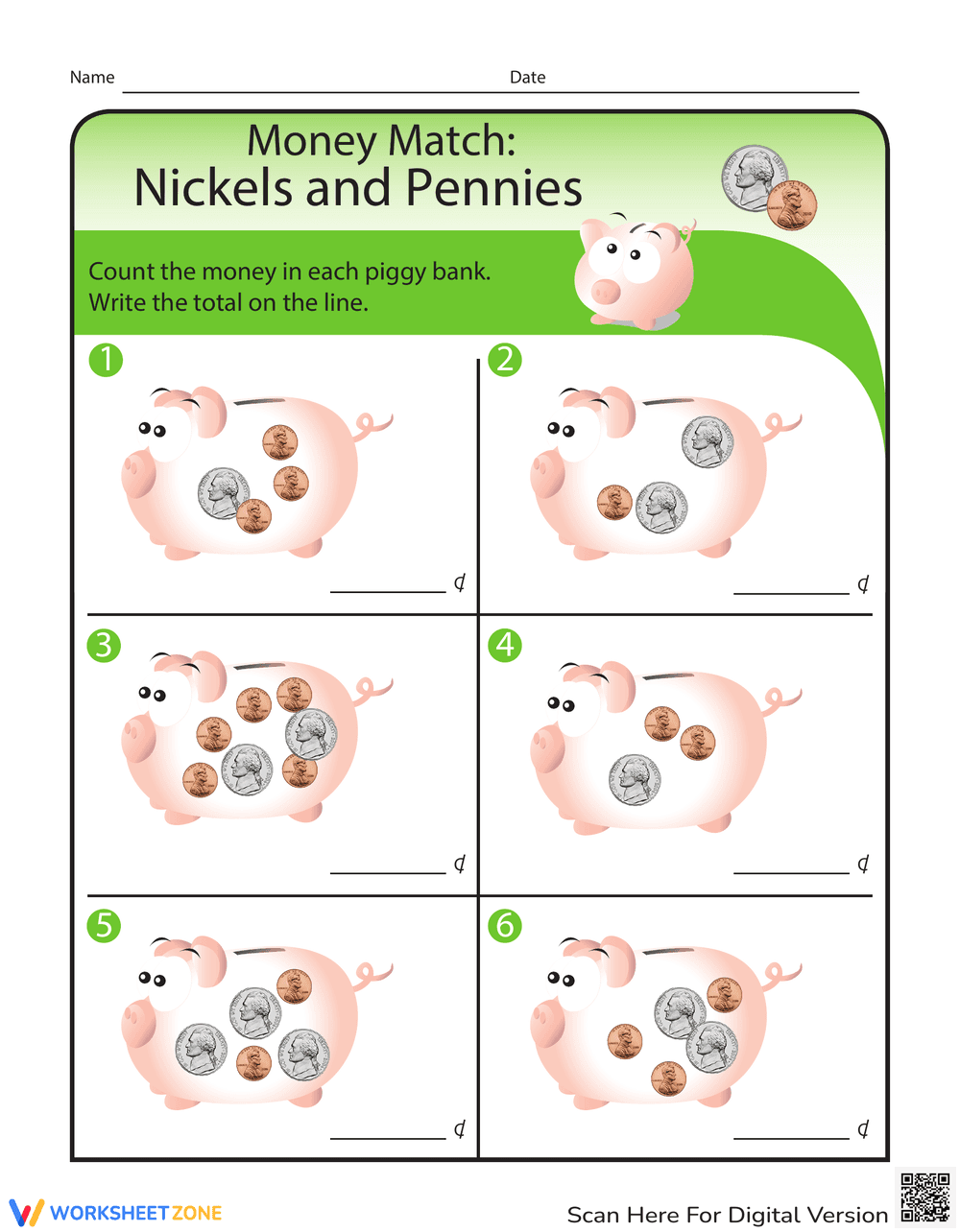

Nickels & Pennies Printable Worksheet | Grade 1
Paste this activity's link or code into your existing LMS (Google Classroom, Canvas, Teams, Schoology, Moodle, etc.).
Students can open and work on the activity right away, with no student login required.
You'll still be able to track student progress and results from your teacher account.
This Grade 1 printable worksheet builds coin-counting fluency by asking students to count groups of nickels and pennies inside illustrated piggy banks and record each total value on a provided line. Students strengthen basic addition and coin-identification skills through six structured, visual problems on a single page.
At a Glance
- Grade: 1 · Subject: Math / Money Math
- Standard:
CCSS.MATH.CONTENT.1.OA.C.5— Add within 20 by counting on to find coin totals- Skill Focus: Identifying nickels and pennies; counting mixed coin groups; writing monetary totals
- Format: 1 page · 6 problems · Answer key included · PDF
- Best For: Guided math centers or morning warm-up
- Time: 10–15 minutes
Each of the six problems presents a piggy bank illustration containing a mixed group of nickels and pennies. Students identify each coin by type, count on from the highest-value coin, and write the total in cents on the answer line. The single-page layout keeps the task focused, and the included answer key lets teachers or caregivers check work at a glance without additional prep.
- Guided practice (problems 1–2): Coin groups are small (2–3 coins) with clear visual spacing, supporting initial count-on strategies with minimal cognitive load.
- Supported practice (problems 3–4): Groups grow to 4–5 coins, requiring students to track running totals and apply nickel-then-penny sequencing independently.
- Independent practice (problems 5–6): Larger mixed groups challenge students to count on fluently without scaffolding, mirroring real-world coin handling. This gradual-release structure (I Do, We Do, You Do) lets teachers model problems 1–2, work through 3–4 together, then release students to complete 5–6 on their own.
Standards Alignment
Primary standard: CCSS.MATH.CONTENT.1.OA.C.5 — Relate counting to addition and subtraction; count on to add. Supporting standard CCSS.MATH.CONTENT.1.OA.A.1 addresses using addition within 20 to solve word problems, reinforced when students interpret each piggy bank as a simple joining situation. Both standard codes can be copied directly into lesson plans, IEP goals, or district curriculum mapping tools.
How to Use It
Use as a during direct-instruction activity: project one piggy bank on the board, model the count-on strategy aloud, then release students to complete remaining problems independently. Alternatively, place in a math center after a coin-identification lesson as formative practice. Observation tip: watch whether students start counting from the penny or the nickel — students who count from the penny likely need additional anchor instruction on coin hierarchy. Expected completion time is 10–15 minutes for most first graders.
Who It's For
Designed for Grade 1 students beginning money math, including those in intervention who benefit from concrete-to-representational tasks. Pairs naturally with a physical coin sorting activity or a nickel/penny anchor chart posted at the math center. Students ready for extension can be prompted to write a number sentence (e.g., 5 + 1 + 1 = 7¢) beneath each answer line.
This worksheet targets CCSS.MATH.CONTENT.1.OA.C.5, the standard requiring first graders to relate counting to addition by counting on to find sums. Counting mixed coin groups — nickels (5¢) and pennies (1¢) — is a high-frequency real-world application of this standard. According to the 2024 NAEP data, fewer than 40% of Grade 2 students demonstrate proficiency in applied money tasks, underscoring the value of early, repeated coin-counting practice in Grade 1. Fisher & Frey (2014) identify structured gradual-release frameworks as critical for building procedural fluency in primary mathematics, a design principle embedded in this worksheet's six-problem progression. The single-page, answer-key-included format reduces teacher preparation time and supports consistent formative data collection across whole-class, small-group, and independent instructional settings.


