


























Views
Downloads

Printable Guide: Modeling Fractions with Rectangles - Grade 3 Math
Paste this activity's link or code into your existing LMS (Google Classroom, Canvas, Teams, Schoology, Moodle, etc.).
Students can open and work on the activity right away, with no student login required.
You'll still be able to track student progress and results from your teacher account.
Modeling Fractions with Rectangles: A Complete Grade 3 Guide
Students develop a conceptual understanding of fractions as area models with this comprehensive worksheet. Moving from multiple-choice recognition to independent drawing and word problems, learners move beyond rote memorization to mastery. This resource ensures students can accurately partition and shade rectangles to represent fractional parts and wholes.
At a Glance
- Grade: 3 · Subject: Math
- Standard:
CCSS.MATH.CONTENT.3.NF.A.1— Understand fractions as parts of a whole partitioned into equal segments- Skill Focus: Partitioning and shading area models
- Format: 3 pages · 7 problems · Answer key included · PDF
- Best For: Independent practice or formative assessment
- Time: 20–30 minutes
What's Inside
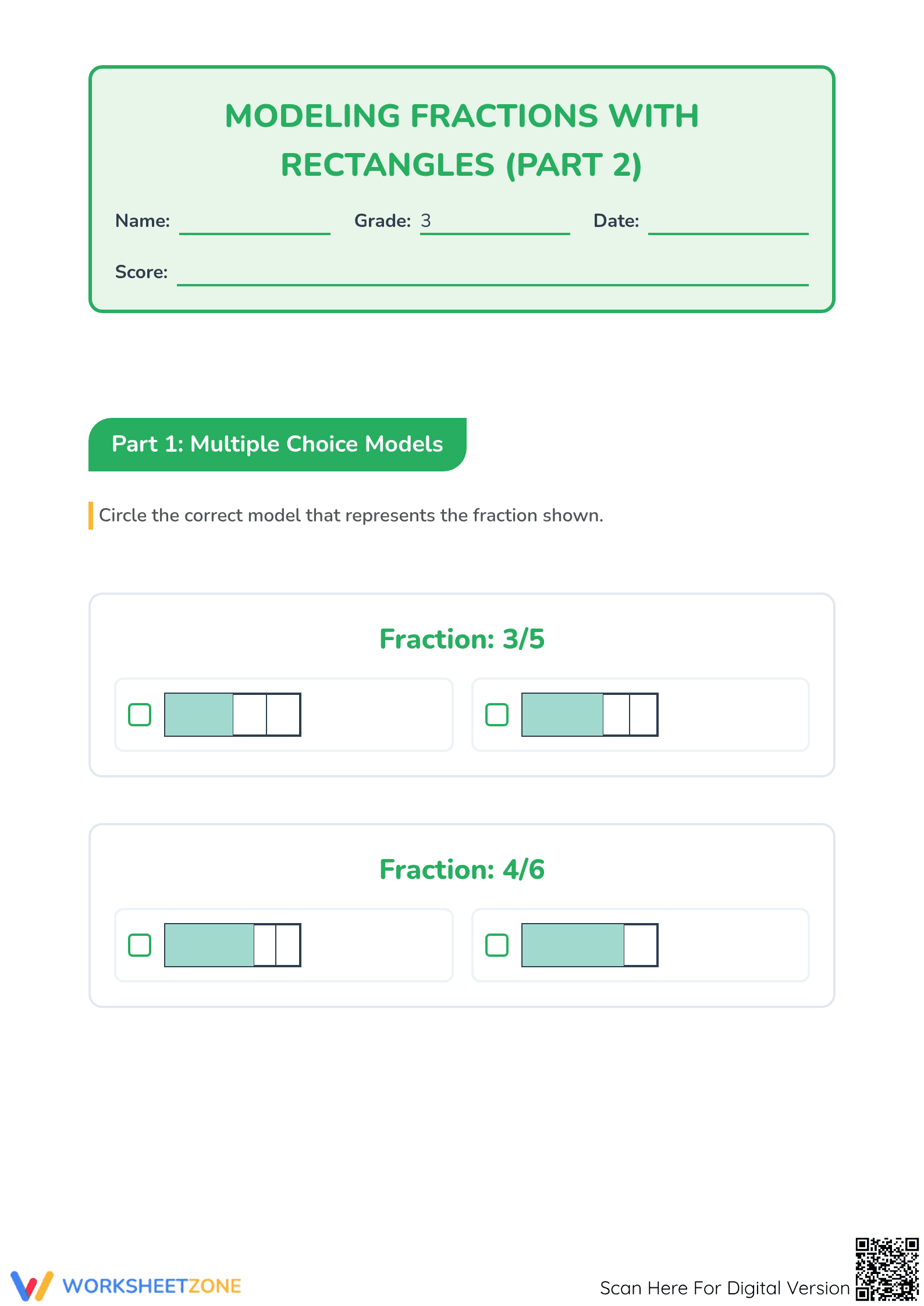
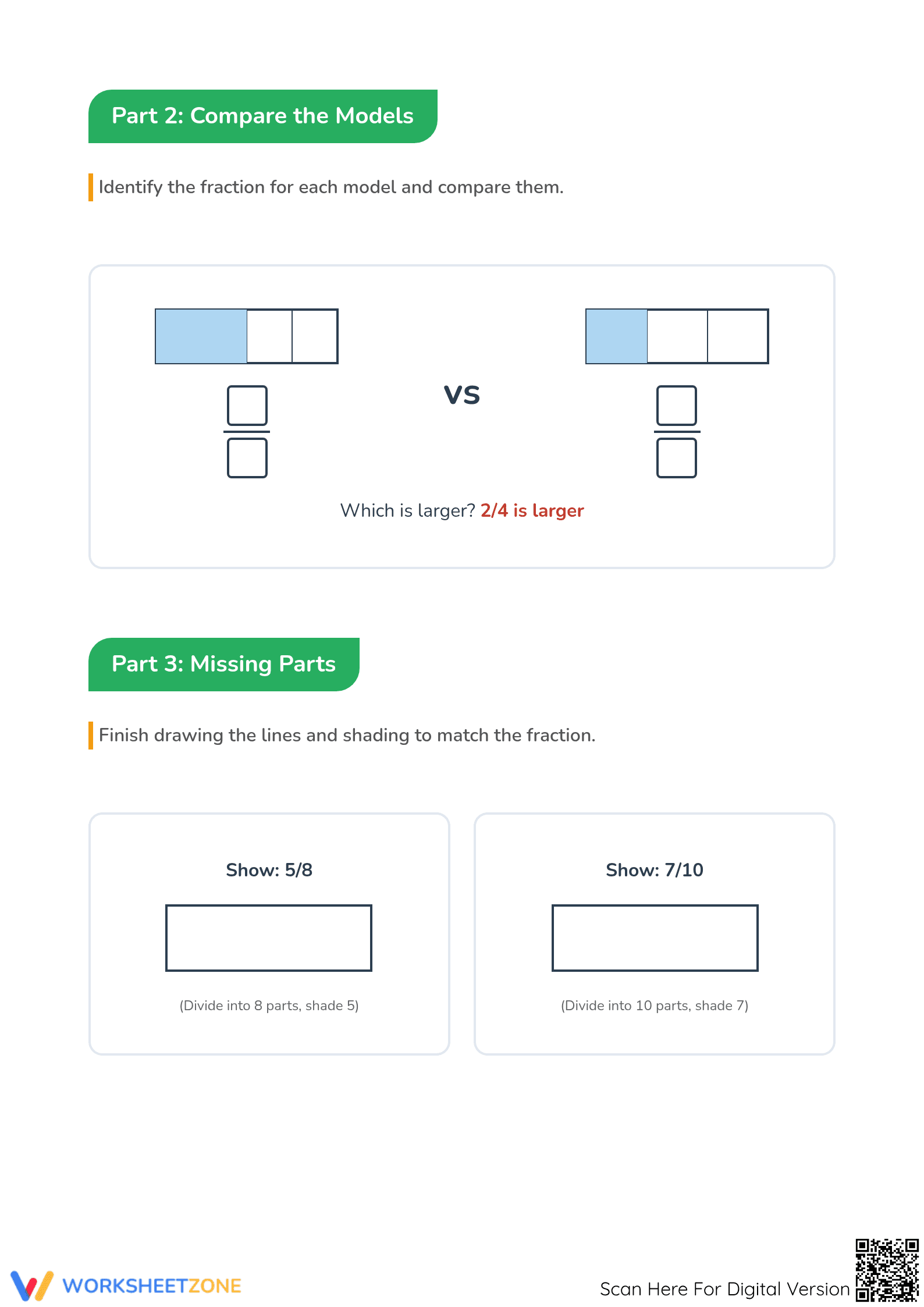
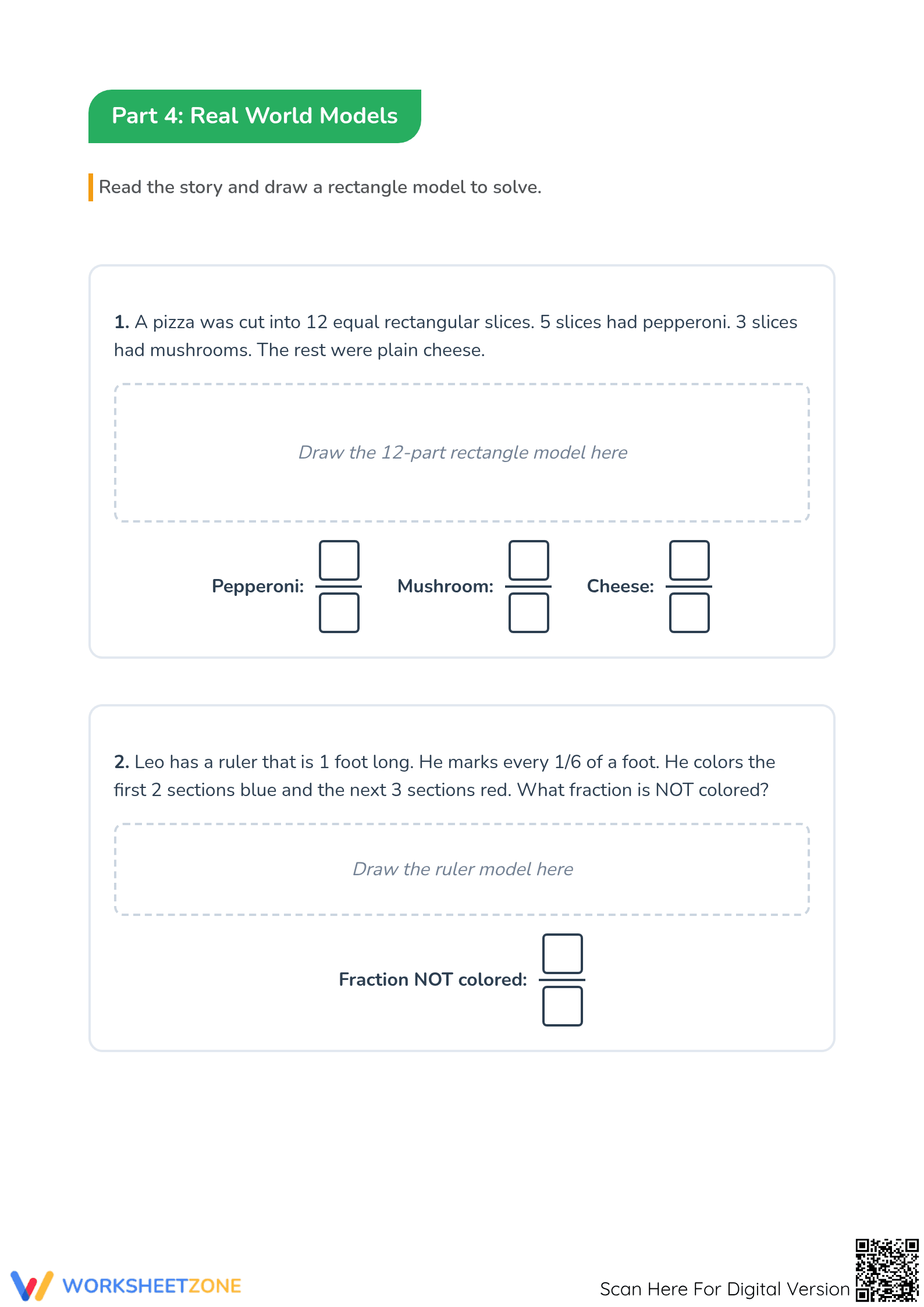
This 3-page printable PDF is divided into four progression steps. Part 1 features multiple-choice identification. Part 2 introduces visual comparison. Part 3 requires partitioning and shading blank rectangles for fractions like 5/8 and 7/10. Finally, Part 4 challenges learners with real-world word problems about sharing pizza or measuring a ruler. These tasks bridge the gap between abstract numbers and tangible scenarios. A full answer key is included for rapid grading.
Zero-Prep Workflow
- Print (1 Minute): Select your pages and hit print; the high-contrast design ensures clear lines even on school-grade copiers.
- Distribute (30 Seconds): Hand out sheets for a morning warm-up, independent practice, or a reliable sub plan.
- Review (30 Seconds): Use the included answer key to check for partitioning errors or shading mistakes in less than two minutes per class set. Total prep time is kept under two minutes.
Standards Alignment
The primary focus is `CCSS.MATH.CONTENT.3.NF.A.1`, requiring students to understand fractions as parts of a partitioned whole. It also supports `CCSS.MATH.CONTENT.3.NF.A.3` by asking students to compare fractional models. Both standard codes can be copied directly into lesson plans, IEP goals, or district curriculum mapping tools to ensure strict adherence to state and national frameworks.
How to Use It
Use this worksheet as a mid-unit formative assessment to gauge comfort with non-unit fractions. During independent practice, circulate and observe students completing Part 3; look for those who struggle to create equal-sized partitions, as this indicates a need for targeted intervention with physical manipulatives. Most Grade 3 students will complete all sections within 20 to 30 minutes, making it an efficient check for understanding after direct instruction.
Who It's For
This resource is designed for third-grade classrooms but serves as a remedial tool for fourth-grade students needing a visual refresher. It is an ideal pairing for lessons using fraction tiles or follow-up to fraction-themed read-alouds. The scaffolded structure supports English Language Learners by providing clear visual cues for every mathematical task, ensuring all students can access the core curriculum content regardless of language proficiency.
Fisher & Frey (2014) emphasize that the gradual release of responsibility is essential for mathematical literacy, a principle directly reflected in this `CCSS.MATH.CONTENT.3.NF.A.1` resource. By beginning with recognition and concluding with word problems, the worksheet provides cognitive scaffolding toward independent proficiency. Research indicates that using area models, such as the rectangles featured here, improves a child's ability to internalize the relationship between the numerator and denominator. This 7-task set provides the repetition needed to build fluency without causing cognitive overload, making it a staple for any Grade 3 fractions unit. Teachers can rely on this standard-aligned tool to provide evidence of learning extractable for progress monitoring. The inclusion of real-world contexts ensures that mathematical concepts remain grounded in practical application, fostering higher-order thinking skills. This approach confirms that student outcomes are aligned with the rigorous demands of modern educational standards.


