


























Views
Downloads

Modeling Fractions (Fourths) — Grade 3 Essential Worksheet
Paste this activity's link or code into your existing LMS (Google Classroom, Canvas, Teams, Schoology, Moodle, etc.).
Students can open and work on the activity right away, with no student login required.
You'll still be able to track student progress and results from your teacher account.
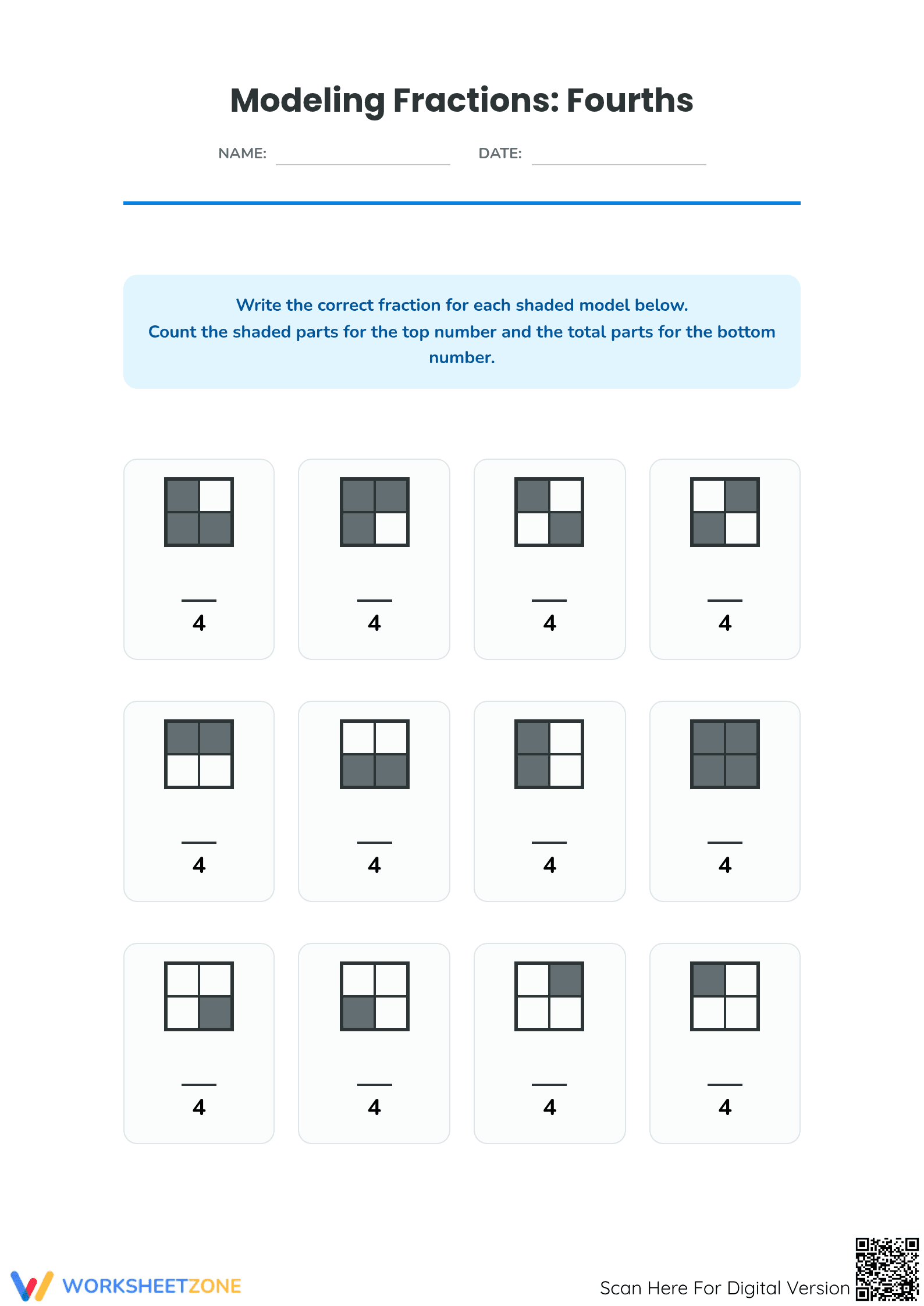
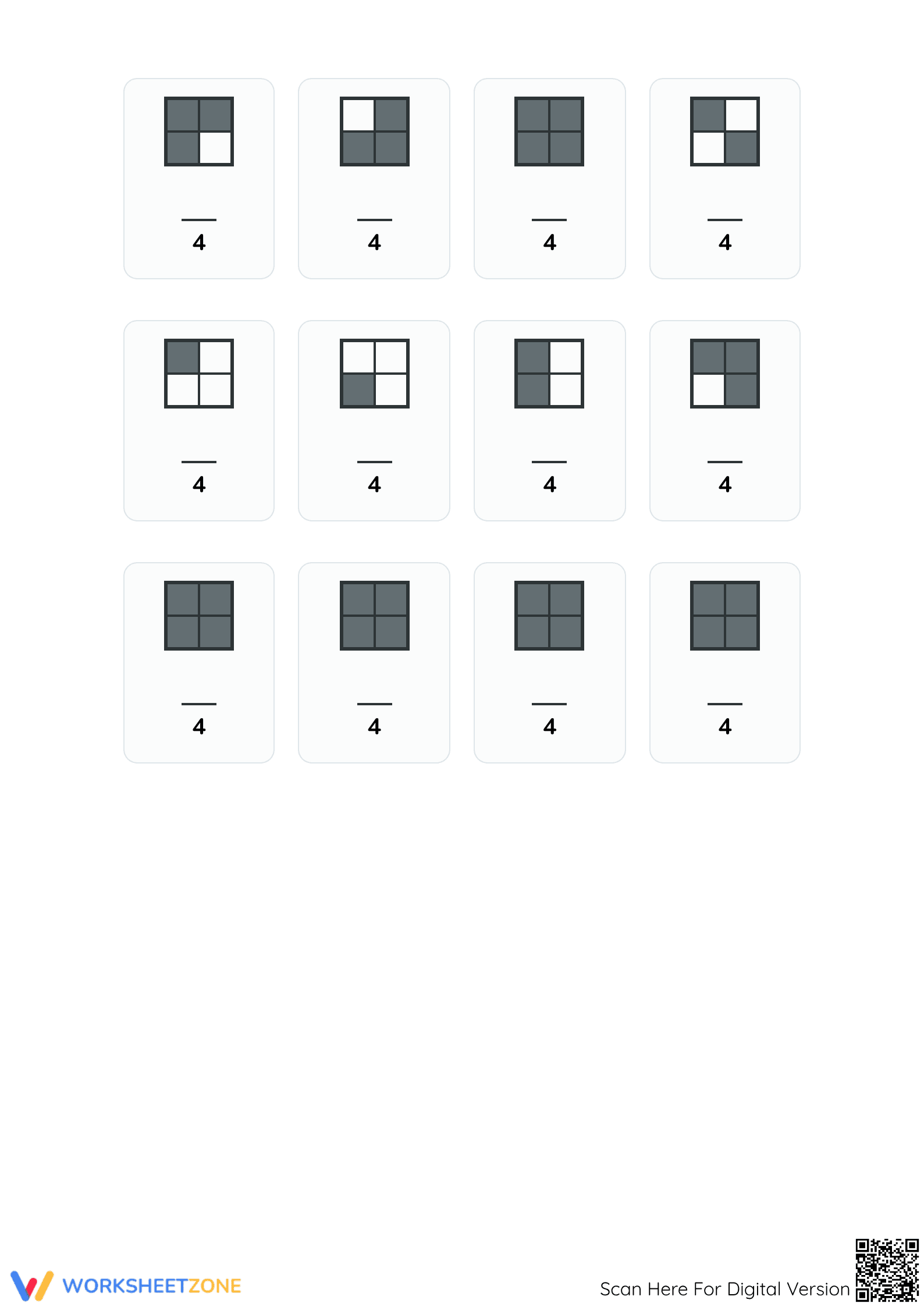
This worksheet helps Grade 3 students master the concept of fourths by identifying shaded parts of a rectangular whole. By visually counting shaded segments and relating them to a denominator of four, learners build a concrete foundation for understanding fractions as area models. This exercise transitions students from basic counting to fractional reasoning.
At a Glance
- Grade: 3 · Subject: Math
- Standard:
CCSS.MATH.CONTENT.3.NF.A.1— Understand a fraction as a part of a whole partitioned into equal parts- Skill Focus: Modeling fractions (fourths) with rectangles
- Format: 2 pages · 24 problems · Answer key included · PDF
- Best For: Independent practice or quick formative assessment
- Time: 15–20 minutes
Inside this resource, you will find 24 distinct rectangle models spread across two pages. Each model is a 2x2 grid representing a whole divided into four equal parts. Students must count the shaded portions and write the numerator over the pre-printed denominator of 4. The consistent layout helps students focus on the quantity being represented without being distracted by changing whole shapes.
This classroom-ready resource follows a zero-prep workflow to save teacher time. First, print the two-page document in seconds. Next, distribute the sheets to students as a warm-up or independent practice task. Finally, use the provided answer key to review results or facilitate student self-correction. The total prep time is under 3 minutes, making it an ideal choice for busy mornings or unexpected sub plans.
The content is strictly aligned to `CCSS.MATH.CONTENT.3.NF.A.1`, which requires students to understand a fraction a/b as the quantity formed by 'a' parts of size 1/b. This worksheet specifically targets the partitioning of a rectangular whole into 4 equal segments. Both standard codes can be copied directly into lesson plans, IEP goals, or district curriculum mapping tools for accurate tracking.
For best results, use this activity as a "do-now" during the first week of your fractions unit to gauge prior knowledge. It also serves as an effective exit ticket to verify students can differentiate between shaded and unshaded parts of a whole. Observe students to see if they count unshaded parts as the numerator, which identifies a need for immediate intervention. Completion typically takes 15-20 minutes.
This worksheet is designed for Grade 3 general education classrooms but is also highly effective for Grade 4 remediation or Special Education students working on basic partitioning skills. It pairs naturally with physical color tiles or fraction bars to provide a hands-on extension for tactile learners. The repetitive nature ensures that the concept of "fourths" becomes second nature before moving to irregular shapes.
Research by Fisher & Frey (2014) emphasizes that visual modeling is a critical bridge between concrete and abstract mathematical thinking. By using rectangular area models, this worksheet adheres to the gradual release of responsibility model, providing a stable denominator (4) to allow students to focus entirely on numerator identification. This approach aligns with EdReports 2024 findings on the importance of high-quality, focused practice in foundational elementary math. Students who master these partitioning concepts early are significantly more likely to succeed with complex fraction operations in later grades. The `CCSS.MATH.CONTENT.3.NF.A.1` alignment ensures that the task meets the cognitive demands of the third-grade standards, focusing on the core concept that a fraction represents the count of equal-sized parts. This resource provides the necessary repetition to move from simple recognition to conceptual fluency in fraction modeling. By anchoring students in a consistent geometric shape, we reduce extraneous cognitive load during initial skill acquisition phases.


