


























Views
Downloads



Essential Grade 3 Fractions Worksheet | Modeling Fourths
Paste this activity's link or code into your existing LMS (Google Classroom, Canvas, Teams, Schoology, Moodle, etc.).
Students can open and work on the activity right away, with no student login required.
You'll still be able to track student progress and results from your teacher account.
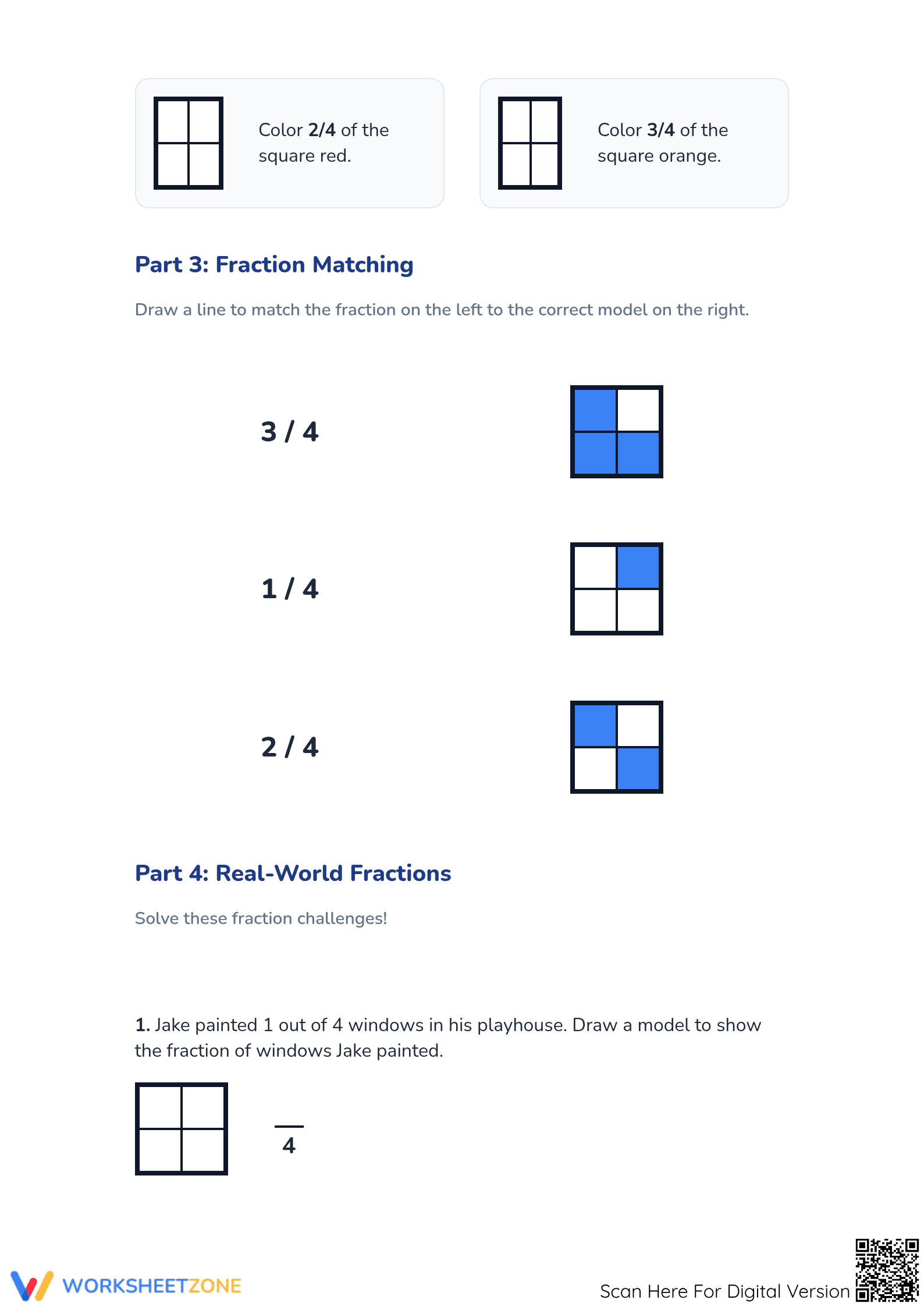
This Grade 3 math worksheet provides essential practice in modeling fourths using rectangular area models. Students develop a concrete understanding of fractions as parts of a whole by identifying shaded regions, shading their own models, and solving real-world word problems. This resource ensures mastery of foundational fractional concepts through varied, scaffolded exercises.
At a Glance
- Grade: 3 · Subject: Math
- Standard:
3.NF.A.1— Understand a fraction as the quantity formed by parts of a whole- Skill Focus: Modeling fractions (fourths) using area models
- Format: 4 pages · 25 problems · Answer key included · PDF
- Best For: Introduction to fractions and guided practice
- Time: 25–35 minutes
This comprehensive 4-page PDF resource includes a series of structured activities designed to build conceptual clarity. The worksheet features 16 identification tasks using colorful square grids, 4 creative shading exercises, 3 matching problems, and 2 contextual word problems. A full answer key is provided to facilitate quick grading or student self-correction during independent work time.
The worksheet follows a clear instructional path to support student growth:
- Guided Practice: 16 visual identification tasks require students to observe pre-shaded area models and write the corresponding fraction, focusing exclusively on fourths to build pattern recognition.
- Supported Practice: 4 shading and 3 matching tasks challenge students to represent fractions manually and connect symbolic notation to visual representations.
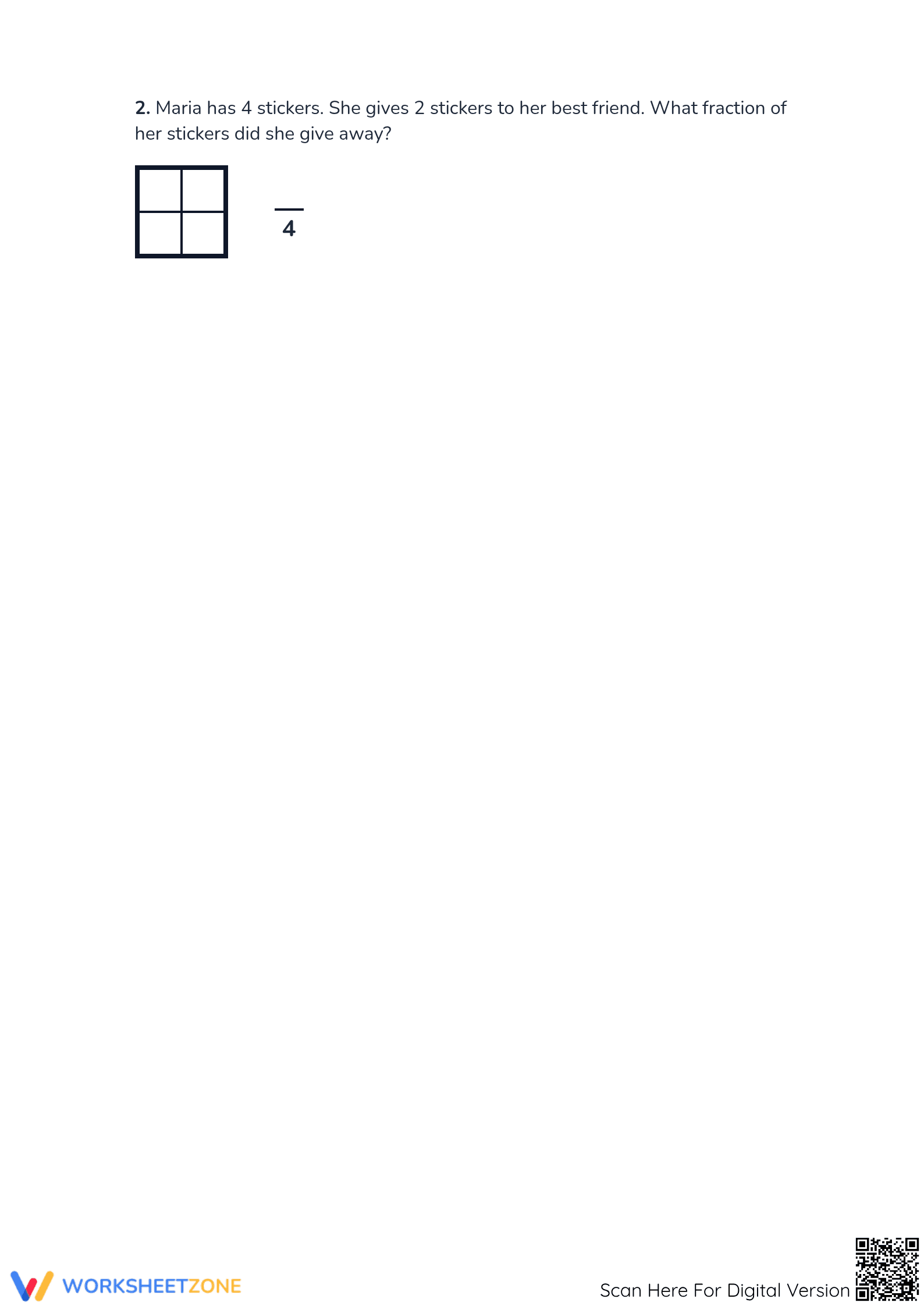
- Independent Practice: 2 real-world word problems require students to apply their knowledge to solve practical scenarios, such as painting windows or sharing stickers.
This approach utilizes the gradual-release model to transition students from basic recognition to higher-order application.
This resource is strictly aligned to `3.NF.A.1`. The standard requires students to understand a fraction 1/b as the quantity formed by 1 part when a whole is partitioned into b equal parts. This worksheet specifically targets the partitioning of wholes into four equal segments. This standard code can be copied directly into lesson plans, IEP goals, or district curriculum mapping tools.
Use this worksheet during the initial phase of your fractions unit. It is an excellent follow-up to a direct instruction lesson involving manipulatives like fraction tiles. Alternatively, assign individual pages as formative-assessment checks. Observe whether students correctly count all parts of the whole to determine the denominator versus the shaded parts for the numerator. Completion usually takes 30 minutes.
This material is tailored for third-grade students beginning their journey with rational numbers. It provides necessary scaffolding for English Language Learners and students with IEPs through clear visual cues. Pair this worksheet with an anchor chart displaying "numerator" and "denominator" definitions to reinforce academic vocabulary during the session.
According to the EdReports 2024 analysis of elementary mathematics curricula, the use of consistent area models is a critical component in developing a student's early fractional number sense. This Grade 3 worksheet aligns with these findings by utilizing 3.NF.A.1 to bridge the gap between concrete visual representations and abstract symbolic notation. By focusing on modeling fourths, students practice identifying 1 part of a whole partitioned into b equal segments, which is the foundational requirement for understanding more complex rational number operations. The inclusion of 25 varied tasks, including shading and word problems, supports the research-backed transition from procedural fluency to conceptual understanding. Research from Fisher & Frey (2014) highlights that such scaffolded visual tools are essential for the gradual-release of responsibility in mathematics. This resource serves as a reliable instrument for both classroom instruction and targeted intervention, providing the repetition needed for long-term retention of fractional concepts.


