


























Views
Downloads


Modeling Fourths Worksheet | Essential Grade 3 Math
Paste this activity's link or code into your existing LMS (Google Classroom, Canvas, Teams, Schoology, Moodle, etc.).
Students can open and work on the activity right away, with no student login required.
You'll still be able to track student progress and results from your teacher account.
This Grade 3 fractions worksheet helps students master modeling fourths through visual representation and comparison. By working with partitioned rectangles, students bridge the gap between abstract numbers and concrete area models. This printable resource ensures learners can accurately identify, shade, and relate fractions of a whole in multiple instructional contexts.
At a Glance
- Grade: 3 · Subject: Math
- Standard:
CCSS.MATH.CONTENT.3.NF.A.1— Understand fractions as parts of a whole partitioned into equal segments- Skill Focus: Modeling fourths with rectangles
- Format: 2 pages · 15 problems · Answer key included · PDF
- Best For: Independent practice or formative assessment
- Time: 15–25 minutes
What's Inside
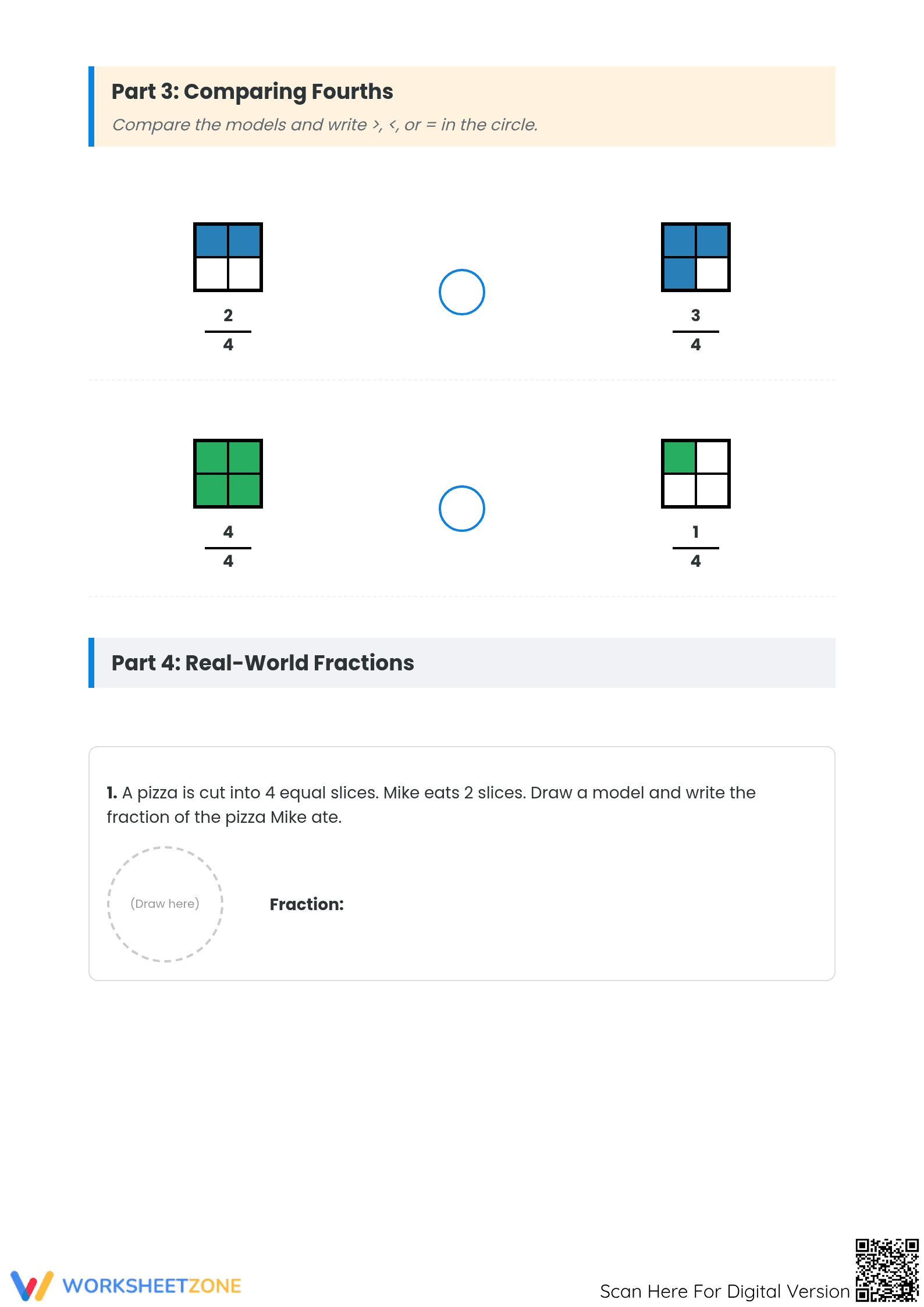
This two-page PDF includes four distinct sections designed to build conceptual depth. Students engage with 8 identification tasks where they write fractions for models, followed by 4 shading exercises that require active construction of unit fractions. The second page introduces 2 comparison challenges and a word problem featuring a pizza scenario to ground the math in daily life. A full answer key is provided for feedback.
Skill Progression
- Guided practice: 8 tasks providing visual models where students identify the numerator to complete the fraction.
- Supported practice: 4 tasks requiring students to shade empty rectangular grids to represent specific fourths.
- Independent practice: Comparison and word problem tasks where students apply knowledge to new contexts.
This sequence follows a gradual-release model, moving from recognition to active construction and logical application.
Standards Alignment
The primary focus is CCSS.MATH.CONTENT.3.NF.A.1, which requires students to "understand a fraction 1/b as the quantity formed by 1 part when a whole is partitioned into b equal parts." By specifically focusing on fourths, this resource also supports CCSS.MATH.CONTENT.3.NF.A.3.D through the comparison of two fractions with the same denominator. Both standard codes can be copied directly into lesson plans, IEP goals, or district curriculum mapping tools.
How to Use It
Deploy this worksheet as a mid-lesson check during your unit on unit fractions. It is effective after direct instruction on partitioning rectangles into equal areas. Teachers should observe students during Part 2 to ensure they are shading distinct segments, which serves as a vital formative-assessment point. Expect completion within 20 minutes as a quiet independent desk activity.
Who It's For
This resource is designed for Grade 3 general education students but serves as an excellent intervention tool for fourth graders who need a refresher on visual models. The clear boundaries of the rectangular grids provide necessary structure for students with dyscalculia or those requiring visual processing support. It pairs naturally with physical fraction tiles or a digital area model demonstration on an interactive whiteboard.
Effective mathematics instruction in the elementary years depends on the transition from concrete manipulatives to representational models before reaching abstract symbolic notation. This worksheet leverages the "Modeling Fourths" approach to satisfy the requirements of CCSS.MATH.CONTENT.3.NF.A.1, ensuring students internalize the relationship between partitioned parts and the whole body. According to research by Fisher & Frey (2014) on the gradual release of responsibility, structured practice that moves from recognition to construction significantly improves long-term retention of fractional concepts. By providing 15 varied tasks, this resource allows students to see fractions as segments of a whole rather than just groups of objects. This conceptual grounding is essential for later success with equivalent fractions and operations. Educators can utilize these visual models to provide the evidentiary support required by modern standards-based reporting systems, ensuring that every learner achieves the necessary proficiency for Grade 3 mathematics mastery.


