


























Views
Downloads

Modeling Fractions with Rectangles — Essential Grade 3 Worksheet
Paste this activity's link or code into your existing LMS (Google Classroom, Canvas, Teams, Schoology, Moodle, etc.).
Students can open and work on the activity right away, with no student login required.
You'll still be able to track student progress and results from your teacher account.
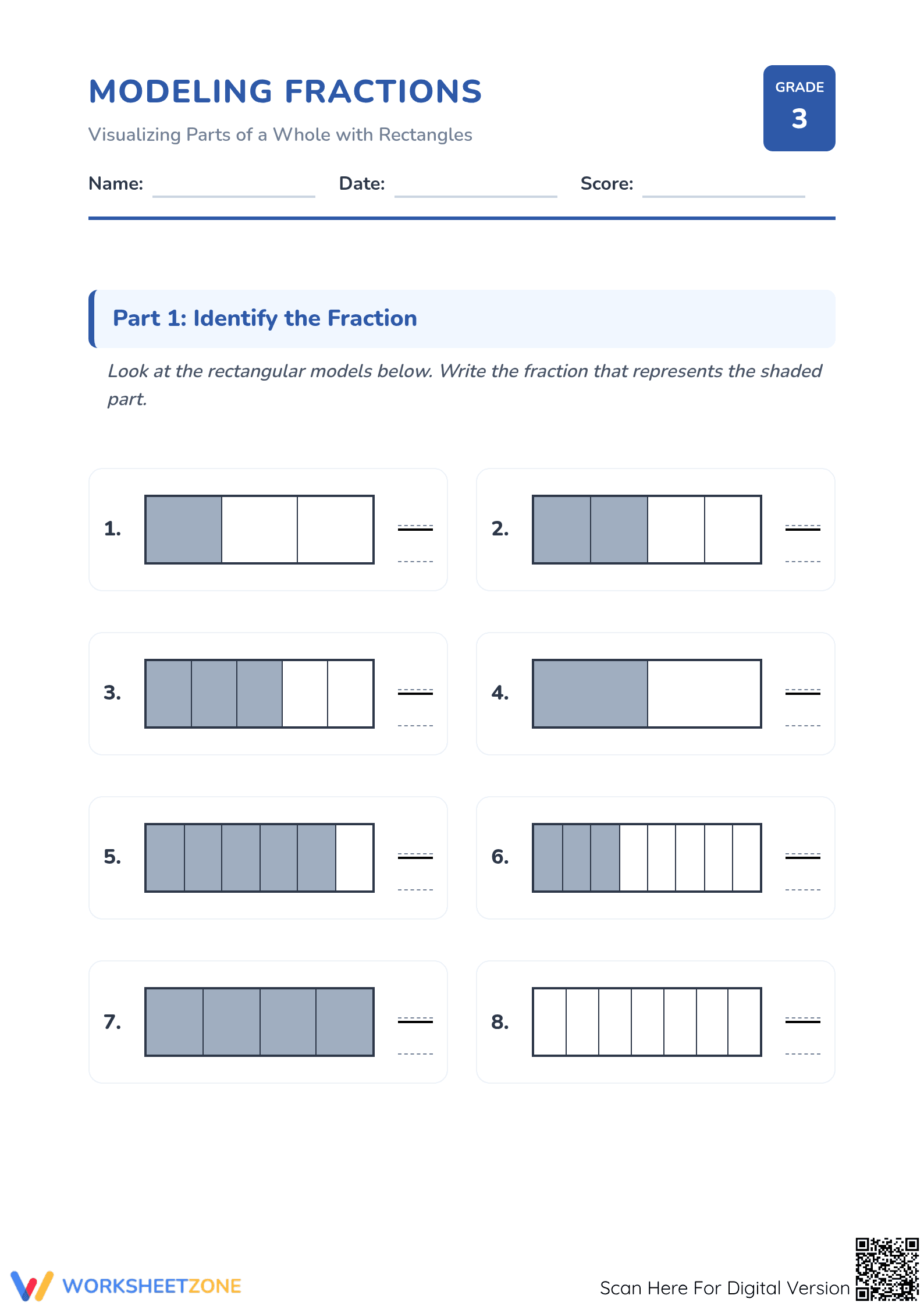
This comprehensive Grade 3 modeling fractions worksheet empowers students to visualize parts of a whole using area models. By working through four distinct sections, learners move from identifying fractions in pre-shaded rectangles to independent shading and solving complex word problems. The resource ensures students recognize that fractions represent specific segments of a whole body.
At a Glance
- Grade: 3 · Subject: Math
- Standard:
CCSS.MATH.CONTENT.3.NF.A.1— Understand a fraction as the quantity formed by parts of a whole- Skill Focus: Rectangular Fraction Models
- Format: 4 pages · 20 problems · Answer key included · PDF
- Best For: Comprehensive fraction introduction or review
- Time: 25–35 minutes
What's Inside
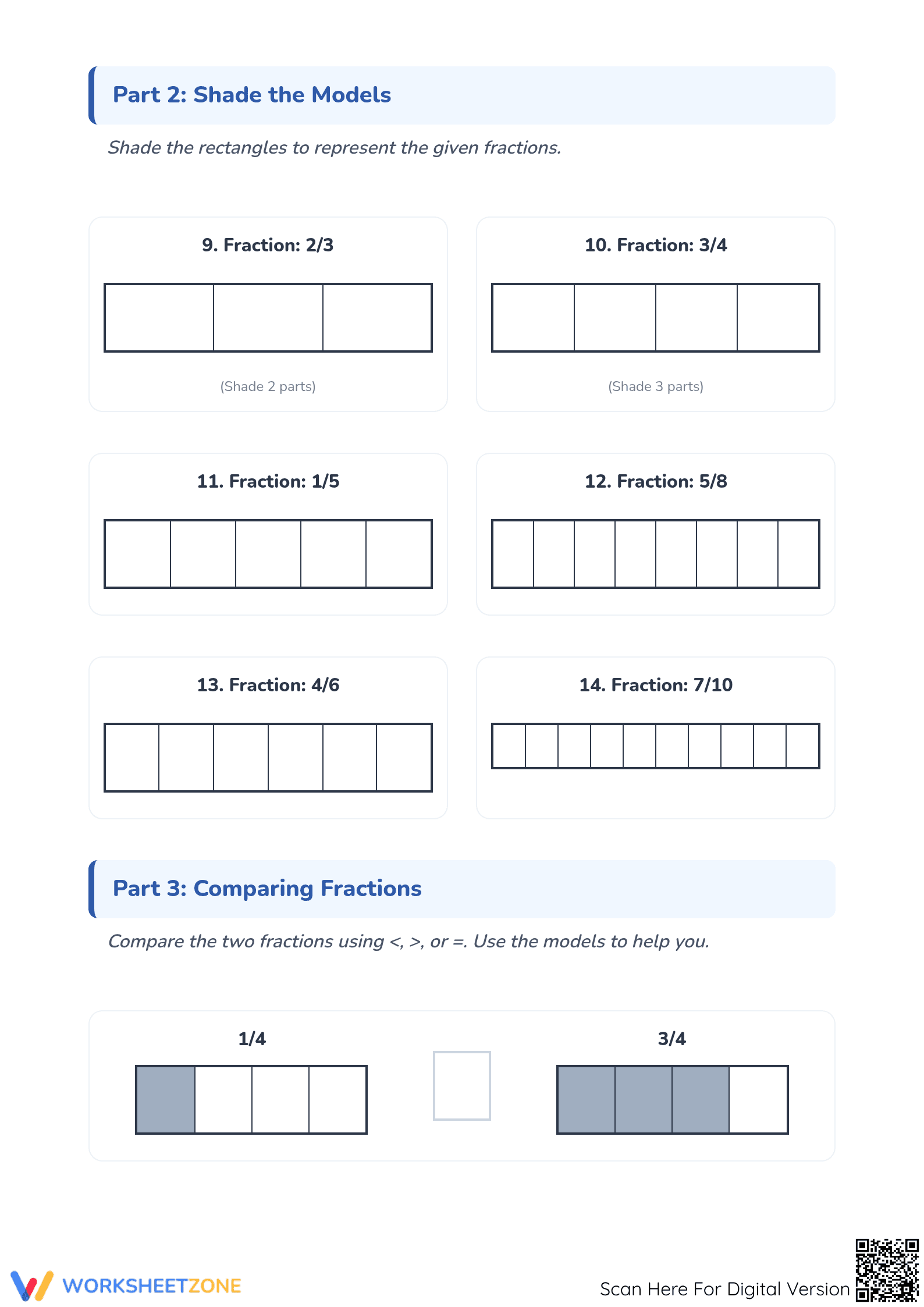
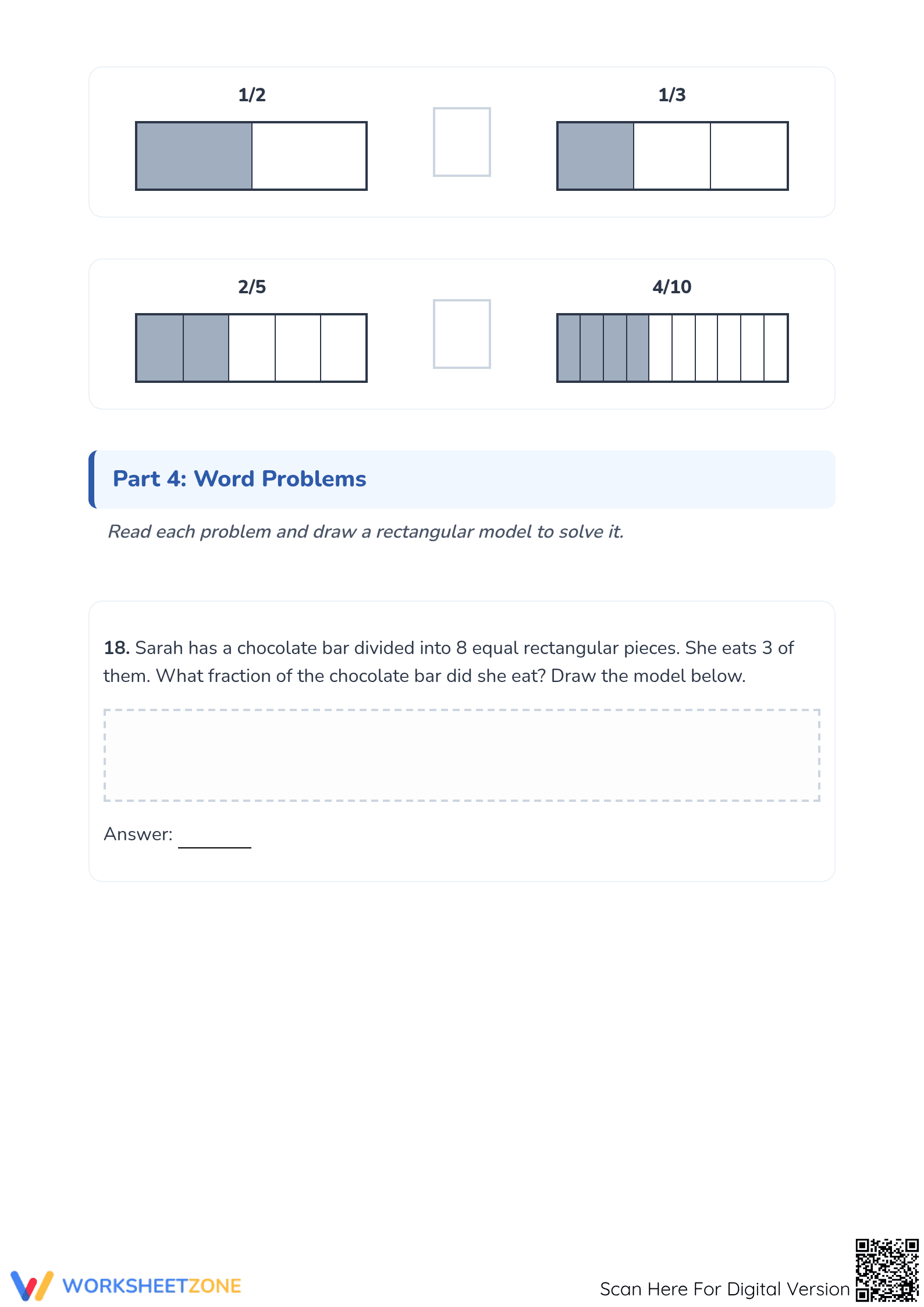
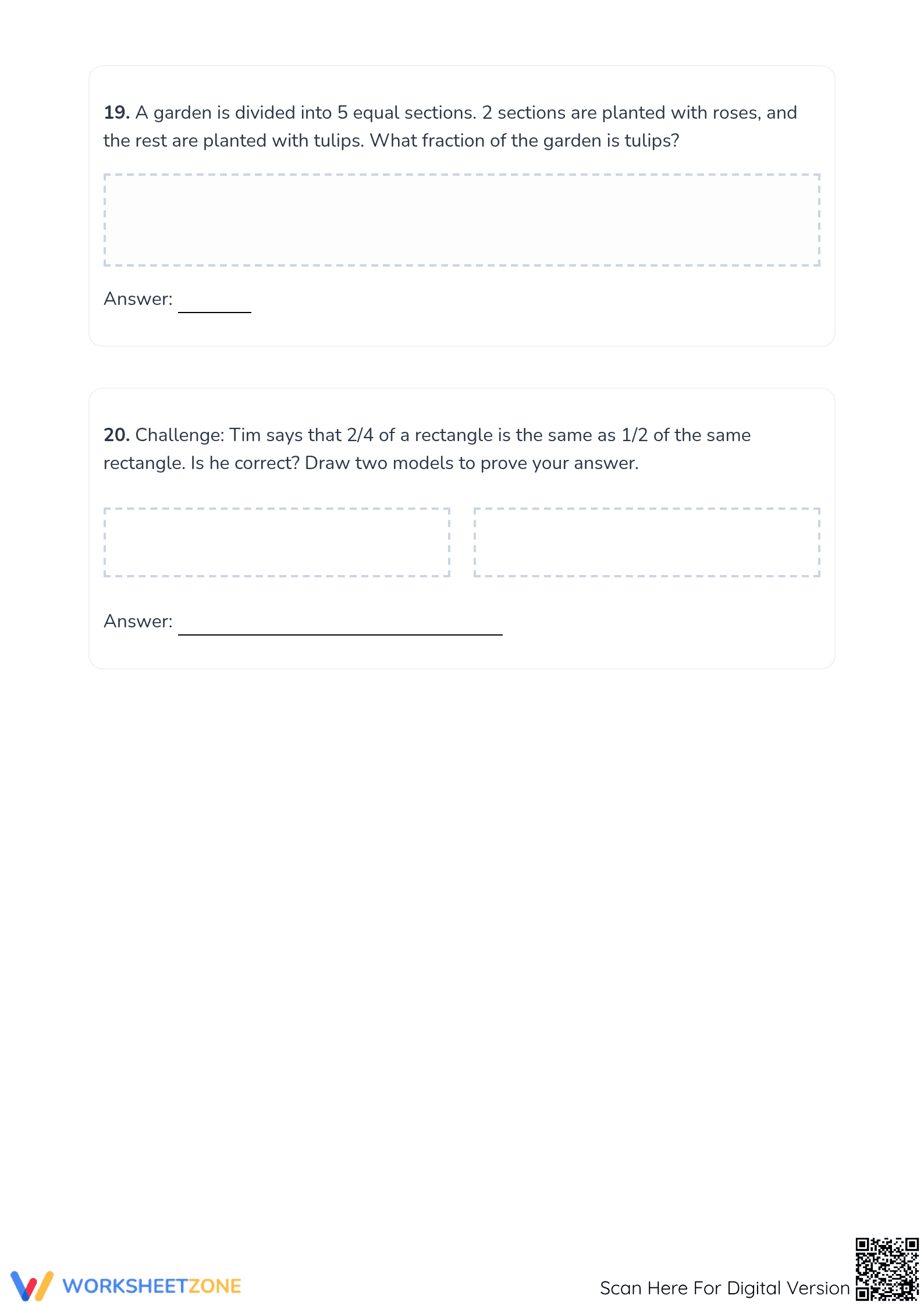
This four-page instructional packet contains twenty diverse problems structured for gradual mastery. Students encounter eight identification tasks, six shading exercises, and three comparison problems that utilize visual supports. The final section includes three word problems, including a high-order challenge question. Each page is designed for clarity, featuring large, clean rectangular models and dedicated workspace.
Zero-Prep Workflow
- Print the four-page PDF for your entire class in under sixty seconds.
- Distribute the packets during your main instructional block; no additional manipulatives are required as the models are built-in.
- Review the included answer key to provide immediate feedback during independent practice or as a summative assessment tool.
Standards Alignment
The primary alignment is `CCSS.MATH.CONTENT.3.NF.A.1`, which requires students to understand a fraction as the quantity formed by parts of a partitioned whole. Students demonstrate this by identifying parts and shading rectangles. Additionally, the worksheet supports `CCSS.MATH.CONTENT.3.NF.A.3.D` through visual comparison tasks. Both standard codes can be copied directly into lesson plans, IEP goals, or district curriculum mapping tools.
How to Use It
Use this resource as a guided practice tool immediately following your initial direct instruction on fraction parts. It serves as an excellent formative assessment to identify students who struggle with equal partitioning before moving to number lines. During the word problem phase, observe if students can translate text into visual segments. Expect a completion time of thirty minutes for the full packet.
Who It's For
This worksheet is ideal for third-grade students beginning their fraction journey or fourth graders needing visual remediation. The structured rectangular models provide necessary scaffolding for students who struggle with abstract numerical concepts. It pairs naturally with fraction tiles or a digital area model demonstration. Differentiation is built into the progression, culminating in a challenge problem for advanced learners.
According to the RAND AIRS 2024 report on elementary mathematics, the use of area models like rectangles is foundational for developing a robust understanding of rational numbers. This worksheet facilitates that development by anchoring abstract fraction notation in concrete visual representations. Students who practice identifying and shading CCSS.MATH.CONTENT.3.NF.A.1 concepts through area models demonstrate significantly higher retention when transitioning to fraction equivalence and comparison. The research emphasizes that early exposure to diverse partitioning—moving from simple halves to complex eighths and tenths—prevents the common misconception that fractions are only about sorted groups. By integrating word problems that require students to generate their own models, this resource aligns with best practices for cognitive load management and conceptual depth. Educators can confidently utilize this structured progression to ensure that students meet Grade 3 benchmarks for visual fraction representation and foundational algebraic thinking.


