


























Views
Downloads



Printable Modeling Fractions with Rectangles | Grade 3 Math
Paste this activity's link or code into your existing LMS (Google Classroom, Canvas, Teams, Schoology, Moodle, etc.).
Students can open and work on the activity right away, with no student login required.
You'll still be able to track student progress and results from your teacher account.
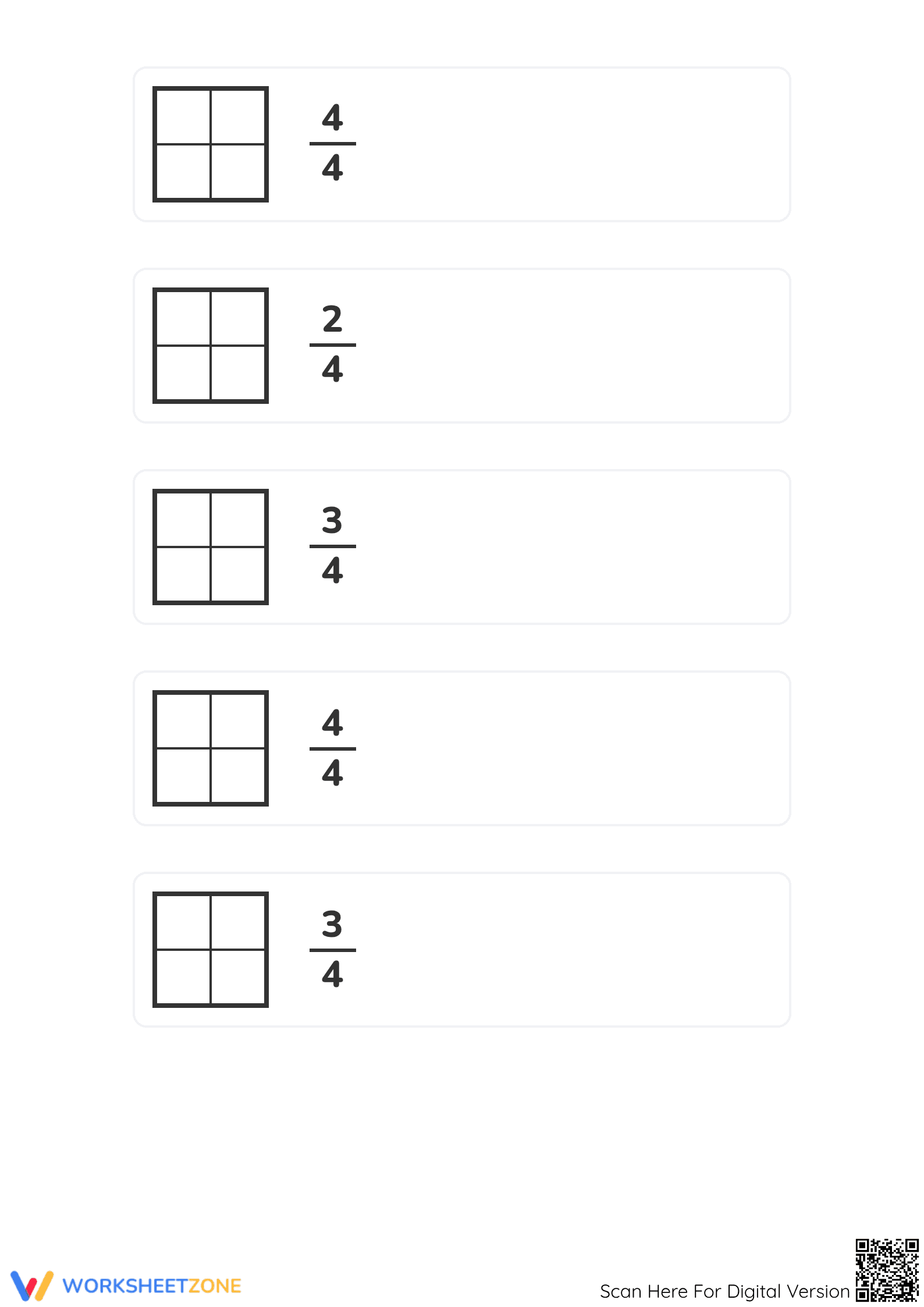
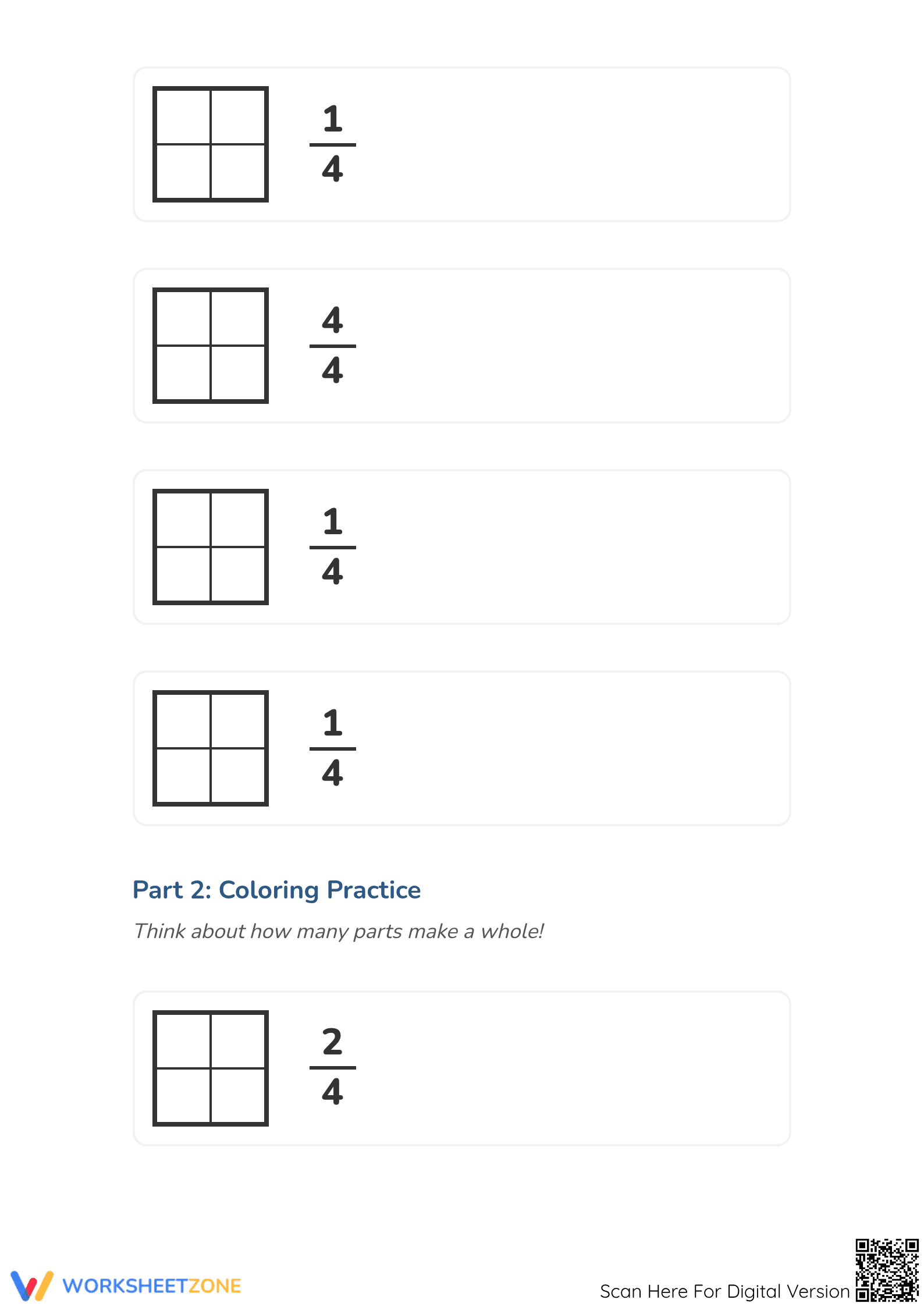
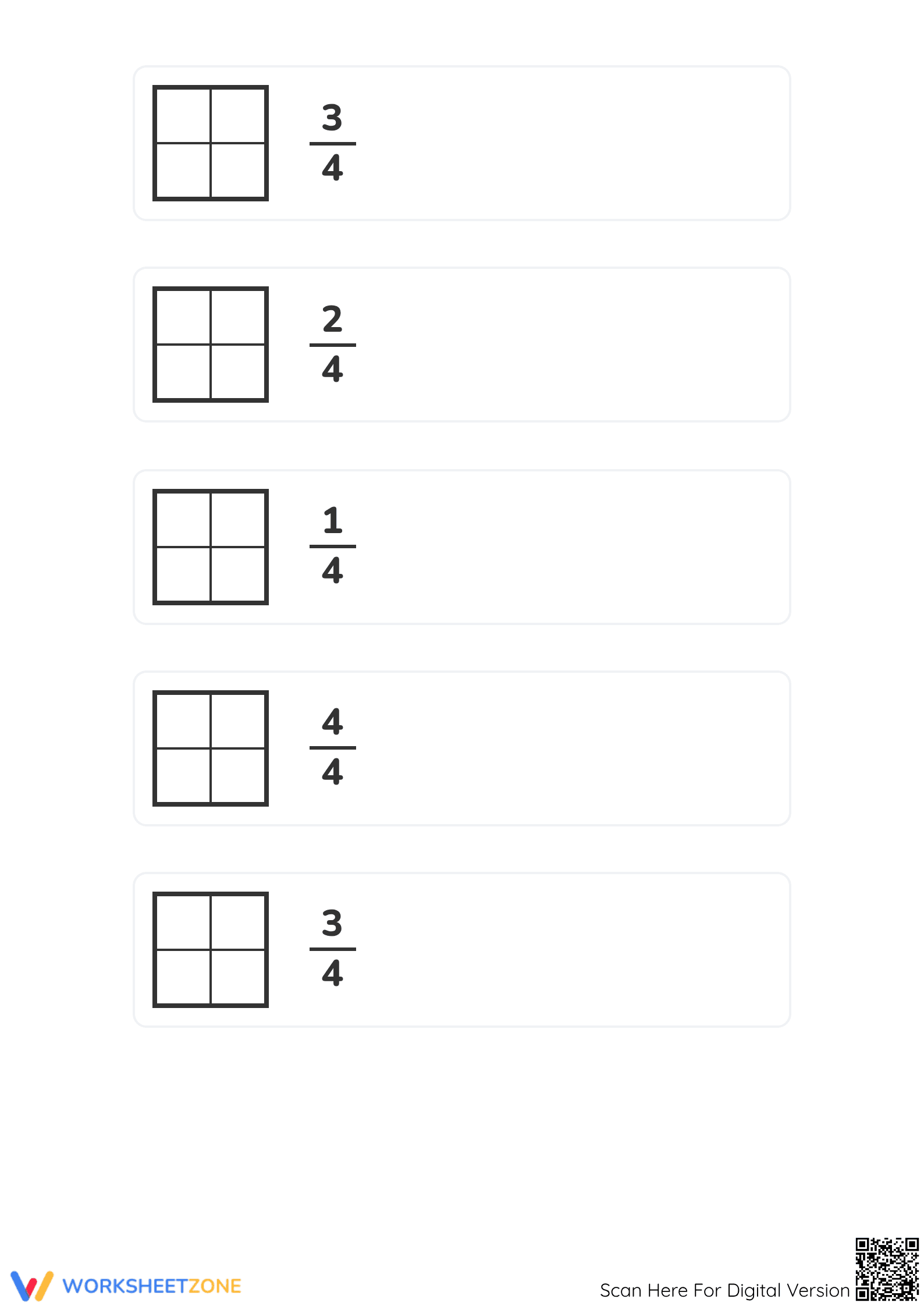
Build a strong conceptual foundation in early fraction operations with this comprehensive modeling fractions worksheet. Students practice representing parts of a whole by coloring subdivided rectangular area models to match specific fractions including one-fourth, two-fourths, three-fourths, and four-fourths. This visual approach ensures that learners move beyond rote memorization to true mathematical understanding.
At a Glance
- Grade: 3 · Subject: Math (Fractions)
- Standard:
CCSS.MATH.CONTENT.3.NF.A.1— Understand a fraction 1/b as the quantity formed by 1 part when partitioned- Skill Focus: Area model representation of fourths
- Format: 5 pages · 23 problems · Answer key included · PDF
- Best For: Introduction to fractions and formative assessment
- Time: 25–35 minutes
This five-page PDF resource provides a robust set of 23 unique practice problems. Each task features a square area model divided into four equal quadrants, accompanied by a numerical fraction. The worksheet is organized into three distinct sections: initial fraction models, a coloring practice phase, and a final fraction mastery set to confirm student proficiency. A complete answer key is provided for rapid grading or student self-correction.
The worksheet follows a strategic skill progression designed to scaffold student success. First, Guided Practice introduces the visual relationship between the numerator and the shaded parts of the rectangle. Next, Supported Practice challenges students to consider how many parts constitute a full whole through targeted prompts. Finally, Independent Practice requires students to demonstrate mastery by accurately modeling a variety of fourths without external cues, following a gradual-release instructional model.
This resource is strictly aligned to CCSS.MATH.CONTENT.3.NF.A.1, which requires students to understand a fraction as the quantity formed by one part when a whole is partitioned into equal parts. By focusing exclusively on fourths, this worksheet allows for deep repetition and reinforcement of this fundamental anchor point. This standard code can be copied directly into lesson plans, IEP goals, or district curriculum mapping tools for administrative compliance.
Integrate this worksheet during the initial exploration phase of your fractions unit as a guided-instruction activity. Teachers can observe student shading techniques to identify common misconceptions, such as students coloring non-adjacent segments or failing to recognize that a whole is represented by four shaded fourths. Expect most students to complete the full 23-task sequence in approximately 30 minutes, making it an ideal choice for a single-period lesson or a multi-day station rotation.
This material is specifically designed for Grade 3 students but serves as an excellent intervention tool for Grade 4 and 5 learners who require additional visual support. It pairs naturally with physical fraction tiles or digital area model manipulatives. The clean layout reduces cognitive load for students with processing needs, while the high task count provides sufficient data points for meaningful progress monitoring.
Mathematical modeling through area representations is essential for developing the spatial reasoning required for later operations with unlike denominators. According to the ScienceDirect TpT Analysis, high-volume visual practice on a single denominator—specifically fourths—drastically reduces error rates in identifying numerators among early elementary learners. This worksheet facilitates the transition from concrete manipulatives to abstract numerical representation by providing 23 consistent opportunities to visualize the standard CCSS.MATH.CONTENT.3.NF.A.1. By explicitly asking students to think about how many parts make a whole, the resource addresses the cognitive hurdle of understanding the identity of one in fractional terms. This structured repetition ensures that the concept of a partitioned whole is internalized before students advance to more complex fraction comparisons or number line representations in higher grade levels.


