


























Views
Downloads

Modeling Fractions with Rectangles Worksheet | Printable Math
Paste this activity's link or code into your existing LMS (Google Classroom, Canvas, Teams, Schoology, Moodle, etc.).
Students can open and work on the activity right away, with no student login required.
You'll still be able to track student progress and results from your teacher account.
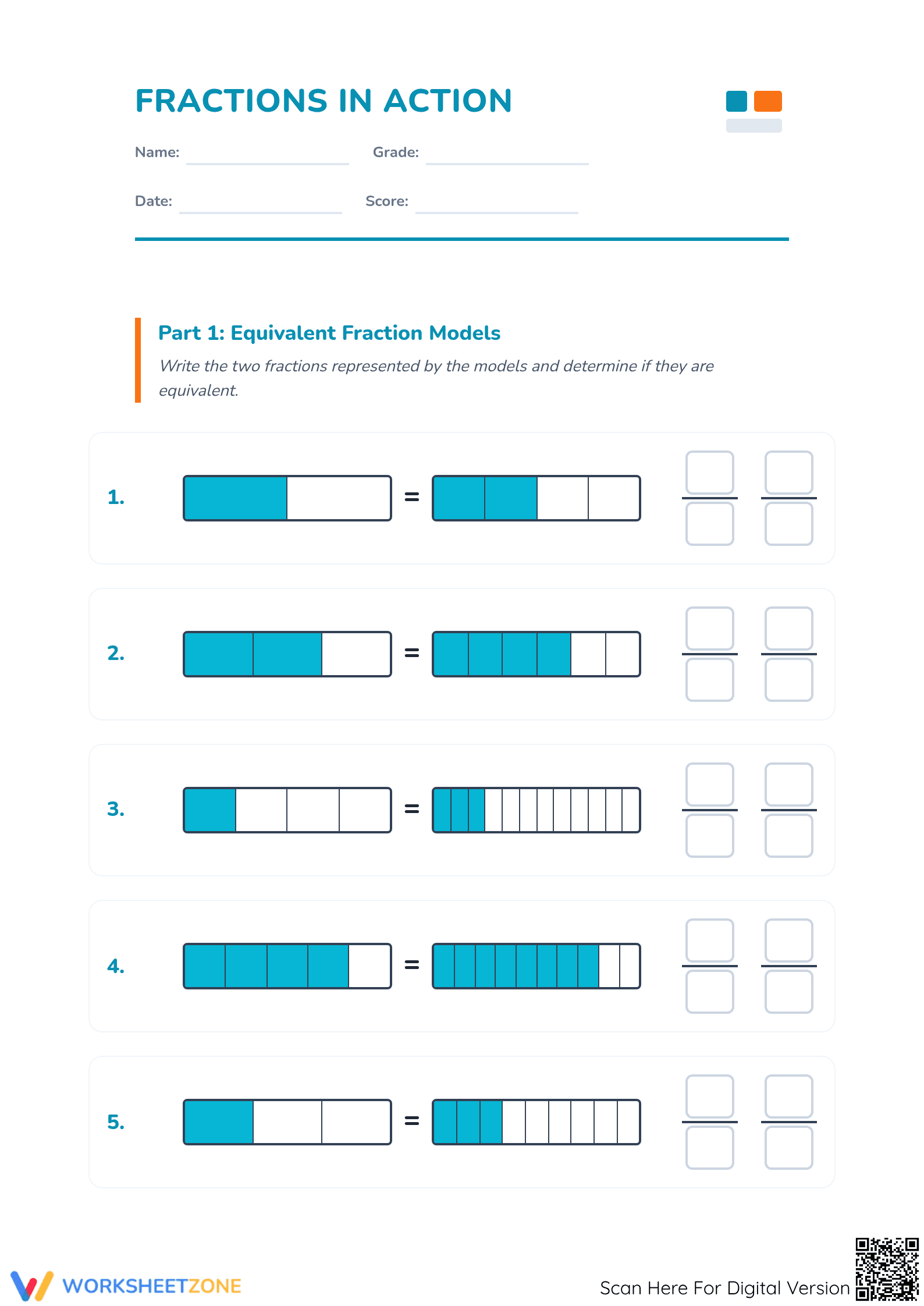
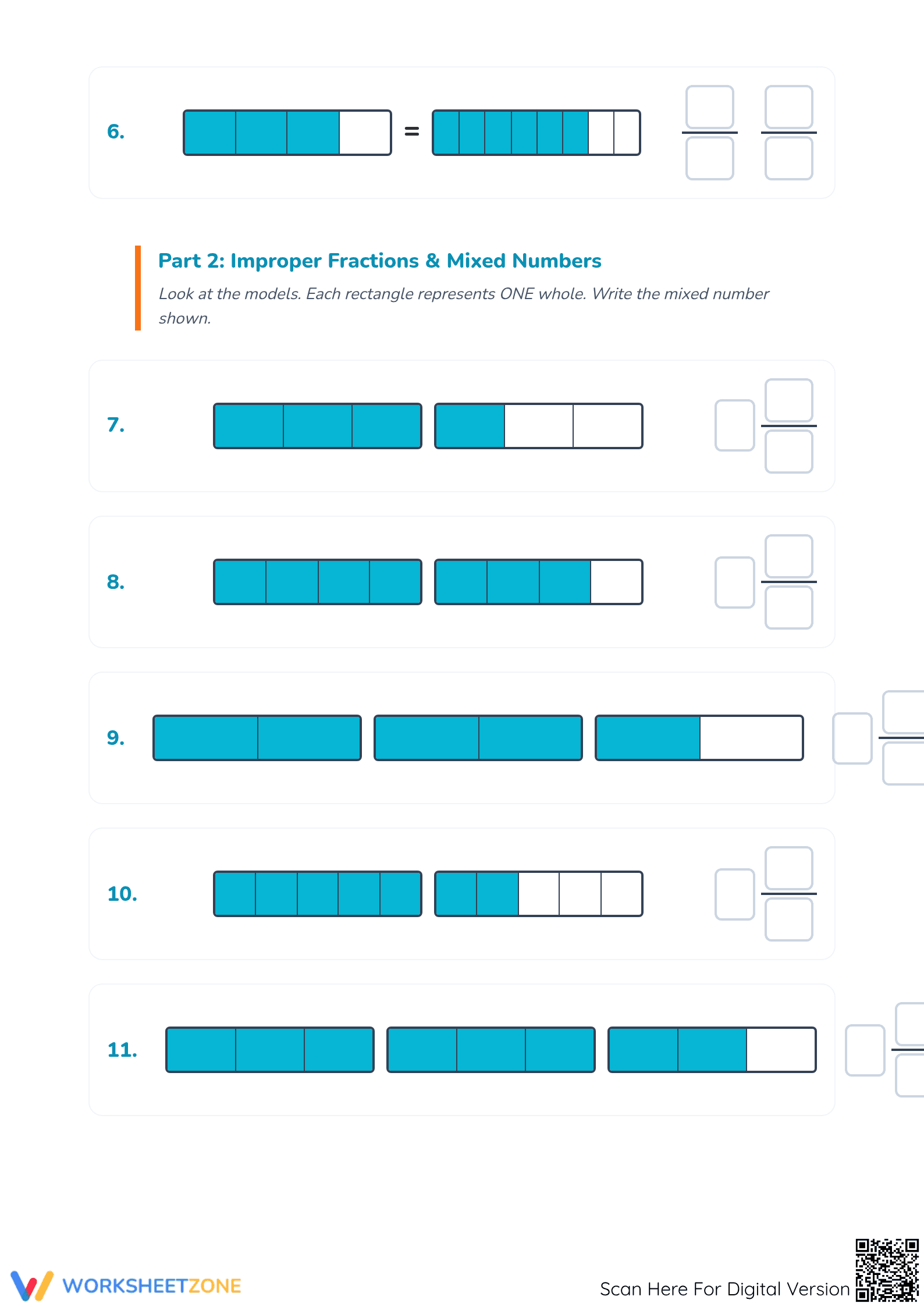
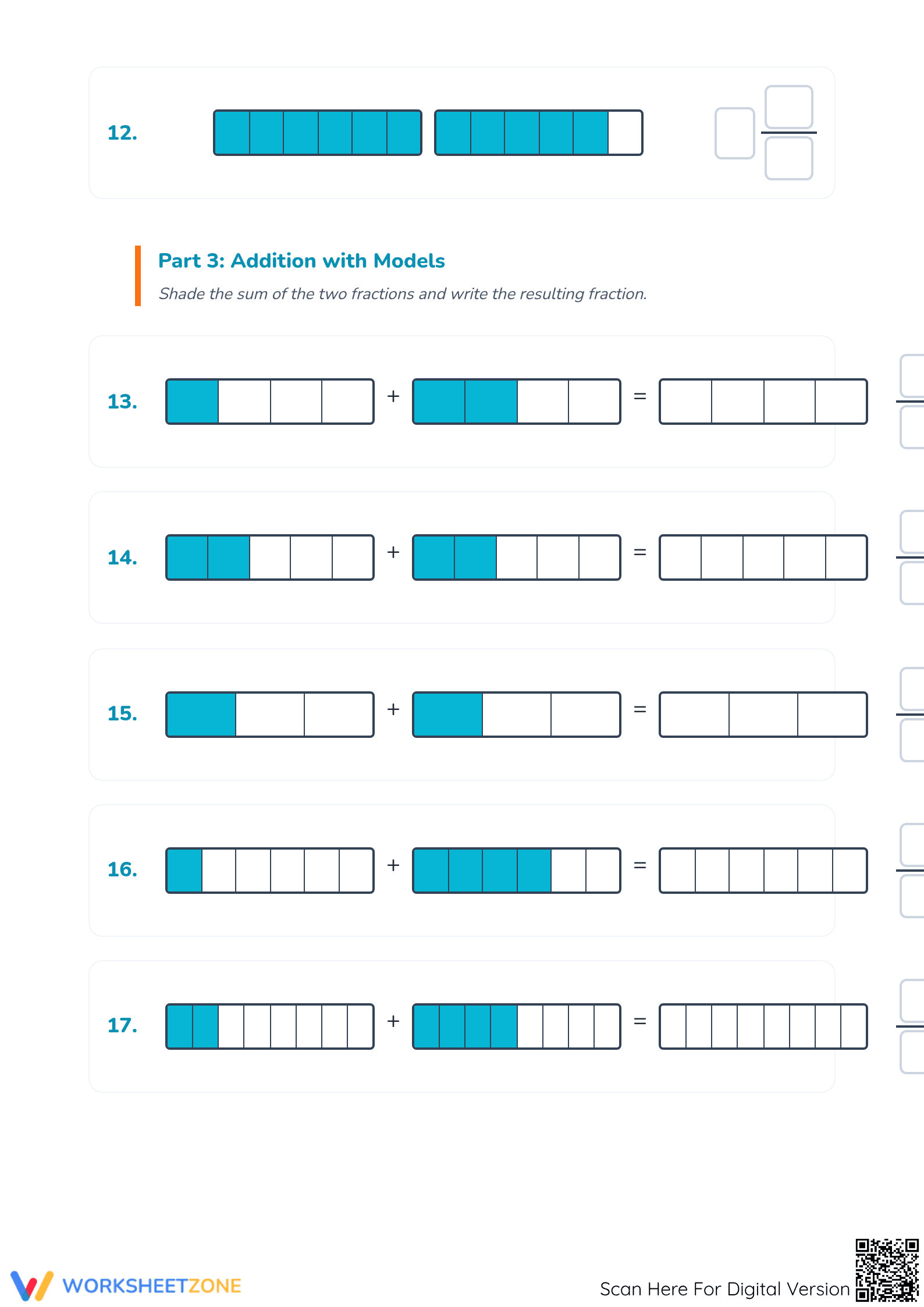
Master the visual representation of numerical values with this comprehensive set. Students translate area models into equivalent fractions, improper values, and sums. By connecting geometric shapes to abstract concepts, this resource ensures learners develop a concrete understanding of how parts relate to the whole through 20 targeted exercises.
At a Glance
- Grade: 4 · Subject: Math
- Standard:
4.NF.A.1— Explain fraction equivalence using visual area models- Skill Focus: Equivalent fractions and mixed numbers
- Format: 4 pages · 20 problems · Answer key included · PDF
- Best For: Individual classroom practice, small group intervention, and formative assessment
- Time: 30–45 minutes
What's Inside
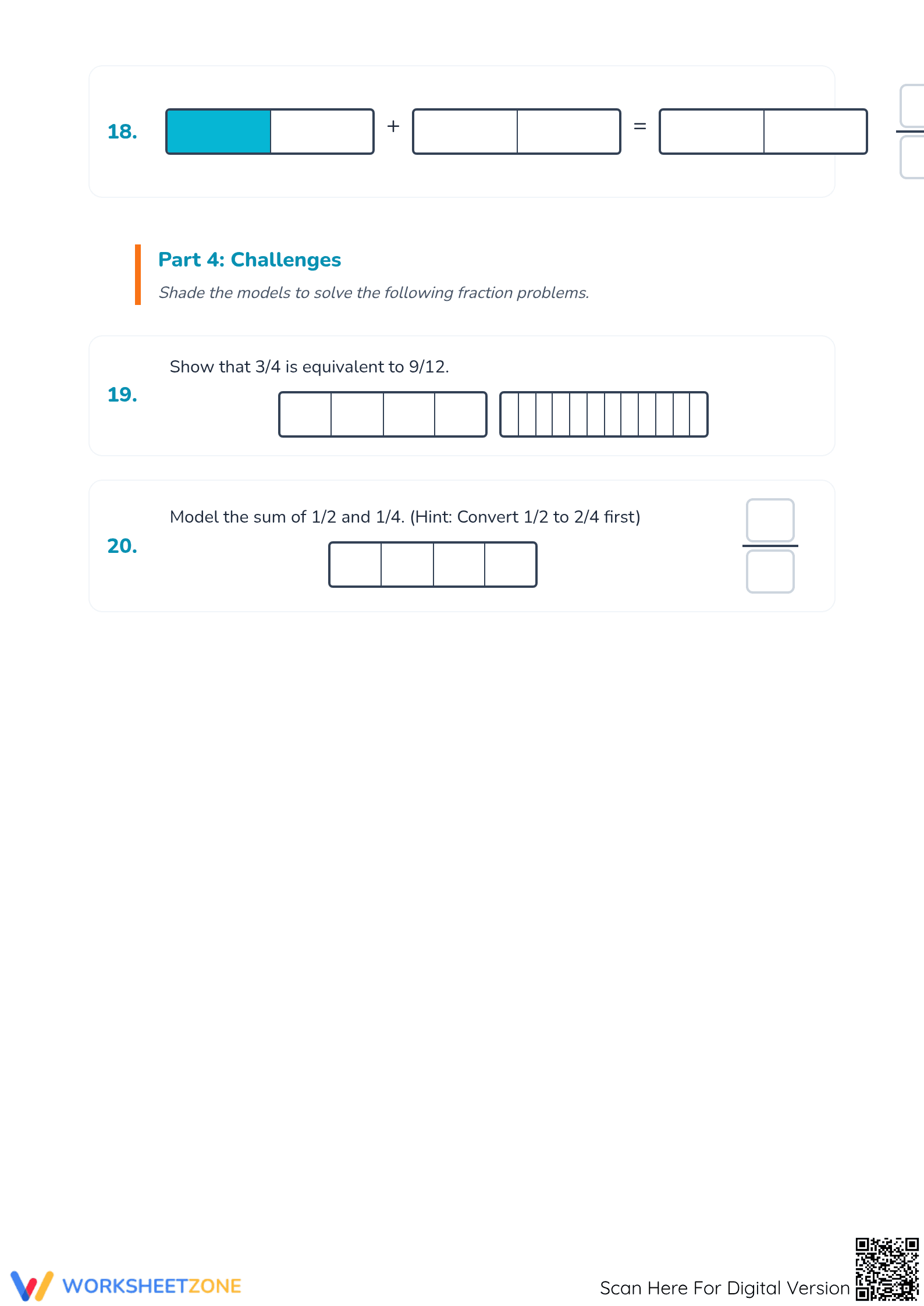
This four-page PDF document provides a logical sequence of exercises starting with visual equivalence. It includes 20 distinct problems divided into four parts: equivalent models, improper fractions, modeling sums, and high-level challenges. The clear layout features large, easy-to-read rectangles that minimize visual clutter for students. A complete answer key is provided for immediate feedback and grading efficiency.
Visual Skill Progression
- Guided Practice: Tasks 1-6 provide pre-divided area models to help students identify simple equivalent pairs like 1/2 and 2/4.
- Supported Practice: Tasks 7-12 introduce mixed numbers and improper fractions, requiring students to count wholes and parts simultaneously.
- Independent Practice: Tasks 13-20 challenge students to shade their own models to solve addition problems and justify complex equivalencies.
This sequence mirrors the gradual-release model of instruction, transitioning from the "I Do" modeling phase to "You Do" independent mastery.
Standards Alignment
Aligned to `CCSS.MATH.CONTENT.4.NF.A.1`, this resource focuses on explaining why a fraction is equivalent to another by using visual fraction models. It also supports 4.NF.B.3.c by addressing the addition of mixed numbers with like denominators. Both standard codes can be copied directly into lesson plans, IEP goals, or district curriculum mapping tools.
How to Use It
Use this as a primary instructional tool during your fractions unit. It works exceptionally well as a formative assessment after introducing area models. Teachers should observe whether students can identify the total number of segments (denominator) versus shaded segments (numerator) in the more complex improper fraction sections. Completion typically takes 30-45 minutes as part of a direct instruction lesson.
Who It's For
This resource is designed for Grade 4 and Grade 5 students, though it serves as an excellent intervention for middle school learners. It pairs perfectly with physical fraction tiles or anchor charts displaying common equivalent sets. The clear visual layout supports English Language Learners and students with IEP accommodations who require concrete representations before moving to abstract algorithms.
Research by Fisher & Frey (2014) emphasizes that visual modeling is a critical bridge between concrete experience and abstract mathematical reasoning. This worksheet applies those principles by requiring students to interact with area models rather than relying on rote memorization of algorithms. By focusing on standard `CCSS.MATH.CONTENT.4.NF.A.1`, the activity ensures students can visually justify fraction equivalence, which is a foundational requirement for all subsequent rational number operations. Evidence from the RAND AIRS 2024 report suggests that structured practice with multiple representations significantly improves long-term retention of fraction concepts compared to test-oriented instruction. This tool provides that necessary structure through 20 problems that transition from basic equivalence to complex mixed-number addition. It serves as a robust resource for educators seeking to align their daily practice with evidence-based instructional strategies that prioritize conceptual depth over procedural speed and ensure students develop the mental frameworks needed for higher-level algebraic success.


