


























Views
Downloads

Modeling Fractions Worksheet | Printable Grade 3 Math
Paste this activity's link or code into your existing LMS (Google Classroom, Canvas, Teams, Schoology, Moodle, etc.).
Students can open and work on the activity right away, with no student login required.
You'll still be able to track student progress and results from your teacher account.
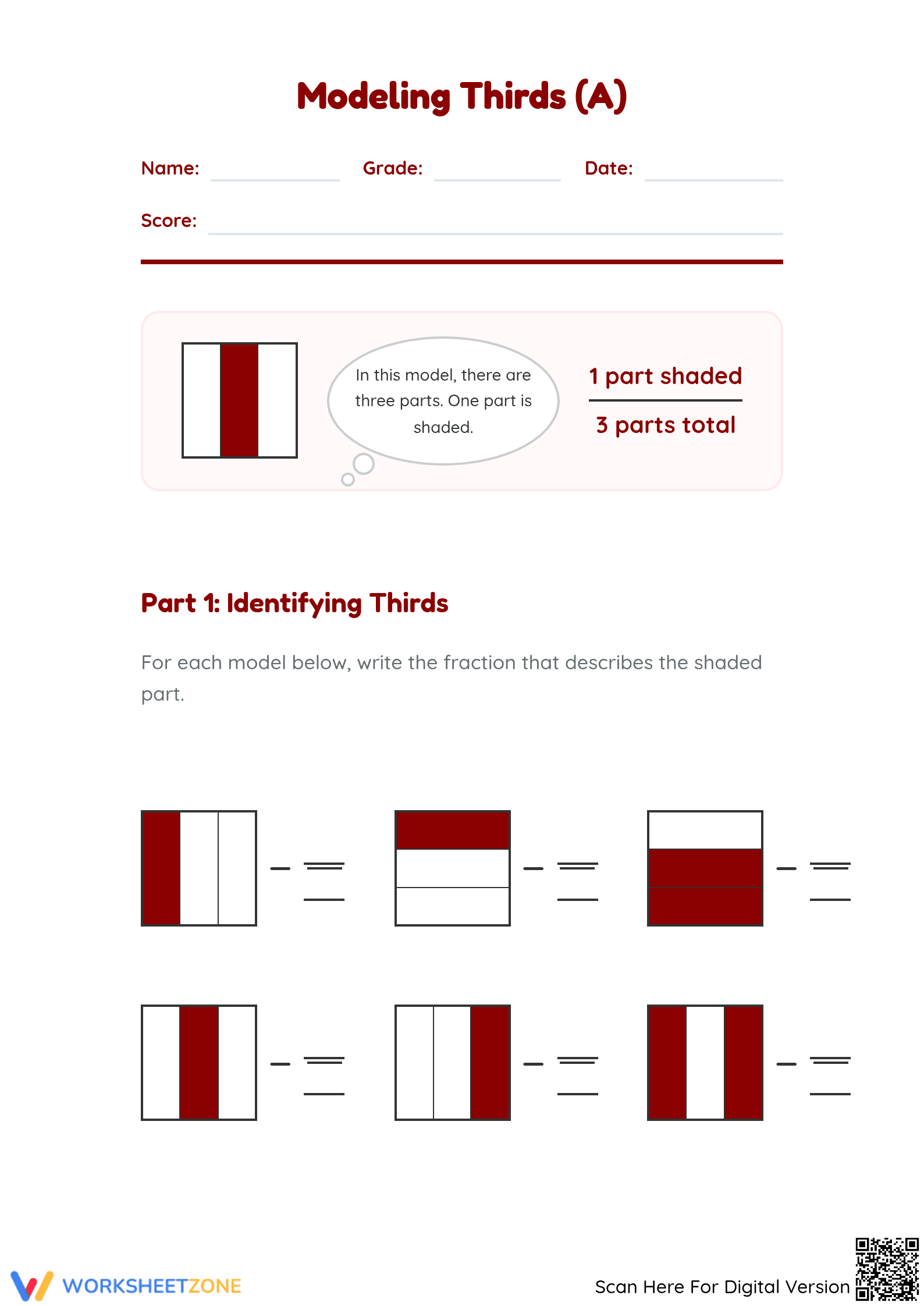
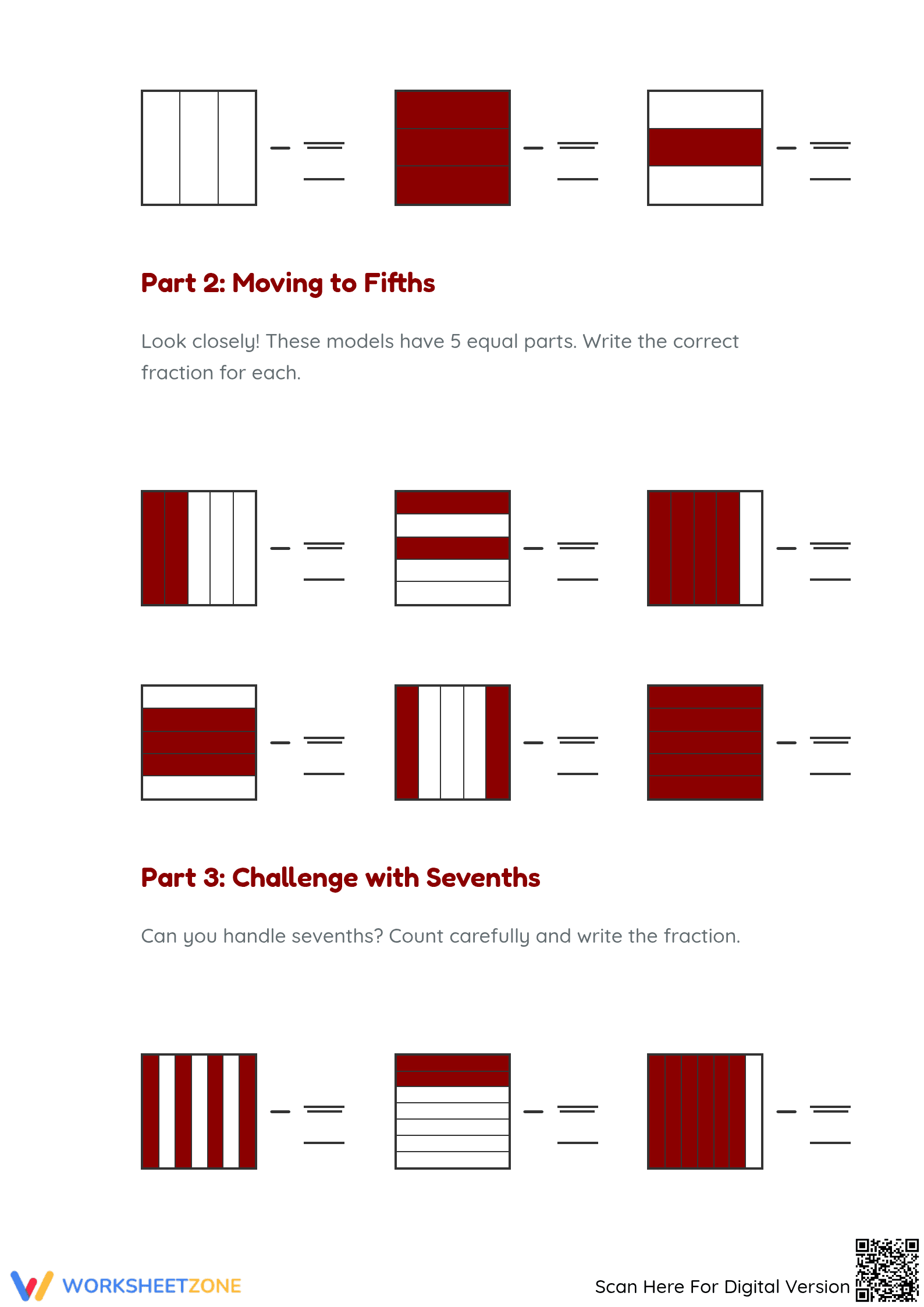
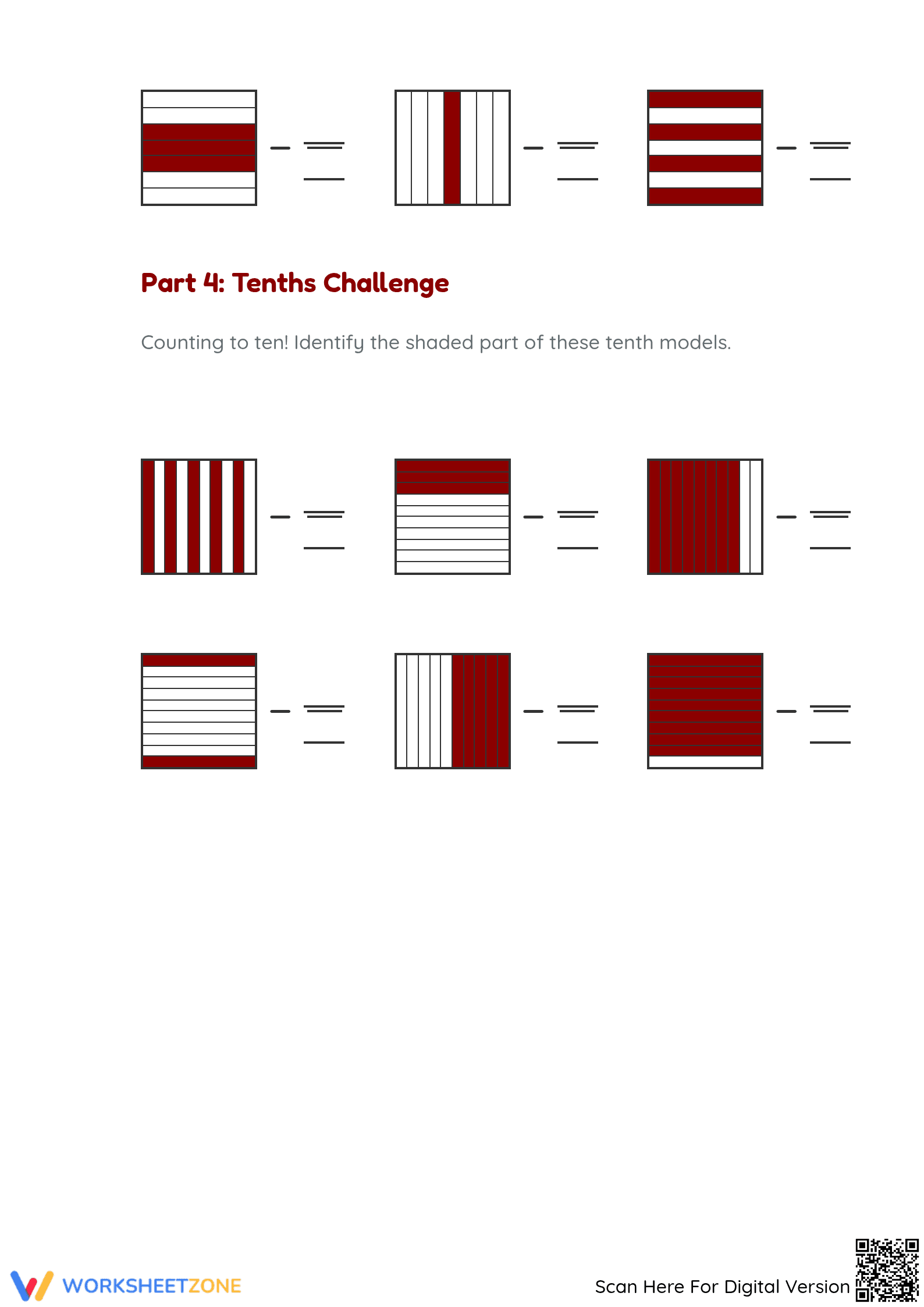
This Grade 3 fractions worksheet provides comprehensive practice for students to identify and write fractions using rectangular area models. By transitioning from thirds to tenths, learners build a concrete understanding of how numerators and denominators represent parts of a whole, ensuring they visualize fractional values before moving to abstract concepts.
At a Glance
- Grade: 3 · Subject: Math
- Standard:
CCSS.MATH.CONTENT.3.NF.A.1— Understand a fraction as parts of a partitioned whole- Skill Focus: Modeling fractions with rectangles
- Format: 3 pages · 27 problems · Answer key included · PDF
- Best For: Independent practice and formative assessment
- Time: 20–30 minutes
What's Inside
Inside this 3-page printable set, students find 27 problems designed to solidify their grasp of fractional parts. The worksheet uses consistent rectangular models to help students identify the denominator (total parts) and numerator (shaded parts). Each page includes clear headers and space for answers, supported by a full answer key.
Skill Progression
- Guided Practice (Thirds): Nine problems focus on thirds, providing a low-floor entry point to practice basic 1/3 and 2/3 configurations.
- Supported Practice (Fifths & Sevenths): Twelve problems increase partition counts to five and seven, requiring precise counting while maintaining familiar layouts.
- Independent Practice (Tenths): Six challenge problems with tenths serve as a mastery check for handling larger denominators.
This structure ensures students master the skill progression effectively through a gradual release of responsibility.
Standards Alignment
This worksheet is directly aligned to CCSS.MATH.CONTENT.3.NF.A.1, which requires students to understand a fraction 1/b as the quantity formed by 1 part when a whole is partitioned into b equal parts. By representing fractions visually, the resource supports the standard's goal of developing a deep conceptual understanding of fractional quantities. This standard code can be copied directly into lesson plans, IEP goals, or district curriculum mapping tools.
How to Use It
Implement this worksheet as independent practice following a direct instruction lesson on area models. It also serves as a formative assessment tool; observing students during Part 3 (Sevenths) helps identify counting errors early. Expect students to complete the three-page set within 25 minutes of focused work time.
Who It's For
This resource is ideal for third-grade students or RTI groups requiring visual support. The clear design is effective for students with visual processing needs. Pair this worksheet with fraction tiles or digital interactive activities to bridge the gap between concrete and semi-abstract representations.
According to the RAND AIRS 2024 study on mathematics instruction, the use of consistent visual area models like rectangles is a proven strategy for reducing cognitive load when students first encounter fractional concepts. This Grade 3 worksheet aligns with these findings by providing 27 high-quality tasks centered on CCSS.MATH.CONTENT.3.NF.A.1. By asking students to identify shaded segments within partitioned wholes, the resource reinforces the relationship between the numerator and the denominator, a critical precursor to fraction equivalence and comparison. Research from the NAEP consistently shows that students who master area models in early elementary grades perform significantly better on complex rational number tasks in middle school. This printable resource offers the essential repetition needed for students to internalize these models, making it a reliable addition to any standard-aligned curriculum. Educators can confidently cite this tool as an evidence-based intervention for building foundational numeracy.


