


























Views
Downloads


Essential Fractions Modeling: Rectangles Worksheet | Grade 3
Paste this activity's link or code into your existing LMS (Google Classroom, Canvas, Teams, Schoology, Moodle, etc.).
Students can open and work on the activity right away, with no student login required.
You'll still be able to track student progress and results from your teacher account.
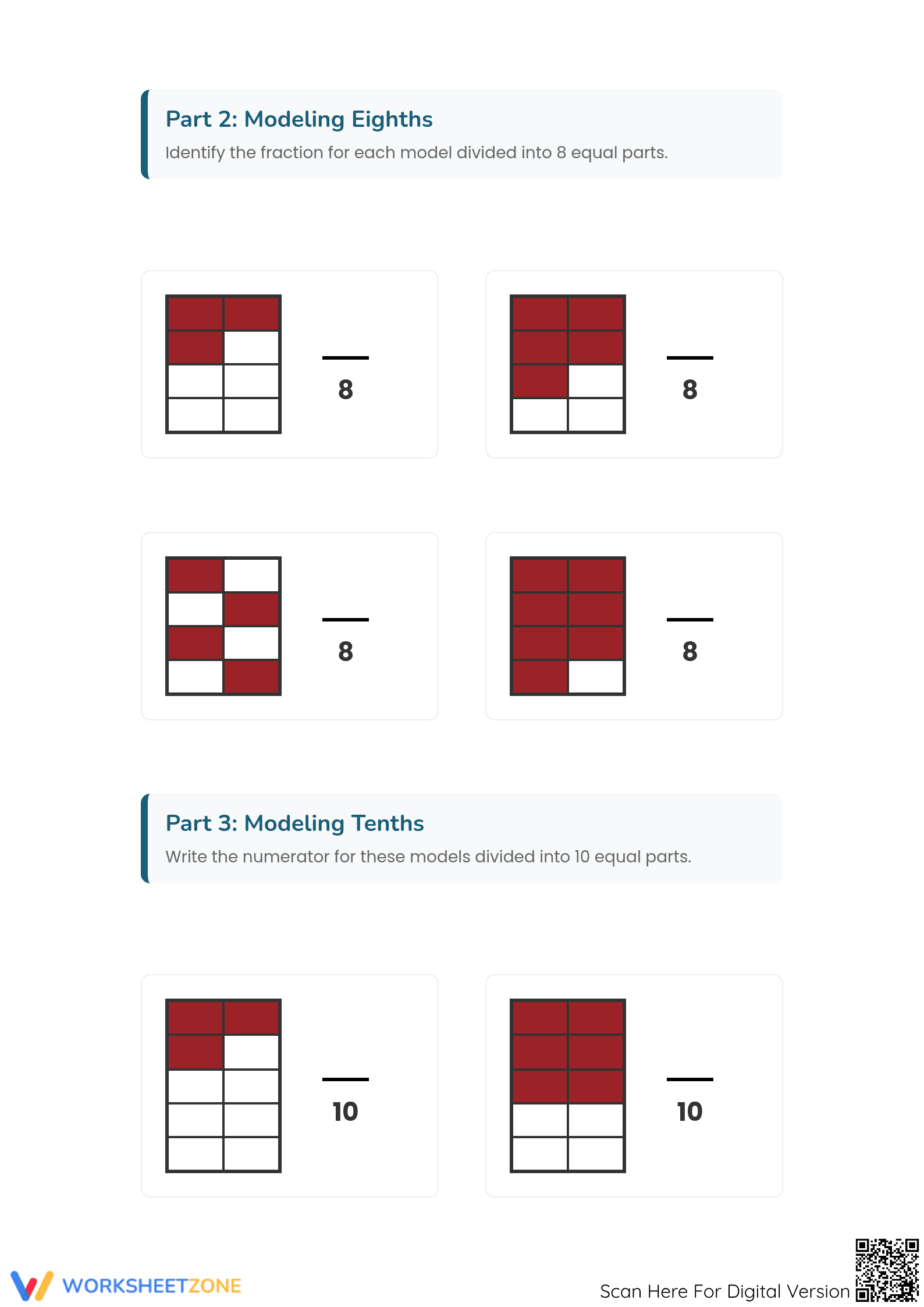
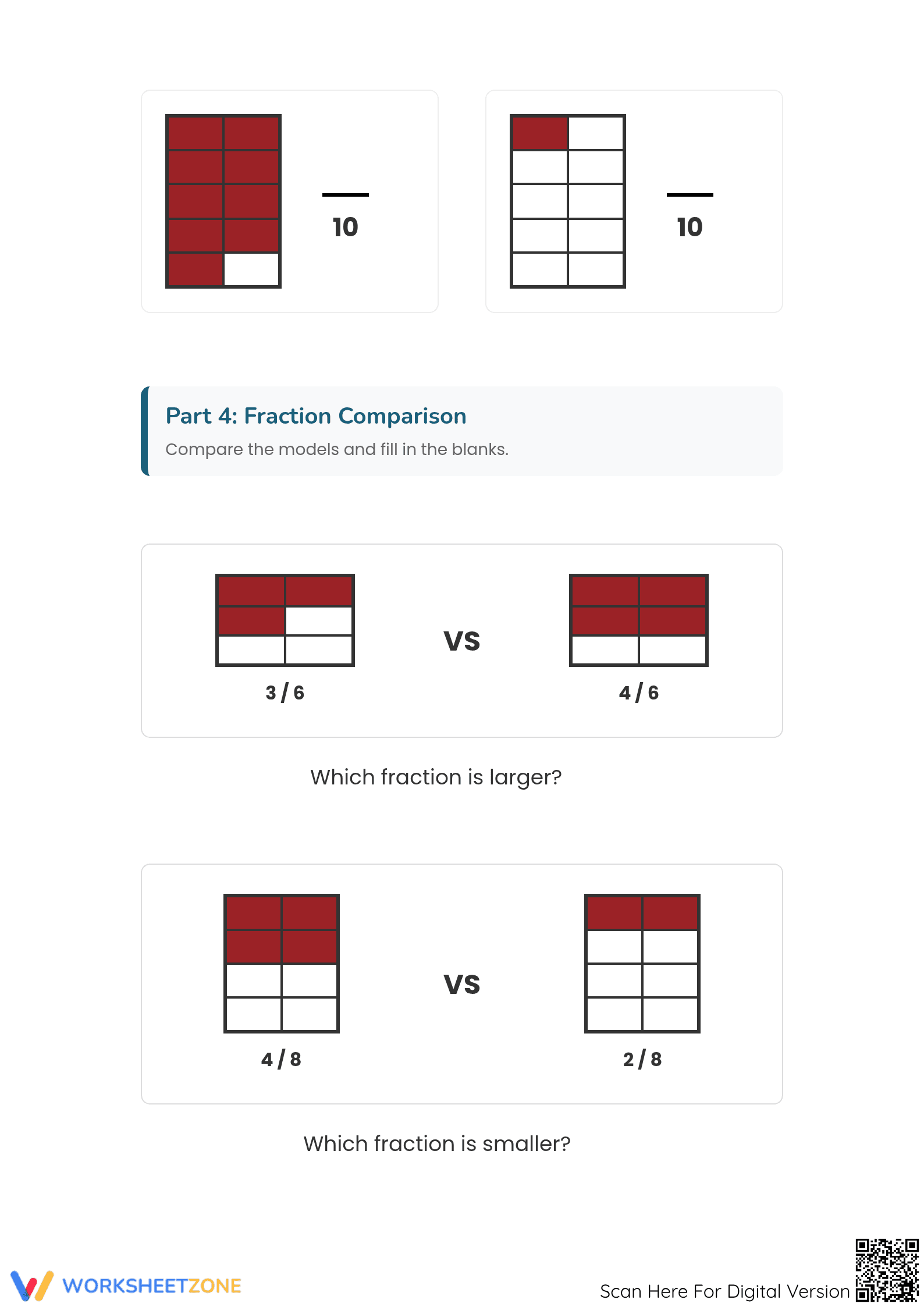
This comprehensive fractions worksheet enables students to master the concept of parts-of-a-whole through clear rectangular area models. By identifying numerators for sixths, eighths, and tenths, learners bridge the gap between abstract numbers and visual representation. Students conclude the exercise by comparing modeled fractions to develop a deep understanding of relative size and value.
At a Glance
- Grade: 3 · Subject: Math · Fractions
- Standard:
CCSS.MATH.CONTENT.3.NF.A.1— Understand fractions as quantities formed by parts partitioned from a whole body- Skill Focus: Visual Modeling and Comparison
- Format: 3 pages · 16 problems · Answer key included · PDF
- Best For: Initial instruction and independent practice sessions
- Time: 25–35 minutes
Across three pages, this resource provides sixteen structured tasks. Parts one through three focus on identifying numerators for rectangles divided into sixths, eighths, and tenths respectively. The final section introduces fraction comparison, requiring students to evaluate two side-by-side models to determine which represents a larger or smaller quantity. A full answer key facilitates quick grading and self-correction.
- Guided Practice: Six introductory tasks focus on sixths, using a fixed denominator to build confidence in counting shaded segments within a consistent frame.
- Supported Practice: Eight tasks expand to eighths and tenths, challenging students to maintain accuracy as the number of partitions increases and the visual density changes.
- Independent Practice: Two final comparison problems require students to apply their visual recognition skills to evaluate relative fraction sizes and identify larger or smaller values.
This gradual-release approach ensures students move from basic identification to higher-order comparative analysis using a familiar visual anchor.
This worksheet aligns directly with `CCSS.MATH.CONTENT.3.NF.A.1`, which requires students to understand a fraction as a quantity formed by parts when a whole is partitioned into equal segments. It also supports `CCSS.MATH.CONTENT.4.NF.A.2` through its final comparison section. Both standard codes can be copied directly into lesson plans, IEP goals, or district curriculum mapping tools.
Use this resource during the instructional phase of a lesson to model how to count segments accurately. It serves as an excellent formative assessment tool; observe if students struggle to count scattered shaded segments versus contiguous ones. Expected completion is thirty minutes. Assign it as independent work after students have practiced with physical manipulatives like fraction tiles or circles.
Designed for Grade 3 and 4 students, this worksheet is ideal for learners who need concrete visual support before moving to abstract fraction operations. It pairs naturally with a lesson on number lines or a parts-of-a-set anchor chart. The clear layout supports students with executive functioning needs who benefit from structured spacing and predictable task patterns.
The use of area models, such as the rectangles featured in this worksheet, is a proven strategy for building conceptual understanding of fractions. According to Fisher & Frey (2014), visual representations allow students to internalize the relationship between numerators and denominators before they engage in complex algorithmic computations. This specific resource targets CCSS.MATH.CONTENT.3.NF.A.1 by requiring students to recognize that a fraction represents a specific number of equal parts within a whole body. Research from the NAEP suggests that students who master visual modeling in early elementary grades show significantly higher proficiency in middle school rational number operations. By providing scattered selected segments rather than just sorted groups, this worksheet prevents the common misconception that fractions must always be contiguous blocks. This instructional design ensures that the plain-English skill of identifying fractional parts is reinforced through repeated, varied practice, making it a staple for any Grade 3 mathematics curriculum.


