


























Views
Downloads



Grade 3 Fractions — Essential Printable No-Prep Worksheet
Paste this activity's link or code into your existing LMS (Google Classroom, Canvas, Teams, Schoology, Moodle, etc.).
Students can open and work on the activity right away, with no student login required.
You'll still be able to track student progress and results from your teacher account.
Students master the fundamentals of unit fractions and parts of a whole through visual area models. This Grade 3 worksheet uses rectangles to bridge the gap between abstract numbers and concrete representation, ensuring students can identify, shade, and compare fractions with confidence. It is a complete solution for introducing or reviewing third-grade fraction standards.
At a Glance
- Grade: 3 · Subject: Math
- Standard:
3.NF.A.1— Understand a fraction as the quantity formed when a whole is partitioned into equal parts.- Skill Focus: Fraction identification, shading, and comparison
- Format: 4 pages · 15 problems · Answer key included · PDF
- Best For: Independent practice or substitute teacher plans
- Time: 20–30 minutes
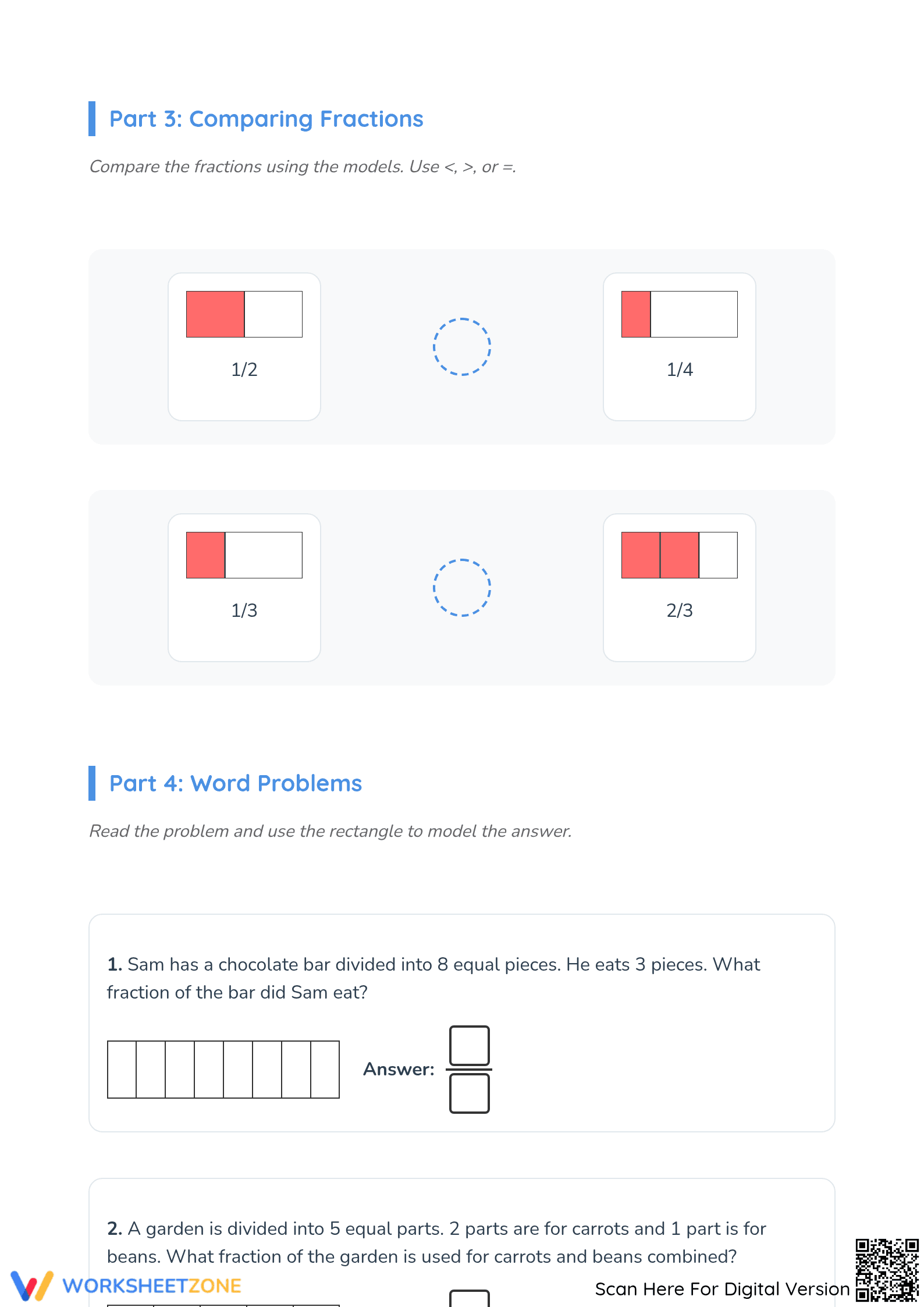
This comprehensive four-page packet includes four distinct sections: identifying fractions from models, shading rectangles to represent specific values, comparing two fractions using visual support, and solving real-world word problems. The set also features a "Bonus Challenge" where students create their own models from scratch. A full answer key is included for immediate feedback and grading.
Zero-Prep Workflow:
- Print: Select the four pages for your class set (less than 1 minute).
- Distribute: Hand out the packets for a self-paced math center or individual work (less than 1 minute).
- Review: Use the provided answer key to grade or have students self-check their models (less than 5 minutes).
Total teacher prep time is under 2 minutes. This worksheet is perfectly suited for substitute plans or unexpected schedule shifts during a busy unit.
Standards Alignment: Primary standard `3.NF.A.1` - Understand a fraction as the quantity formed when a whole is partitioned into equal parts. This resource also supports `3.NF.A.3.D` regarding comparing fractions with the same numerator or denominator. Both standard codes can be copied directly into lesson plans, IEP goals, or district curriculum mapping tools.
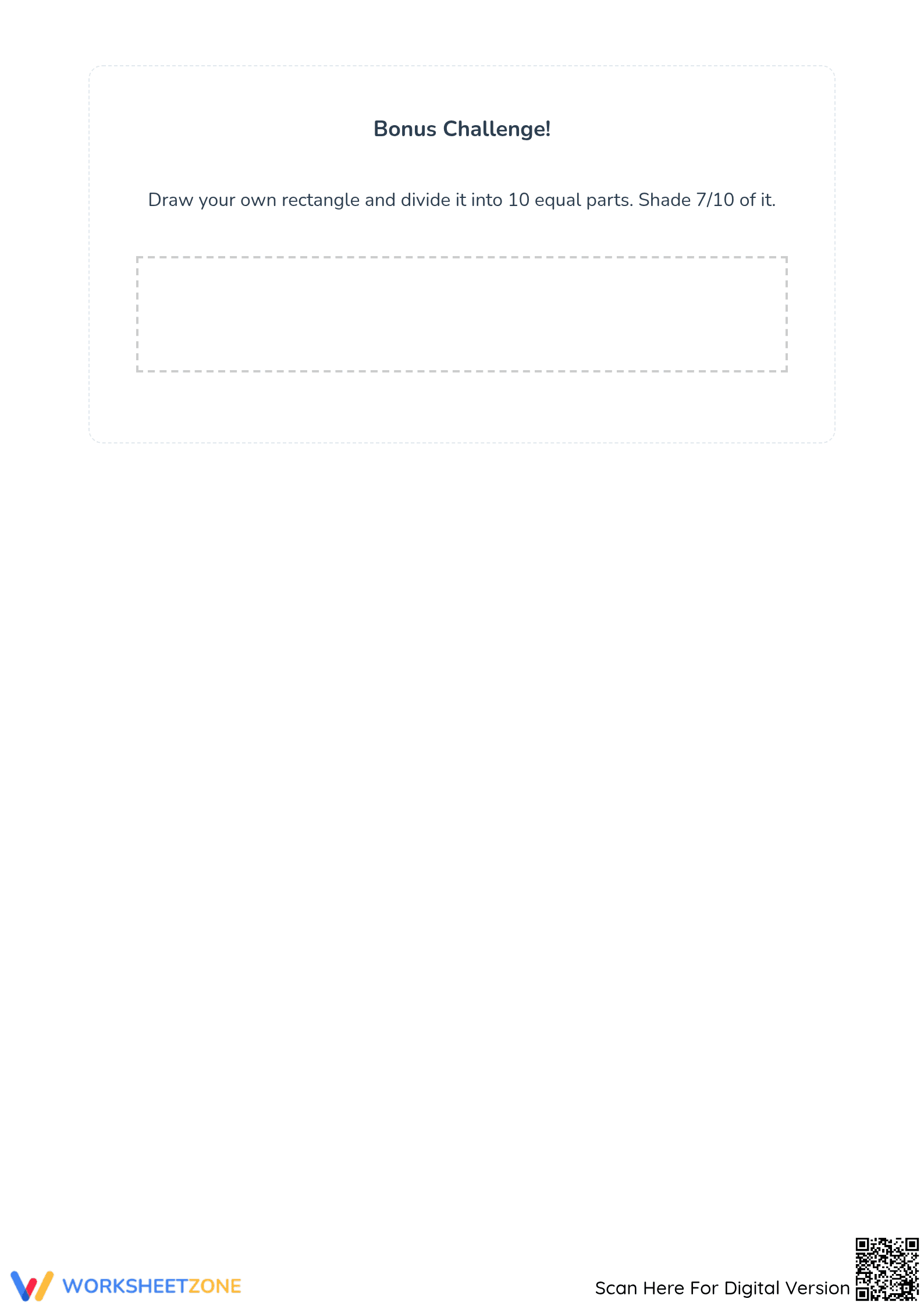
Assign this packet as a summative assessment at the end of a fractions unit or use individual pages as formative checks during direct instruction. Teachers should observe whether students can accurately partition the bonus rectangle into ten equal parts, which provides a quick look at their spatial reasoning and understanding of equal parts. Expected completion takes 20-30 minutes.
Designed for Grade 3 students, this resource is excellent for Tier 1 instruction or Tier 2 intervention for older students struggling with visual models. It pairs naturally with fraction tiles or area model anchor charts to reinforce the concept that the size of the whole must remain consistent for comparison.
This resource leverages the "Gradual Release of Responsibility" model (Fisher & Frey, 2014) by moving from identification to creation and finally to application in word problems. Research from RAND AIRS 2024 highlights that visual representations, specifically area models like rectangles, are superior to abstract number lines for initial fraction acquisition in early elementary grades. By requiring students to shade and partition their own models (3.NF.A.1), the worksheet aligns with the National Assessment of Educational Progress (NAEP) recommendations for multi-modal math instruction. The inclusion of word problems ensures that students translate visual literacy into logical reasoning, a key predictor of success in middle school rational number units. This 15-task set provides the exact cognitive load recommended for 30-minute instructional blocks, ensuring mastery without student fatigue.


