


























Views
Downloads

Printable Modeling Fractions with Groups of Shapes | Grade 3
Paste this activity's link or code into your existing LMS (Google Classroom, Canvas, Teams, Schoology, Moodle, etc.).
Students can open and work on the activity right away, with no student login required.
You'll still be able to track student progress and results from your teacher account.
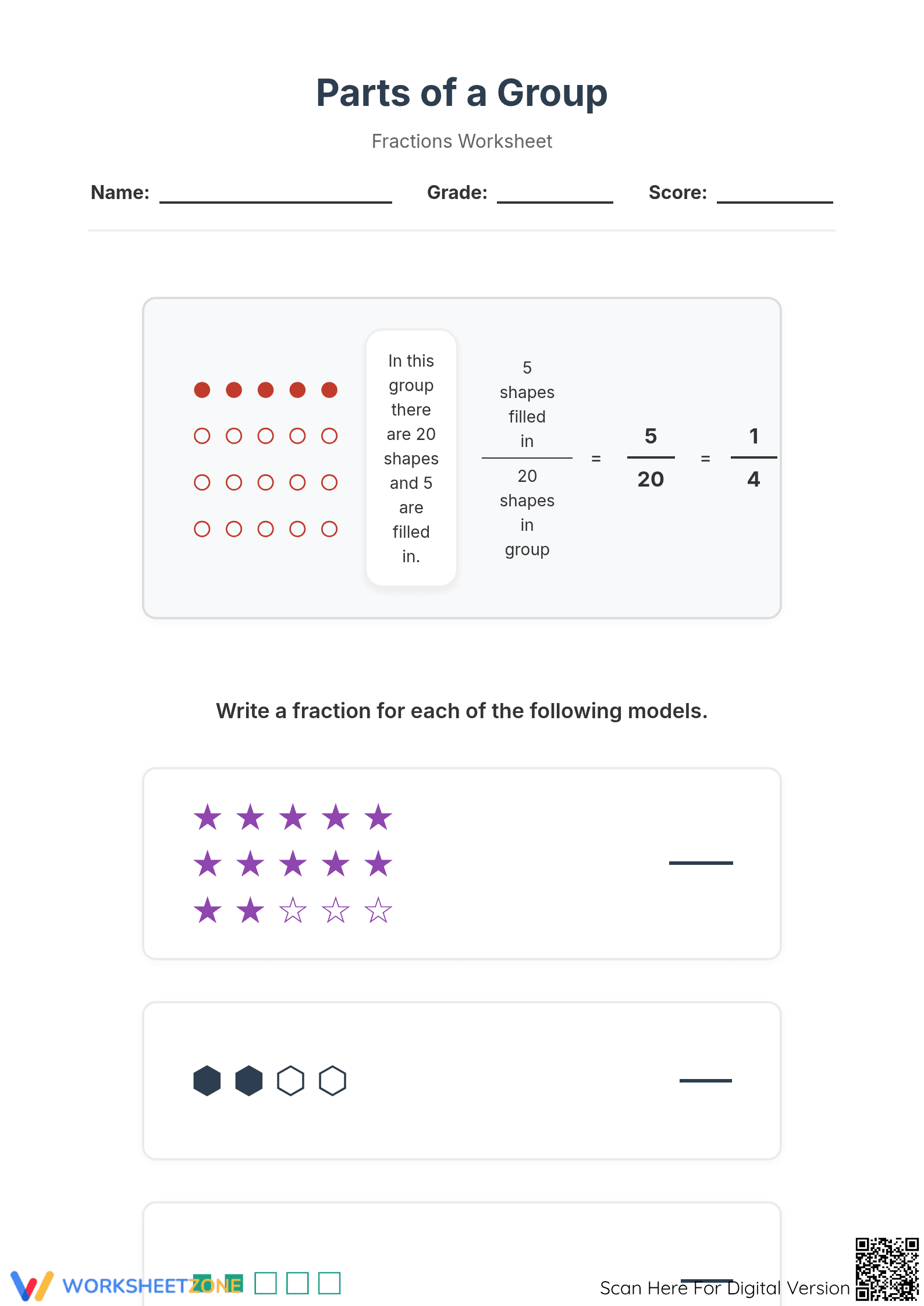
Students identify and write fractions representing parts of a set using clear visual shape models. This worksheet bridges the gap between area models and set models, ensuring learners understand that fractions represent specific quantities within a larger group. It is an essential tool for building early fractional fluency.
At a Glance
- Grade: 3 · Subject: Math
- Standard:
CCSS.MATH.CONTENT.3.NF.A.1— Understand a fraction as the quantity formed by parts of a whole group- Skill Focus: Fractions as parts of a set
- Format: 2 pages · 7 problems · Answer key included · PDF
- Best For: Introductory fraction lessons and independent practice
- Time: 15–20 minutes
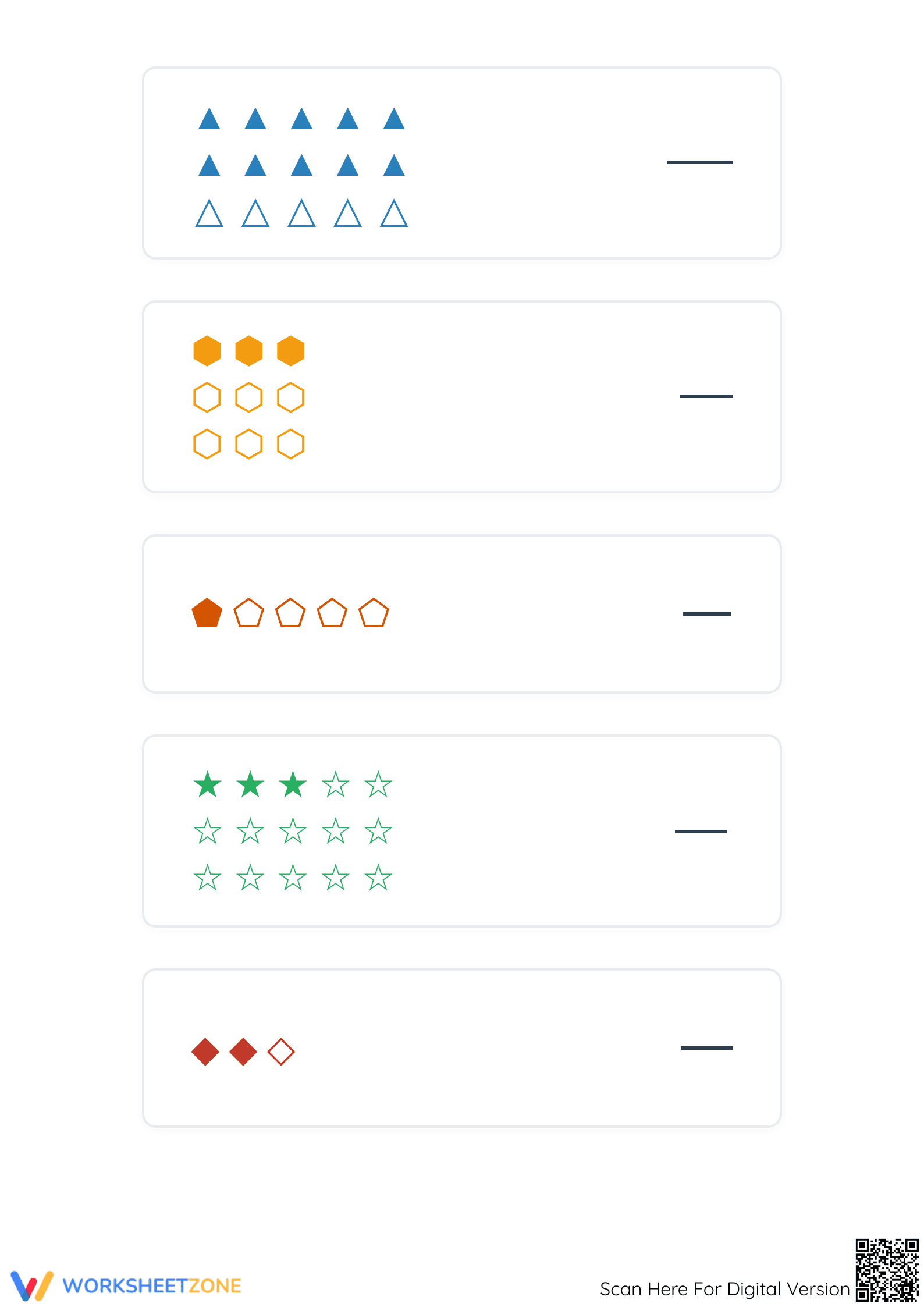
What's Inside: This 2-page PDF provides a structured approach to set-based fractions. Page 1 features a detailed worked example showing how to count total shapes for the denominator and filled shapes for the numerator, followed by 2 practice items. Page 2 provides 5 additional problems using varied shapes like triangles, stars, and hexagons. A full answer key is included to facilitate quick grading or student self-correction.
Skill Progression
- Guided practice: The first page includes a comprehensive visual anchor that breaks down the fraction 5/20 into its component parts, explaining the logic behind the numerator and denominator.
- Supported practice: Initial problems use simple grids and familiar shapes to help students transition from the example to independent work without feeling overwhelmed.
- Independent practice: The second page challenges students with 5 distinct sets of varying sizes, ranging from 3 to 15 items, to solidify mastery of the concept.
This sequence follows a gradual-release model to build student confidence through structured repetition and visual support.
Standards Alignment: This resource is aligned to primary standard CCSS.MATH.CONTENT.3.NF.A.1. Students demonstrate they understand a fraction 1/b as the quantity formed by 1 part when a whole is partitioned into b equal parts. This worksheet specifically applies this concept to groups of discrete objects rather than single shapes. Both standard codes can be copied directly into lesson plans, IEP goals, or district curriculum mapping tools.
How to Use It: Use this as a formative assessment immediately after introducing the concept of "parts of a group." During the activity, observe if students correctly identify the denominator as the total count rather than just the unfilled shapes. This worksheet is ideal for independent desk work or as a quick exit ticket. Expected completion time is 15–20 minutes.
Who It's For: This is designed for 3rd-grade students beginning their fraction journey. It is also highly effective for 4th or 5th-grade intervention for students who struggle with set models. Pair this with physical manipulatives like two-color counters to provide a concrete-to-representational transition for struggling learners.
This resource aligns with the CCSS.MATH.CONTENT.3.NF.A.1 standard, focusing on the conceptual understanding of fractions as parts of a set. According to Fisher & Frey (2014), visual modeling is a critical component of the gradual release of responsibility, allowing students to move from teacher-led examples to independent mastery. By using 7 distinct visual tasks, this worksheet provides the necessary repetition for students to internalize the relationship between the numerator and the denominator in a group context. Research from the NAEP indicates that students who master visual fraction models in early elementary grades show significantly higher proficiency in rational number operations in middle school. This worksheet serves as a foundational tool for building that mathematical fluency through clear, uncluttered visual representations and structured practice that minimizes cognitive load while maximizing conceptual gain.


