


























Views
Downloads

Printable Modeling Fractions of a Group Worksheet | Grade 3
Paste this activity's link or code into your existing LMS (Google Classroom, Canvas, Teams, Schoology, Moodle, etc.).
Students can open and work on the activity right away, with no student login required.
You'll still be able to track student progress and results from your teacher account.
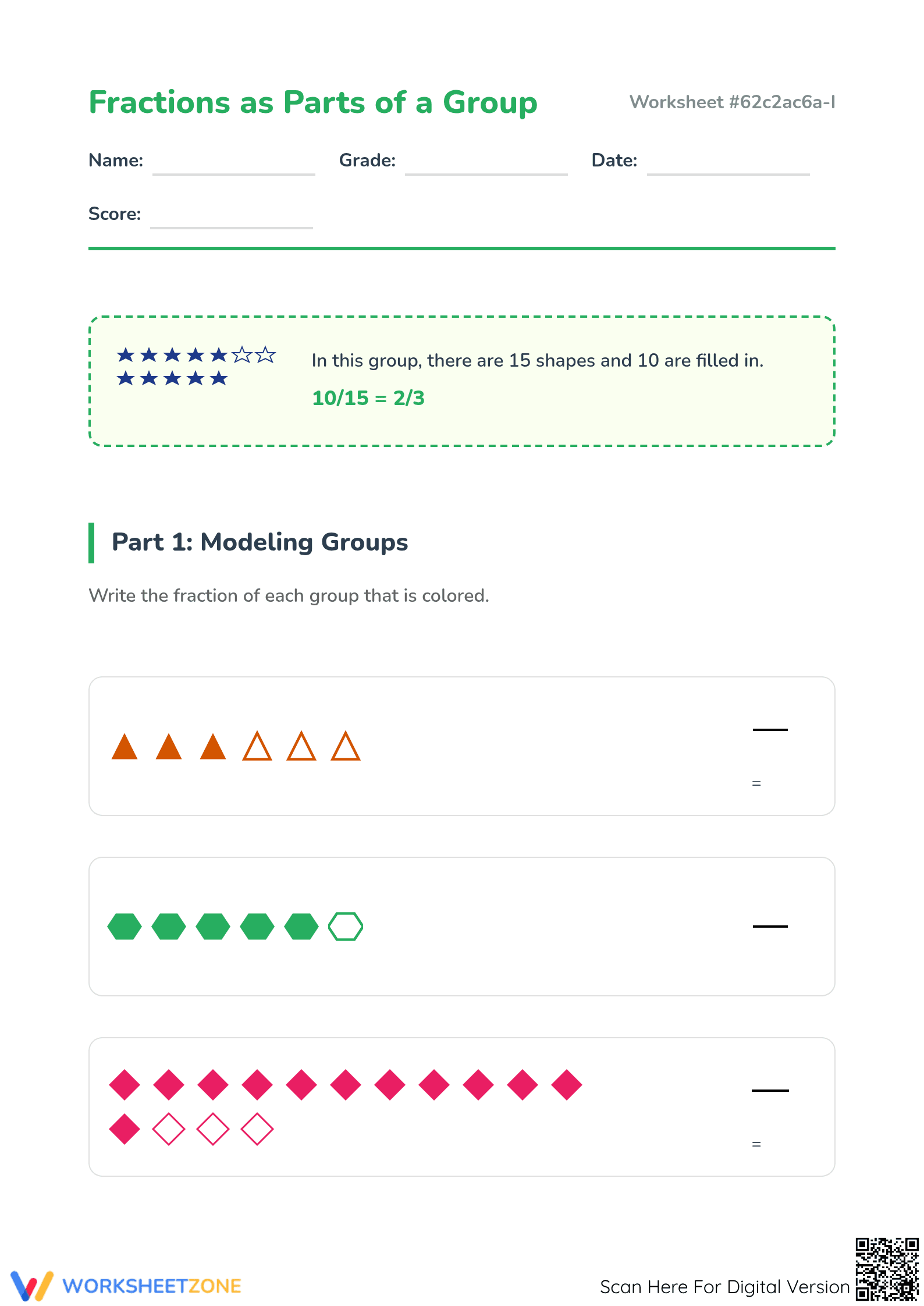
Representing fractions as parts of a set is a foundational skill for elementary math. This Grade 3 worksheet provides targeted practice to identify and write fractions based on groups of objects. Using visual models and word problems, students develop a deep understanding of numerator and denominator relationships in a set model.
At a Glance
- Grade: 3 · Subject: Math
- Standard:
CCSS.MATH.CONTENT.3.NF.A.1— Understand a fraction as the quantity formed by parts of a whole- Skill Focus: Modeling fractions of a group
- Format: 3 pages · 17 problems · Answer key included · PDF
- Best For: Small group instruction or independent practice
- Time: 25–35 minutes
This three-page resource is organized into four parts to support learning. The worksheet includes 17 tasks, ranging from basic identification to multi-step word problems. Each page is designed with generous white space for student work, and a full answer key is provided for grading efficiency and immediate student feedback.
Skill Progression
- Guided Practice: Section one uses shapes like triangles and hexagons. Students count items in a group and identify colored parts to write fractions.
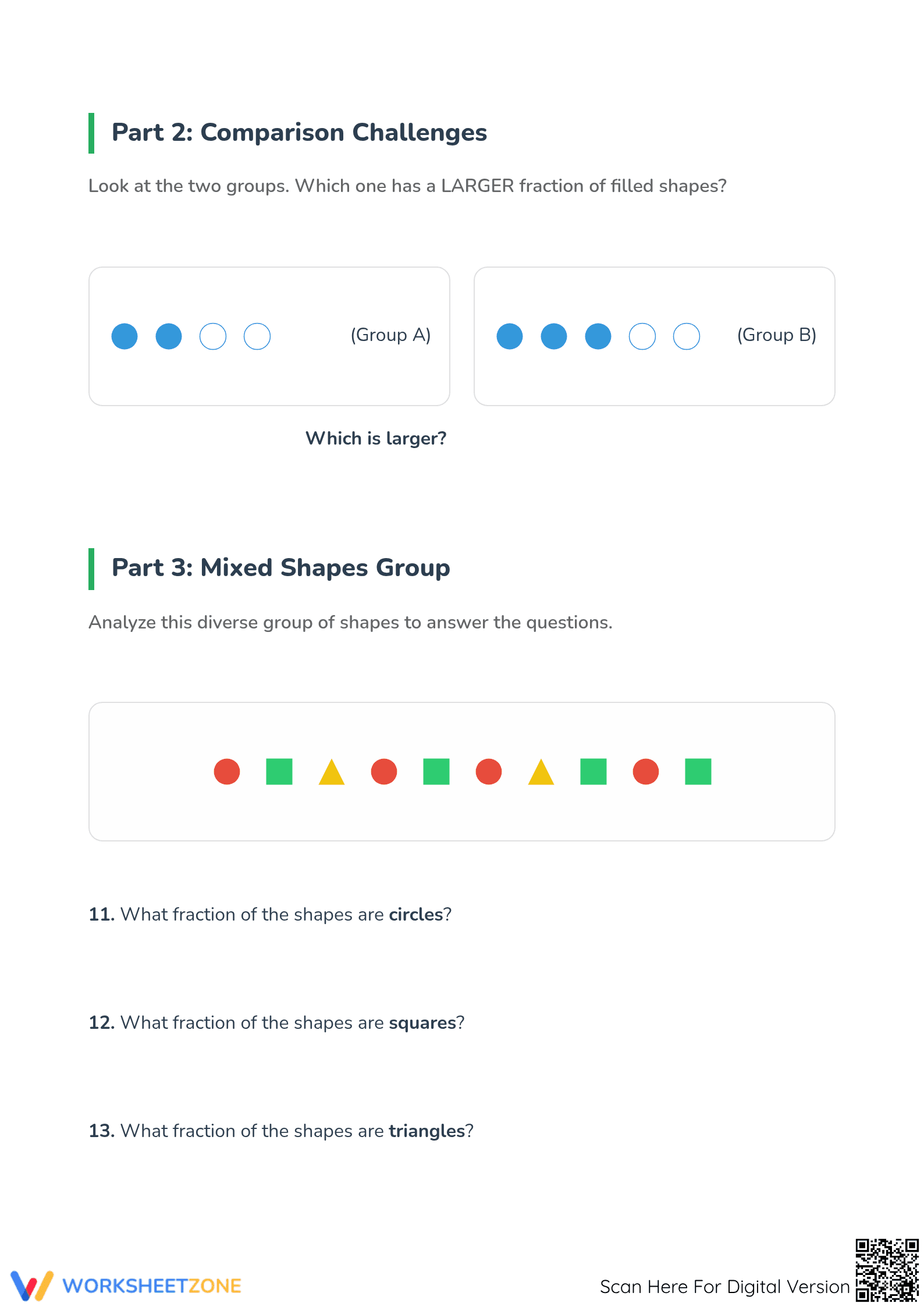
- Supported Practice: Students analyze mixed sets of circles, squares, and triangles to answer specific fractional questions about diverse groups.
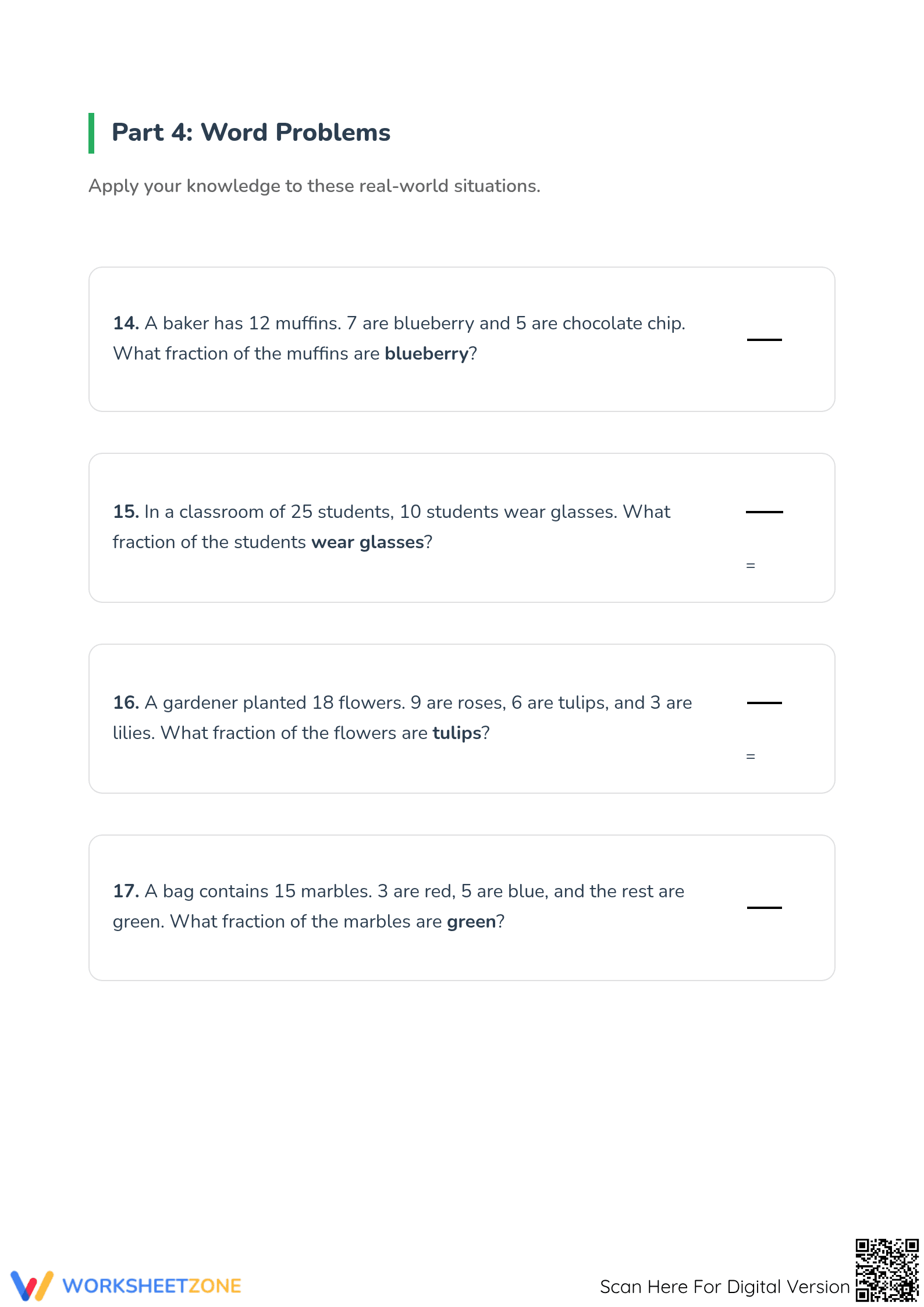
- Independent Practice: The final section features word problems involving real-life scenarios like muffins or flowers, requiring students to translate text into fractions.
This sequence follows a gradual-release framework, ensuring that learners build confidence with concrete visual models before moving to abstract problem-solving and real-world application.
Standards Alignment
This resource is meticulously aligned with CCSS.MATH.CONTENT.3.NF.A.1: "Understand a fraction 1/b as the quantity formed by 1 part when a whole is partitioned into b equal parts." It also supports 4.NF.A.1 by reinforcing fractional concepts through visual grouping. Both standard codes can be copied directly into lesson plans, IEP goals, or district curriculum mapping tools.
How to Use It
For direct instruction, use the first page during the "We Do" phase to model notation. For assessment, assign the mixed shapes and observe if students correctly identify denominators. Students typically complete the packet in 30 minutes, making it ideal for math centers, independent practice, or homework assignments.
Who It's For
This worksheet is for Grade 3 students but serves as an intervention for older learners. It pairs naturally with fraction tiles or a text about sharing items. Differentiation is supported through the visual scaffolds provided in the early sections, allowing students to see the parts of the whole group.
According to the RAND AIRS 2024 report, visual modeling is a critical bridge for Grade 3 learners transitioning from whole numbers to rational number concepts. This worksheet directly addresses the CCSS.MATH.CONTENT.3.NF.A.1 standard by requiring students to identify fractions as parts of a group across 17 distinct problems. By moving from concrete shape models to abstract word problems, the resource supports the gradual release of responsibility framework. Students first observe filled-in shapes to determine numerators and denominators before applying these skills to real-world scenarios involving muffins, students, and flowers. Research by Fisher & Frey (2014) emphasizes that such structured practice reduces cognitive load while increasing the retention of fractional notation. This three-page resource provides the necessary scaffolding for students to accurately name and compare fractions of a set, ensuring they are prepared for more complex operations with rational numbers in later elementary grades.


