


























Views
Downloads



Modeling Fractions with Groups of Shapes | Essential Grade 3
Paste this activity's link or code into your existing LMS (Google Classroom, Canvas, Teams, Schoology, Moodle, etc.).
Students can open and work on the activity right away, with no student login required.
You'll still be able to track student progress and results from your teacher account.
Modeling fractions using sets of objects helps students move beyond area models to understand fractions as parts of a group. This comprehensive practice set guides learners to identify numerators and denominators by observing shaded shapes within distinct collections. Students develop a concrete grasp of fractional parts before applying their knowledge to real-world scenarios and word problems.
At a Glance
- Grade: 3 · Subject: Math
- Standard:
CCSS.MATH.CONTENT.3.NF.A.1— Understand a fraction 1/b as the quantity formed by 1 part of a whole- Skill Focus: Visual set modeling and fractional reasoning
- Format: 5 pages · 25 problems · Answer key included · PDF
- Best For: Independent practice and formative assessment
- Time: 30–45 minutes
What's Inside
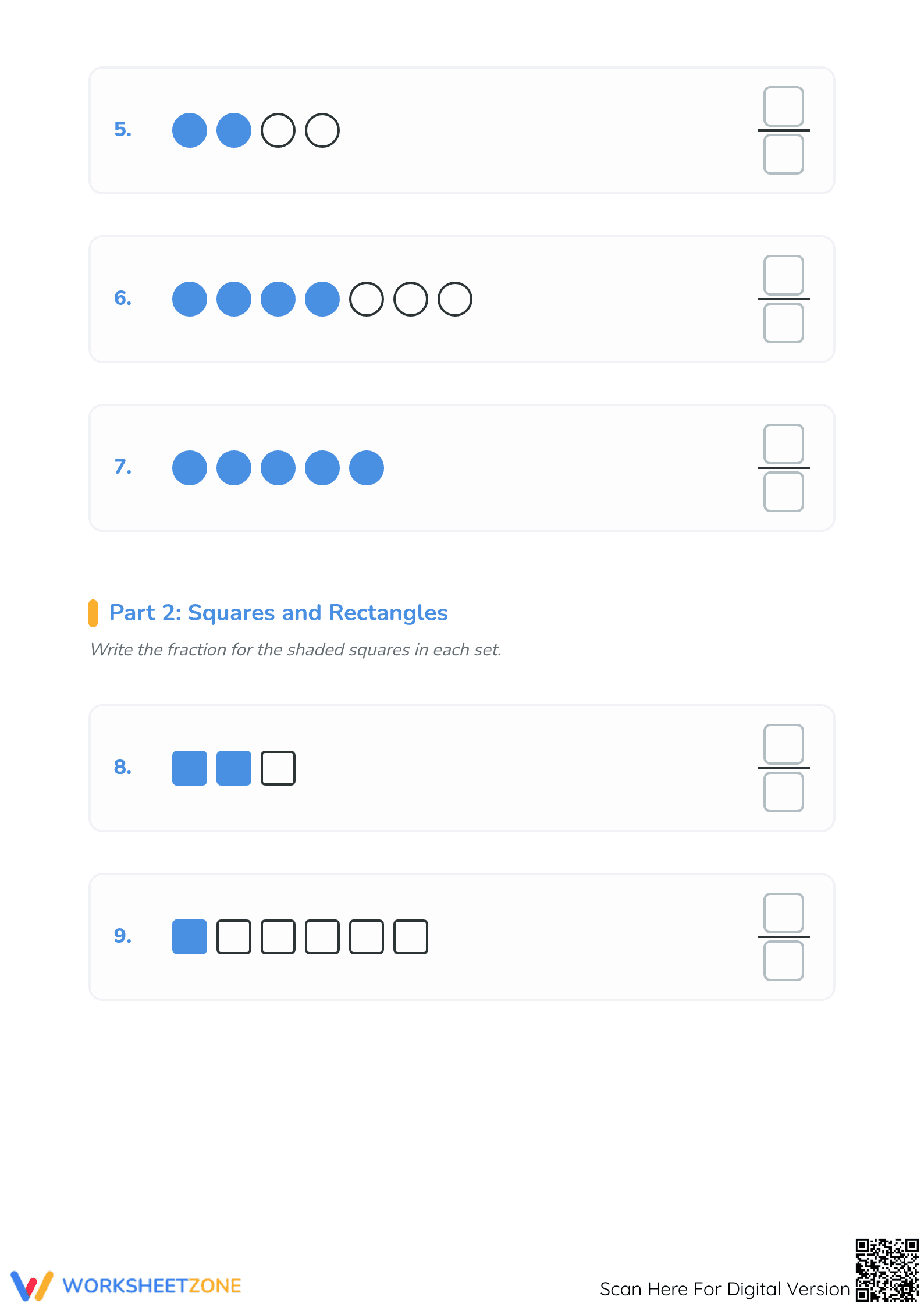
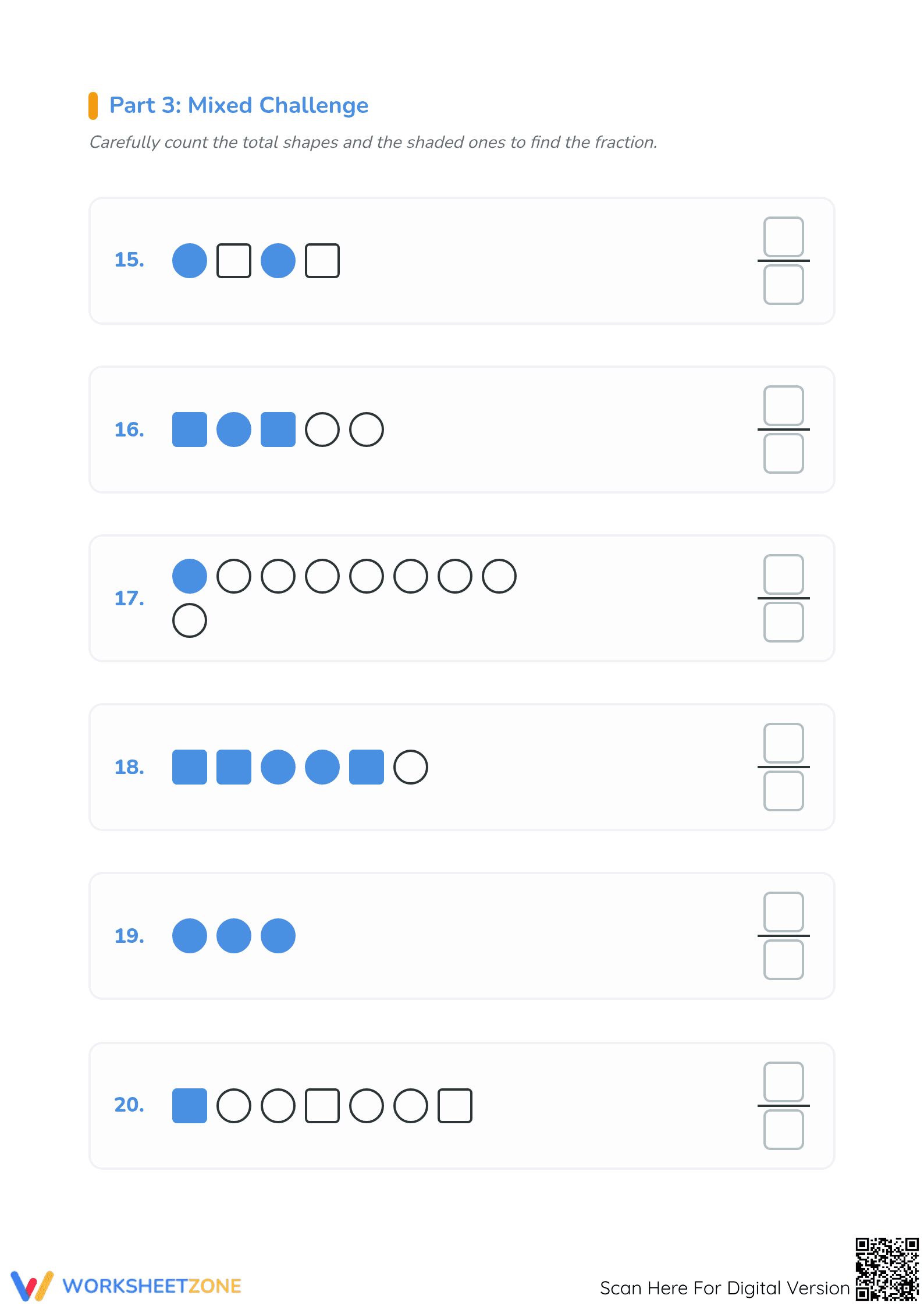
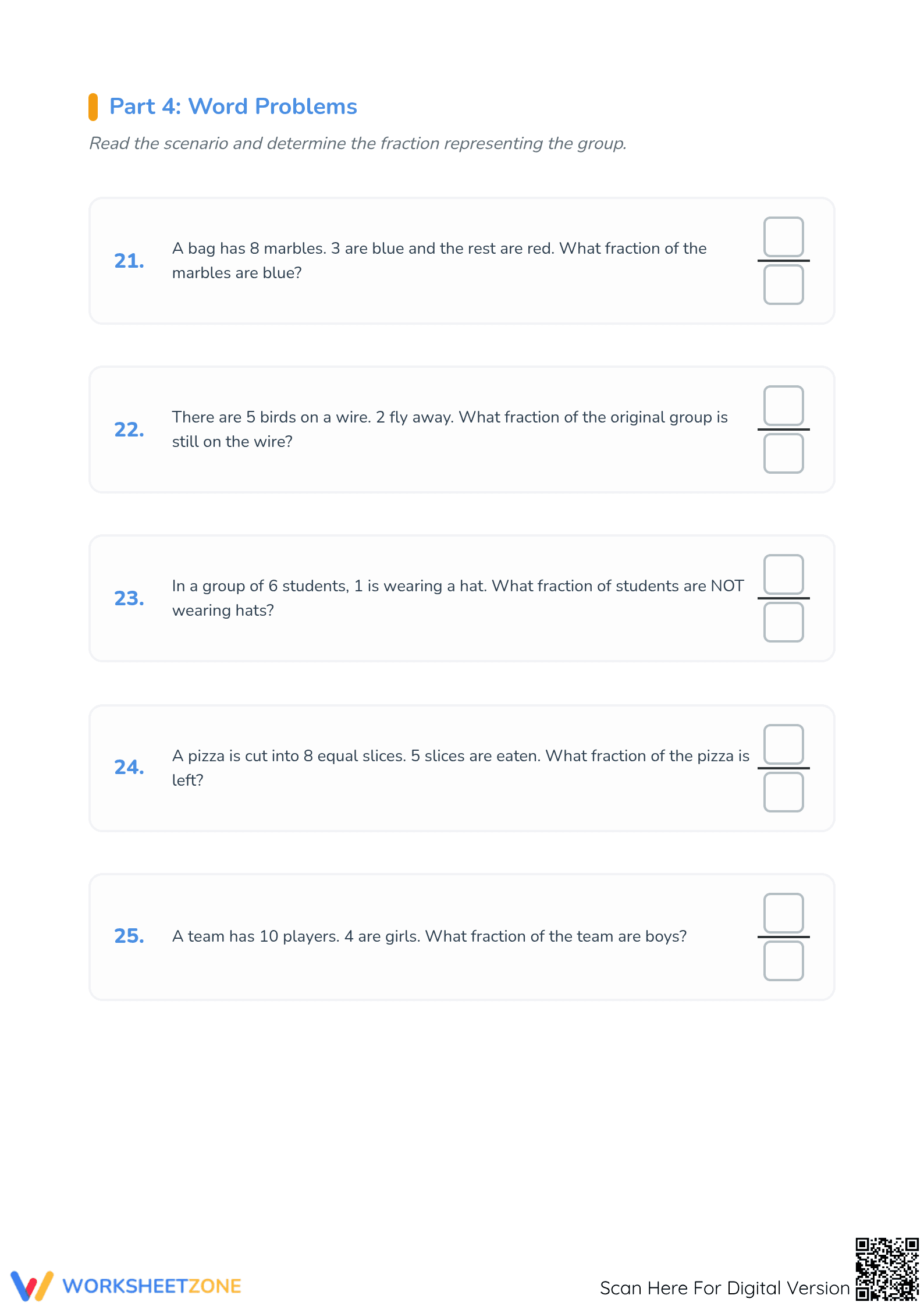
This five-page instructional resource features 25 structured problems organized into four developmental sections. Part 1 and Part 2 focus on circles, squares, and rectangles arranged in groups, requiring students to write the representative fraction for shaded portions. Part 3 provides a mixed challenge with various shapes, while Part 4 introduces word problems that require students to derive fractions from descriptive scenarios like marbles in a bag or slices of pizza.
Zero-Prep Workflow
This resource is designed for immediate classroom implementation with a total teacher preparation time of under two minutes. Educators can print the 5-page packet and distribute it directly to students for a complete lesson cycle. The clear section headers allow for easy transition between visual modeling and word problem application. Reviewing student work is simplified by the included answer key, which provides exact fractional representations for all 25 tasks, making it an ideal choice for emergency sub plans or quiet seatwork.
Standards Alignment
This worksheet is primarily aligned to `CCSS.MATH.CONTENT.3.NF.A.1`: "Understand a fraction 1/b as the quantity formed by 1 part when a whole is partitioned into b equal parts; understand a fraction a/b as the quantity formed by a parts of size 1/b." It also supports foundational skills for equivalent fractions. Both standard codes can be copied directly into lesson plans, IEP goals, or district curriculum mapping tools.
How to Use It
Use this packet as a summative check after direct instruction on fractions as sets. During the activity, walk around and observe if students are correctly counting the total number of objects for the denominator; this is a common point of confusion for beginners. For a quick formative check, assign only the first page and review the "Circles in Groups" section before moving to word problems. Completion time ranges from 30 minutes for advanced learners to 45 minutes for those requiring more visual counting time.
Who It's For
This resource is tailored for Grade 3 students introduced to the concept of sets but remains highly effective for Grade 4 and 5 students who require intervention or a refresher on non-area fraction models. It pairs naturally with a math center rotation or a direct instruction lesson involving physical manipulatives like counters or bears. The varied shape types and word problems provide enough cognitive demand to keep diverse learners engaged throughout the practice session.
The transition from area models to set models represents a significant cognitive step in early mathematics. This worksheet facilitates that bridge by providing 25 specific opportunities for students to map visual sets to fractions under CCSS.MATH.CONTENT.3.NF.A.1. By incorporating both geometric shapes and situational word problems, the resource ensures that students apply fractional logic to diverse contexts. This resource serves as a reliable instrument for identifying misconceptions in denominator identification before they impact more complex math standards.


