


























Views
Downloads

Printable Modeling Fractions with Groups of Shapes Worksheet
Paste this activity's link or code into your existing LMS (Google Classroom, Canvas, Teams, Schoology, Moodle, etc.).
Students can open and work on the activity right away, with no student login required.
You'll still be able to track student progress and results from your teacher account.
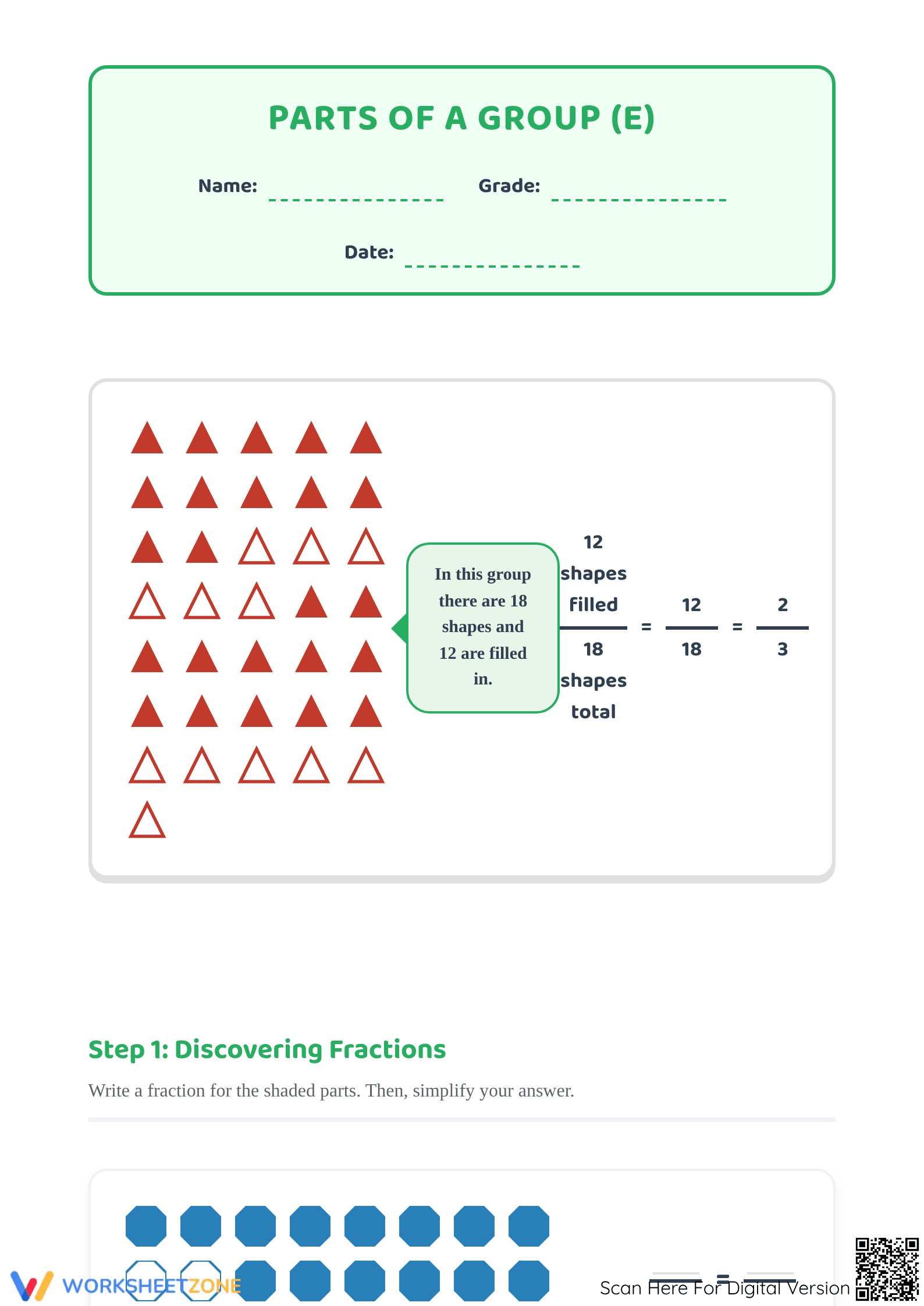
This comprehensive fractions worksheet helps students master the concept of parts of a group using visual models. By representing fractions with sets of shapes, learners transition from concrete counting to abstract fractional reasoning. Students identify the shaded numerator, the total group denominator, and practice reducing their results to simplest form for complete mastery of basic fractions.
At a Glance
- Grade: 3–5 · Subject: Math
- Standard:
CCSS.MATH.CONTENT.3.NF.A.1— Identify and write fractions based on visual parts of a group- Skill Focus: Modeling fractions with sets of shapes
- Format: 5 pages · 12 problems · Answer key included · PDF
- Best For: Small group instruction or independent practice
- Time: 25–35 minutes
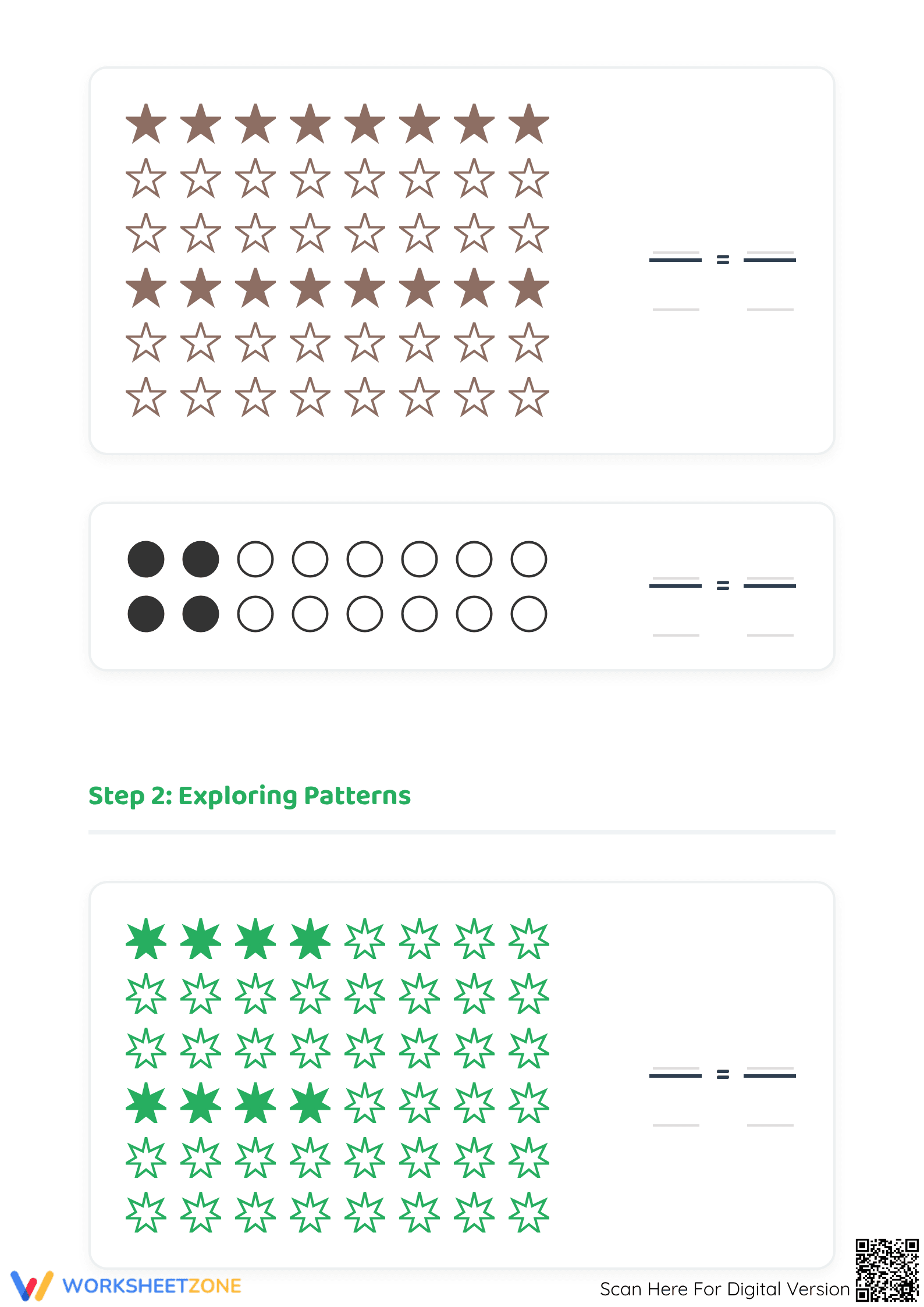
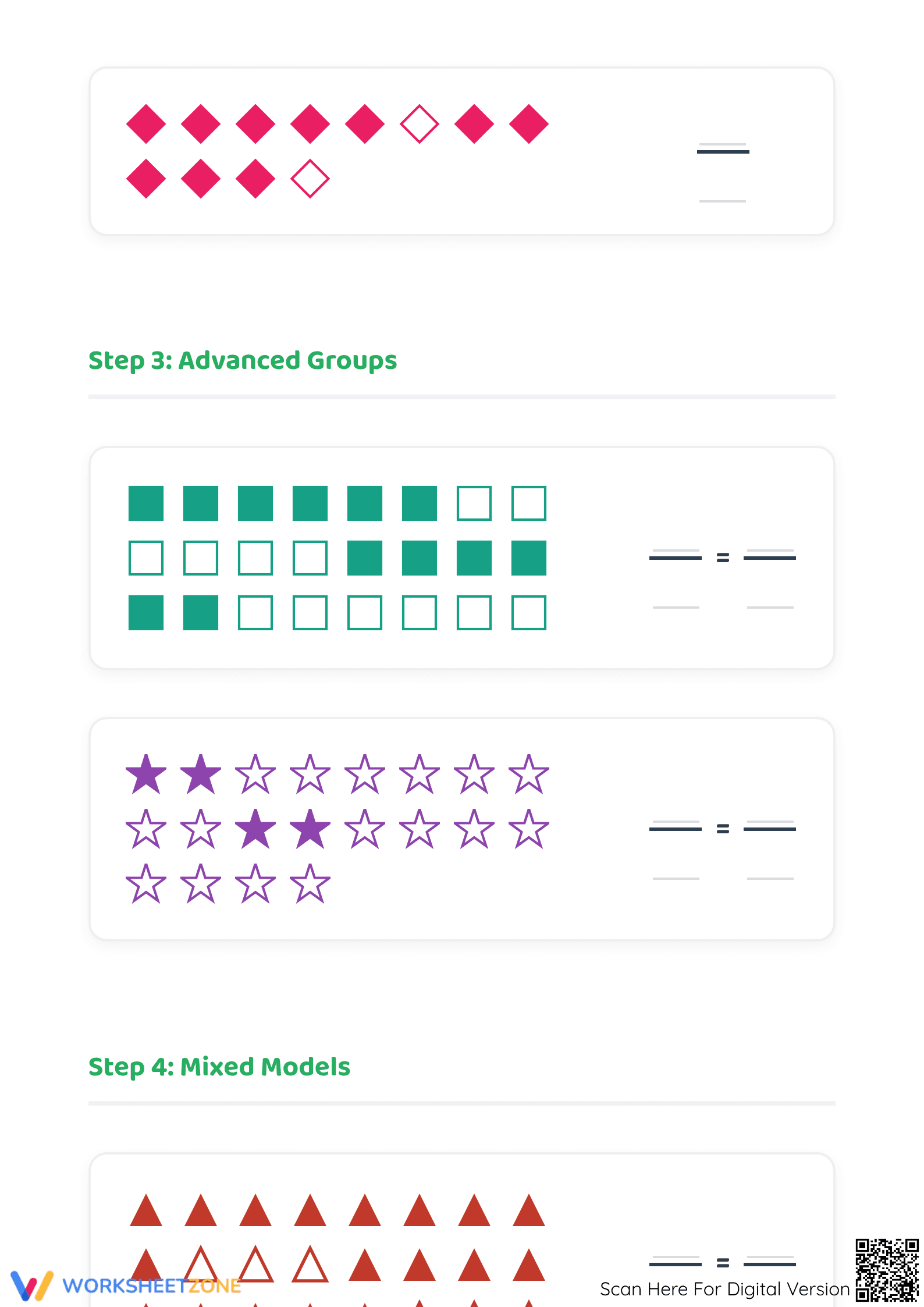
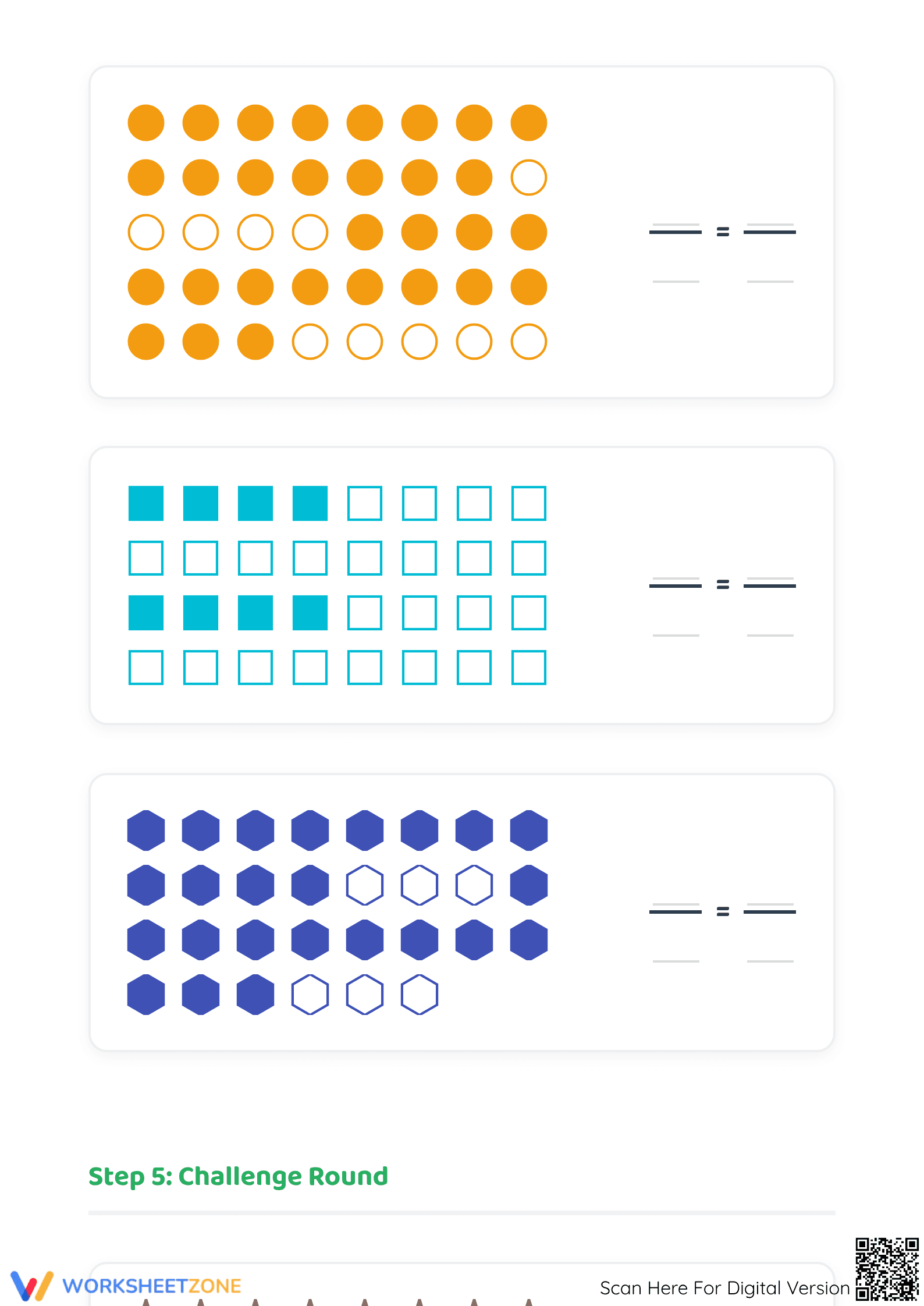
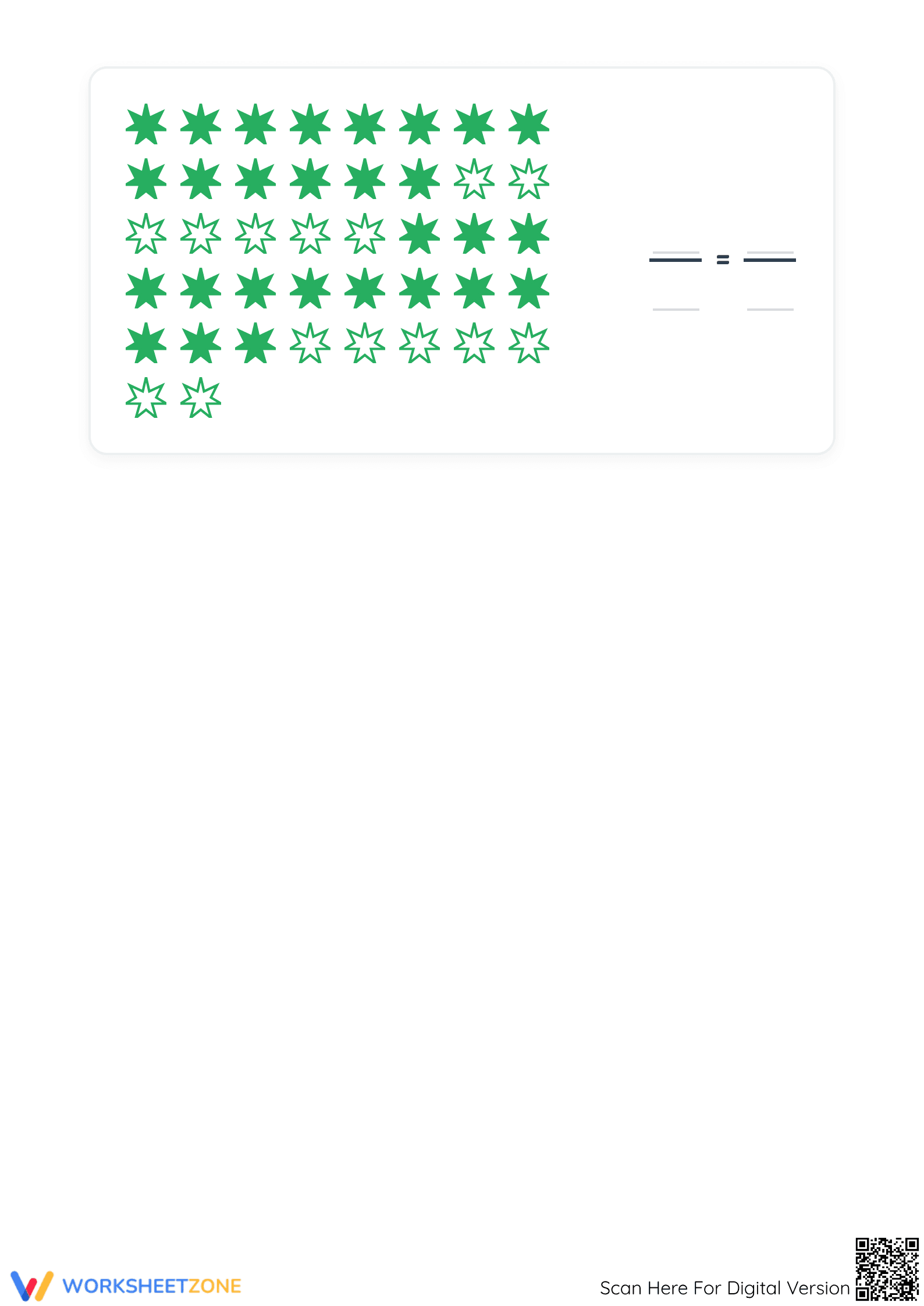
This 5-page instructional packet contains 12 structured tasks that progress in complexity. Each page features clear boxes with various geometric shapes—including stars, circles, hexagons, and diamonds—that represent items in a set. The layout provides dedicated equation lines for the initial fraction and a separate line for the simplified version. A complete teacher answer key is included to ensure quick and accurate grading.
Skill Progression
- Guided practice: The first two pages feature an explicit worked example and sets with smaller totals (under 15 items) to build confidence in identifying the numerator and denominator.
- Supported practice: The middle pages introduce larger sets and "Advanced Groups" that require more careful counting and division skills to arrive at a simplified fraction.
- Independent practice: The final pages present "Challenge Rounds" with higher-volume sets (up to 40 items) where students must apply simplifying techniques without visual hints.
This gradual-release approach ensures that students move from the "I Do" phase of the example to a confident "You Do" by the final challenge.
Standards Alignment
The primary focus of this worksheet is `CCSS.MATH.CONTENT.3.NF.A.1`: "Understand a fraction 1/b as the quantity formed by 1 part when a whole is partitioned into b equal parts; understand a fraction a/b as the quantity formed by a parts of size 1/b." Additionally, the simplifying tasks support `CCSS.MATH.CONTENT.4.NF.A.1` regarding equivalent fractions. Both standard codes can be copied directly into lesson plans, IEP goals, or district curriculum mapping tools.
How to Use It
This worksheet is ideal for use during the direct instruction phase of a fractions unit. Teachers can use the first page for a document-camera demonstration to show how to count the "filled" versus "total" shapes. It also serves as an excellent formative assessment tool; while students work, observe their ability to simplify fractions to determine if a remediation lesson on greatest common factors is needed. Expect completion in 30 minutes.
Who It's For
This resource is designed for elementary students in grades 3 through 5 who are beginning their journey into rational numbers. It is particularly effective for visual learners who benefit from seeing groups rather than just area models. It pairs naturally with a set of physical manipulatives like counting bears or pattern blocks to provide a tactile connection to the printed shapes.
Visual fraction models bridge the gap between whole number counting and proportional reasoning. Research indicates that students engaging with "set models" (parts of a group) demonstrate higher retention of fractional concepts compared to those using only "area models." This worksheet offers repetitive, high-quality practice to internalize the part-to-whole relationship, satisfying `CCSS.MATH.CONTENT.3.NF.A.1`. Integrating simplifying tasks prepares students for complex operations, aligning with best practices and fostering a robust mental schema for fractions representing real-world data.


