


























Views
Downloads




Essential Modeling Fractions with Groups of Shapes Worksheet
Paste this activity's link or code into your existing LMS (Google Classroom, Canvas, Teams, Schoology, Moodle, etc.).
Students can open and work on the activity right away, with no student login required.
You'll still be able to track student progress and results from your teacher account.
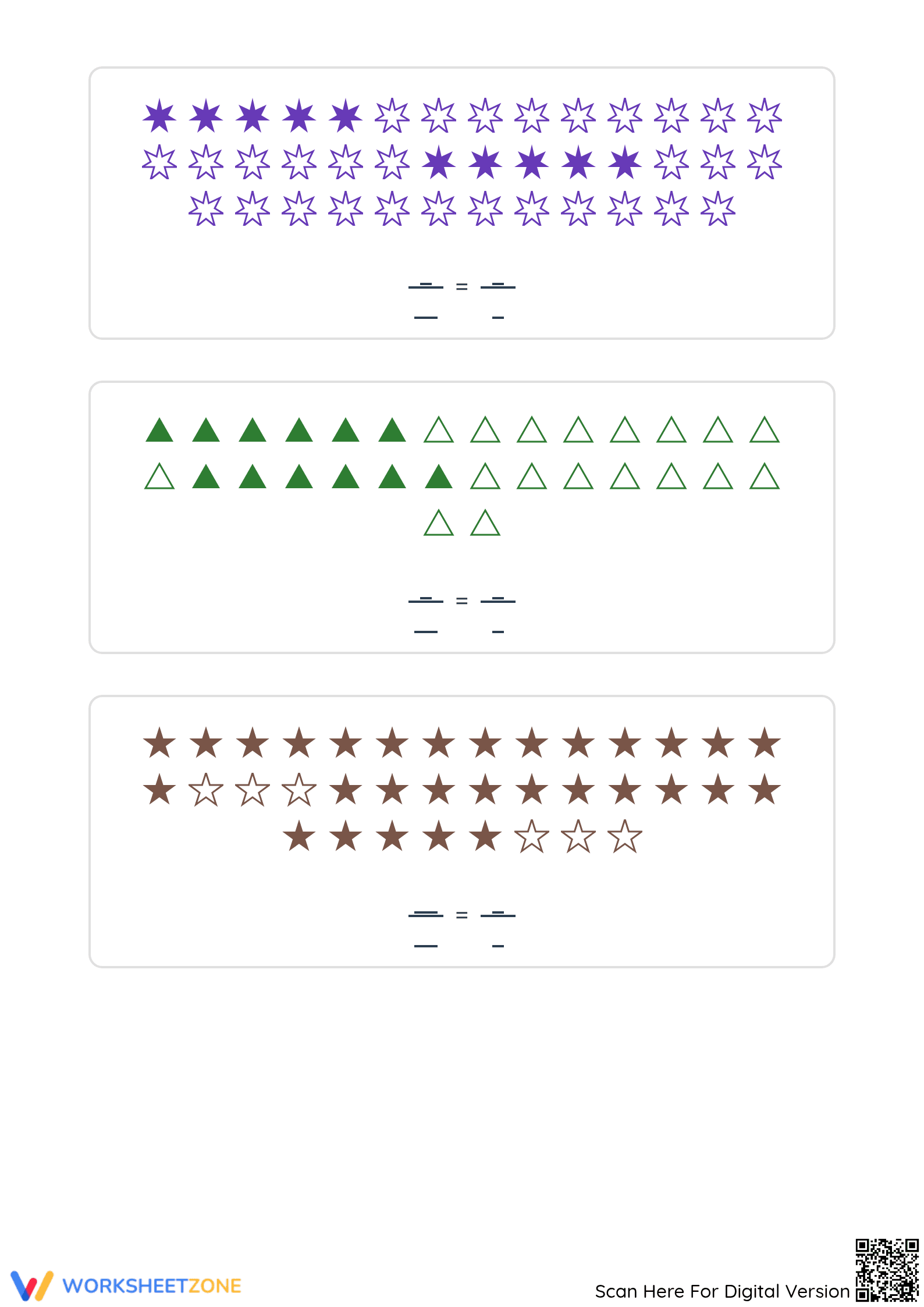
Modeling fractions as parts of a set is a fundamental skill for elementary and middle school mathematicians. This comprehensive 5-page worksheet uses groups of geometric shapes to help students visualize numerator and denominator relationships. By identifying filled versus total shapes, learners build a concrete understanding of fractional values, moving from basic identification to simplifying complex groups.
At a Glance
- Grade: 3–10 · Subject: Math
- Standard:
3.NF.A.1— Understand a fraction as the quantity formed by parts of a whole group- Skill Focus: Modeling fractions with sets and groups of shapes
- Format: 5 pages · 14 problems · Answer key included · PDF
- Best For: Introduction to fractions and set-model practice
- Time: 25–40 minutes
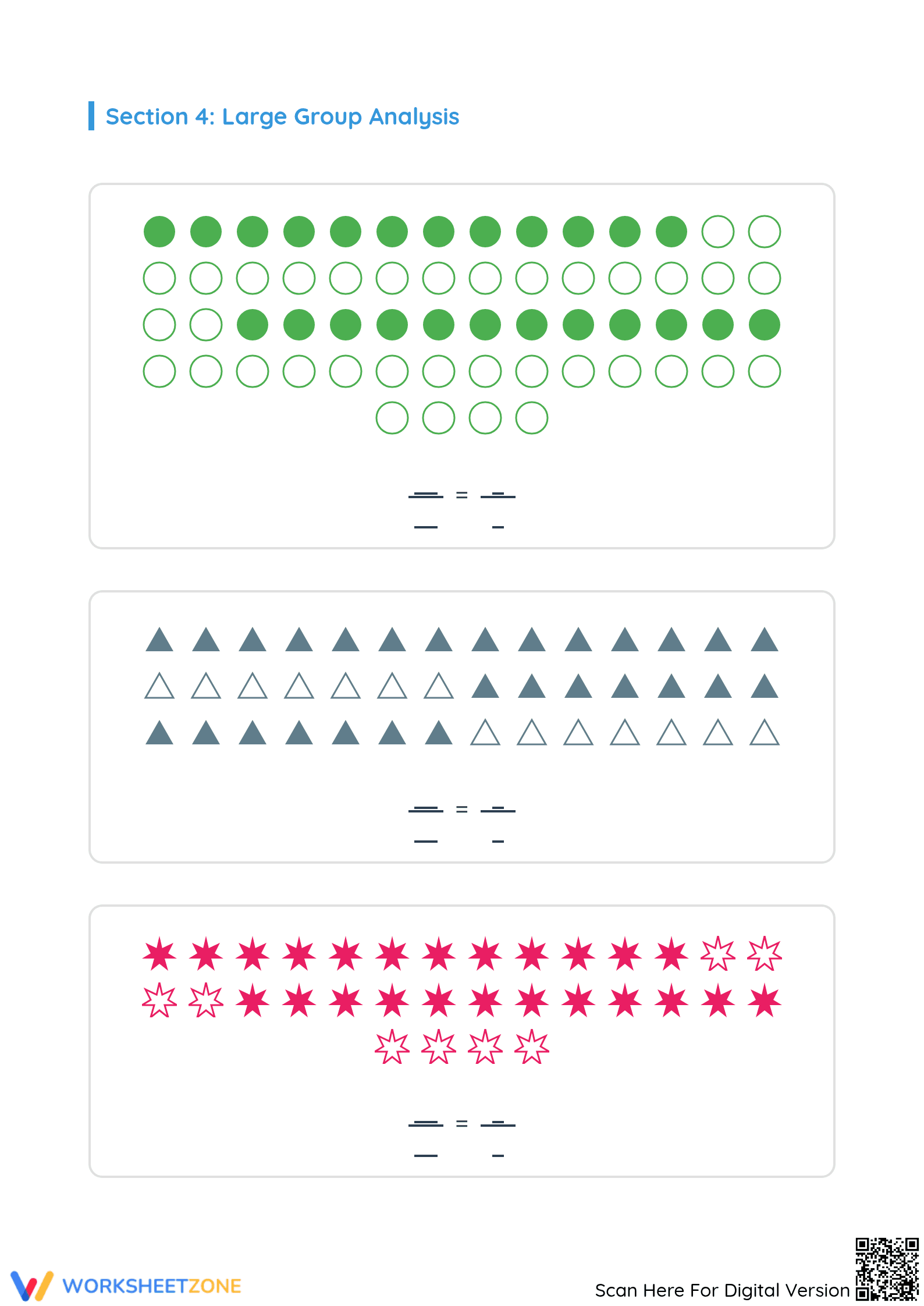
This 5-page PDF contains 14 distinct modeling problems organized by increasing complexity across four distinct sections. Each task presents a group of shapes—hexagons, stars, triangles, or squares—with a specific number shaded. Students must write the corresponding fraction and, where applicable, reduce it to its simplest form. The packet includes a clear worked example on the first page and a full answer key for immediate feedback.
Skill Progression
- Guided practice: The first section provides smaller groups (3–6 shapes) with large visual cues to help students establish the "part-over-total" concept using familiar hexagons and circles.
- Supported practice: Sections 2 and 3 introduce larger sets and different shape orientations, requiring students to count more carefully while maintaining the conceptual link to the total group size.
- Independent practice: The final "Large Group Analysis" section challenges students to model fractions from sets of 20 or more items, promoting fluency and preparation for simplifying larger fractions.
The worksheet follows a gradual-release model, beginning with direct visual modeling and concluding with complex set analysis to ensure deep conceptual understanding.
Standards Alignment
The primary alignment for this resource is 3.NF.A.1, which requires students to understand a fraction as the quantity formed by parts of a whole. While the standard often refers to partitioned area models, applying this to a group of objects is a critical transition to set models used in higher-level statistics and probability. This resource also supports 4.NF.A.1 by requiring students to show answers in simplest form. Both standard codes can be copied directly into lesson plans, IEP goals, or district curriculum mapping tools.
How to Use It
Assign this worksheet during the independent practice phase of a lesson on set models or as a formative assessment after introducing the concept of numerators and denominators. Teachers can observe students as they count the total number of items to identify those struggling with the "whole" versus "part" distinction. The expected completion time is approximately 30 minutes for a typical student, making it an excellent option for morning work or a focused math station.
Who It's For
This resource is designed for Grade 3–10 students first learning fractions or for older students requiring targeted intervention on set-model visualization. It pairs naturally with a math center rotation involving physical manipulatives, such as two-color counters, or a direct instruction lesson. The inclusion of an answer key also makes it suitable for independent study or as a high-quality substitute teacher plan.
This worksheet utilizes visual models and set representations to teach fractions, addressing the misconception that fractions only apply to physically sliced objects. Supported by research emphasizing varied representations, it offers structured practice for developing a flexible and deep understanding of fractional concepts, essential for future mathematical progression.


