


























Views
Downloads


Essential Modeling Fractions with Groups of Shapes | Grade 3
Paste this activity's link or code into your existing LMS (Google Classroom, Canvas, Teams, Schoology, Moodle, etc.).
Students can open and work on the activity right away, with no student login required.
You'll still be able to track student progress and results from your teacher account.
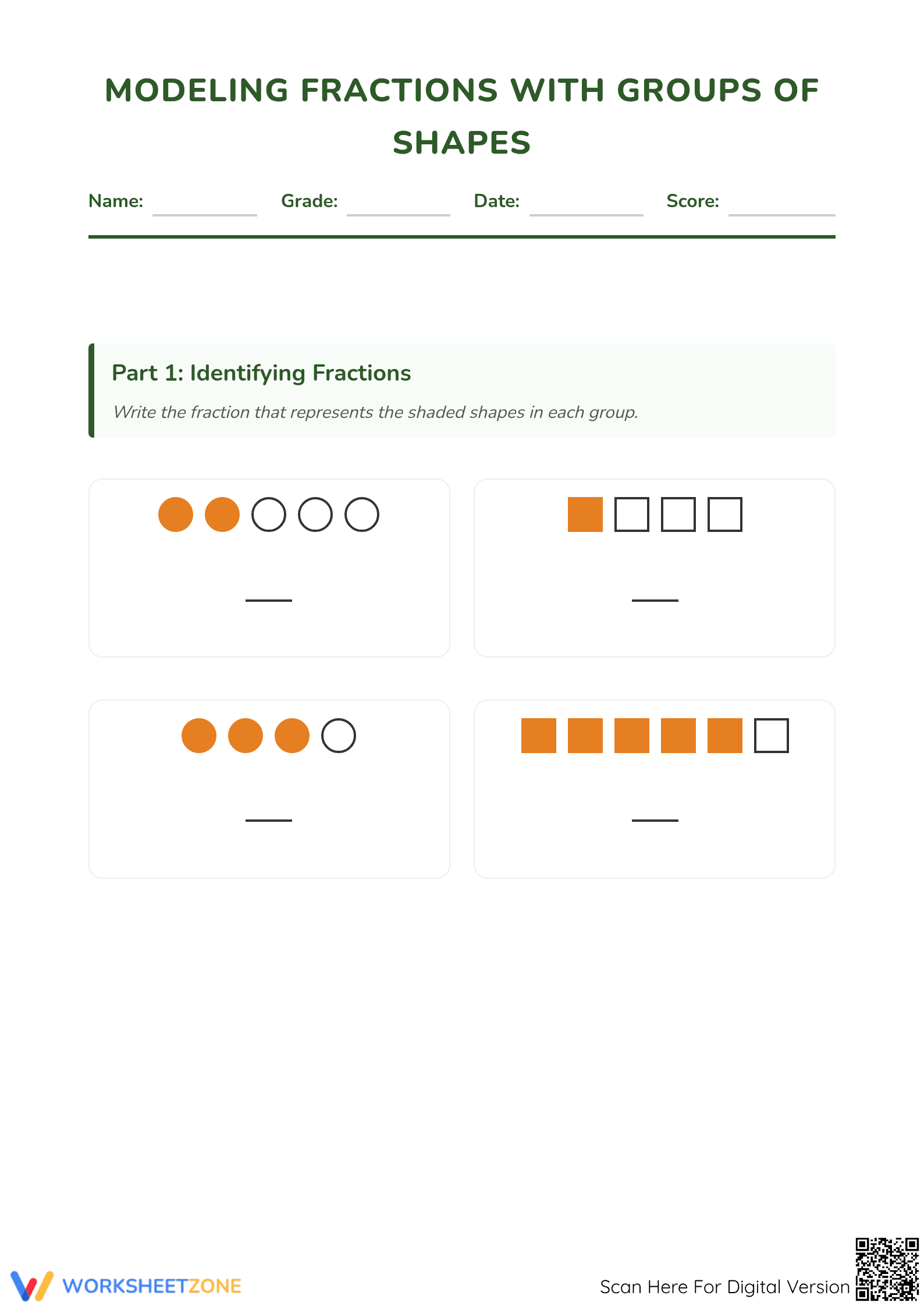
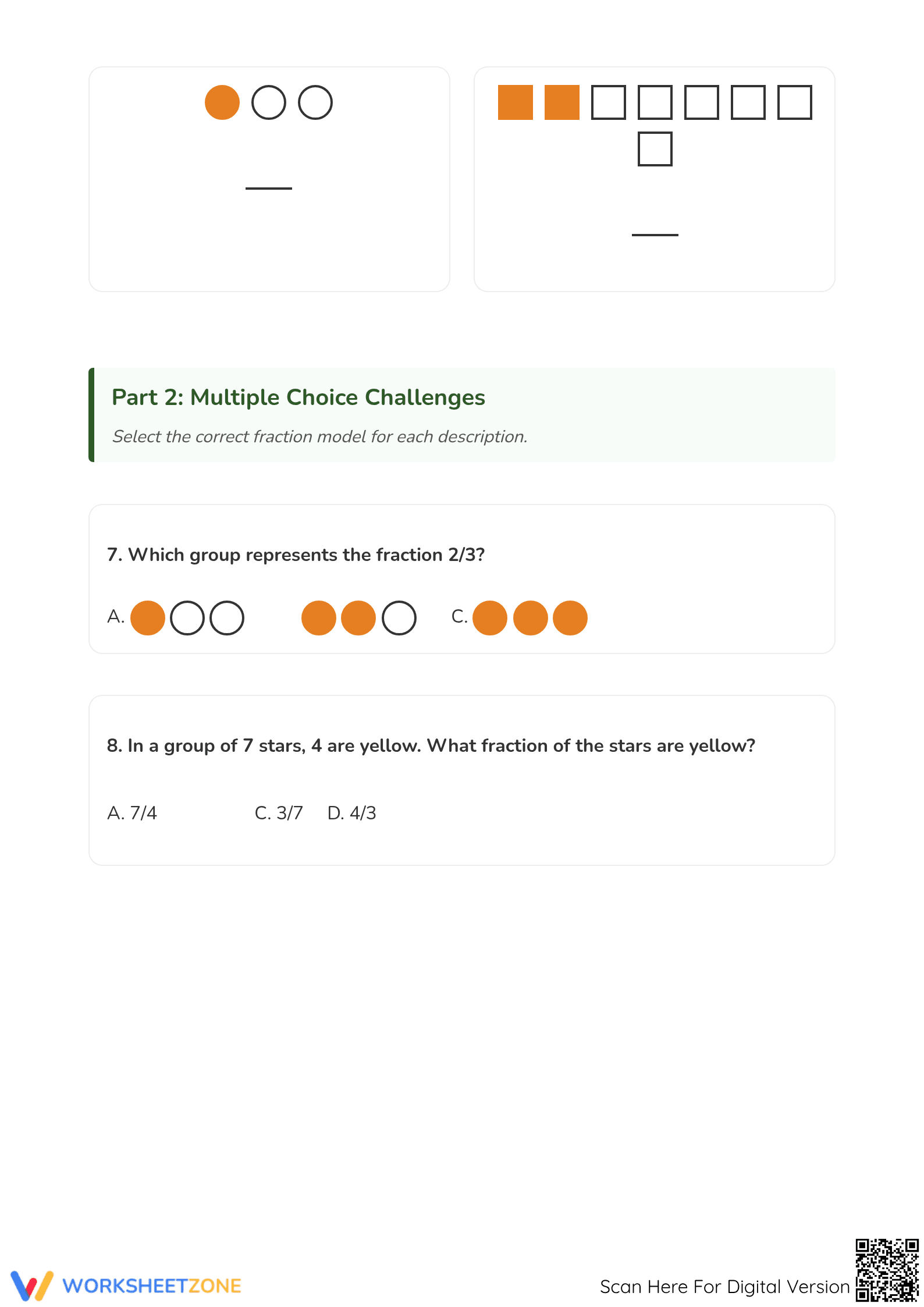
Students master the concept of parts-of-a-set using this comprehensive fractions pack. By identifying shaded shapes, drawing custom models, and solving real-world word problems, learners bridge the gap between abstract numbers and visual representations. It ensures a deep understanding of numerators and denominators within various group configurations to improve overall math fluency.
At a Glance
- Grade: 3 · Subject: Math
- Standard:
3.NF.A.1— Understand fractions as the quantity formed by parts of a partitioned whole or set.- Skill Focus: Modeling fractions with shapes and sets
- Format: 5 pages · 16 problems · Answer key included · PDF
- Best For: Guided practice and formative assessment
- Time: 30–45 minutes
This 5-page PDF bundle includes sixteen structured tasks across four distinct sections. Students move from identifying fractions in shaded groups to multiple-choice challenges and creative drawing models. The final section features real-world word problems involving shared sets, complete with a teacher-ready answer key for immediate feedback and grading efficiency.
Skill Progression
- Guided Practice: The first six problems provide clear visual cues where students identify fractions based on shaded shapes within sets of four to six items to establish baseline understanding.
- Supported Practice: Learners tackle multiple-choice and drawing tasks that require them to translate numerical fractions into visual representations of specific group sizes without pre-drawn guides.
- Independent Practice: The worksheet concludes with four contextual word problems requiring students to extract data and calculate fractions from scenarios like sharing pizza or counting birds on a wire.
This sequence follows a gradual-release model, moving from simple observation to creation and then high-level application.
Standards Alignment
Primary alignment is CCSS.MATH.CONTENT.3.NF.A.1: "Understand a fraction 1/b as the quantity formed by 1 part when a whole is partitioned into b equal parts; understand a fraction a/b as the quantity formed by a parts of size 1/b." This resource specifically supports the transition from area models to set models. Both standard codes can be copied directly into lesson plans, IEP goals, or district curriculum mapping tools.
How to Use It
Assign this during the independent practice portion of a lesson on fractions as part of a set to verify student grasp of denominators versus numerators. As a formative-assessment tip, observe students during Part 3 (Drawing Models) to see if they can accurately partition their own sets without pre-drawn guides. Completion usually takes 35 minutes for most learners.
Who It's For
Ideal for third-grade students beginning their fraction journey, fourth-grade review, or RTI small groups. It serves as a natural pairing for concrete manipulatives like plastic counters or a direct instruction lesson on parts of a whole. Teachers can use it as a standalone assessment or a homework packet.
According to the CCSS.MATH.CONTENT.3.NF.A.1 standard, students must move beyond simple area models to understand fractions within sets. This printable resource provides the essential scaffold for this cognitive shift, using 16 varied problems to build fluency in identifying and creating fraction models. Research from EdReports (2024) emphasizes that high-quality visual modeling is critical for preventing the whole number bias common in early fraction learners. By integrating identifying, drawing, and word problem solving, this worksheet addresses the multi-modal requirements of the National Assessment of Educational Progress (NAEP) frameworks. It provides the structured repetition needed for long-term retention of numerator and denominator functions across different contexts. This citation-ready capsule confirms the resource meets rigorous educational standards for Grade 3 mathematics instruction and assessment readiness, providing measurable evidence of student growth in fractional reasoning and visual-spatial math skills.


