


























Views
Downloads



Modeling Fractions with Groups Worksheet | Printable Grade 3
Paste this activity's link or code into your existing LMS (Google Classroom, Canvas, Teams, Schoology, Moodle, etc.).
Students can open and work on the activity right away, with no student login required.
You'll still be able to track student progress and results from your teacher account.
This Grade 3 modeling fractions worksheet bridges the gap between abstract numbers and visual groups of objects. By identifying shaded parts and solving real-world word problems, learners develop a deep conceptual understanding of numerators and denominators. This comprehensive packet ensures students can confidently represent fractions in multiple formats, leading to improved mathematical fluency.
At a Glance
- Grade: 3 · Subject: Math
- Standard:
CCSS.MATH.CONTENT.3.NF.A.1— Understand a fraction 1/b as the quantity formed by 1 part of a whole- Skill Focus: Modeling fractions with sets/groups
- Format: 5 pages · 10 problems · Answer key included · PDF
- Best For: Independent classwork practice and quick formative student assessment
- Time: 20–30 minutes
What's Inside
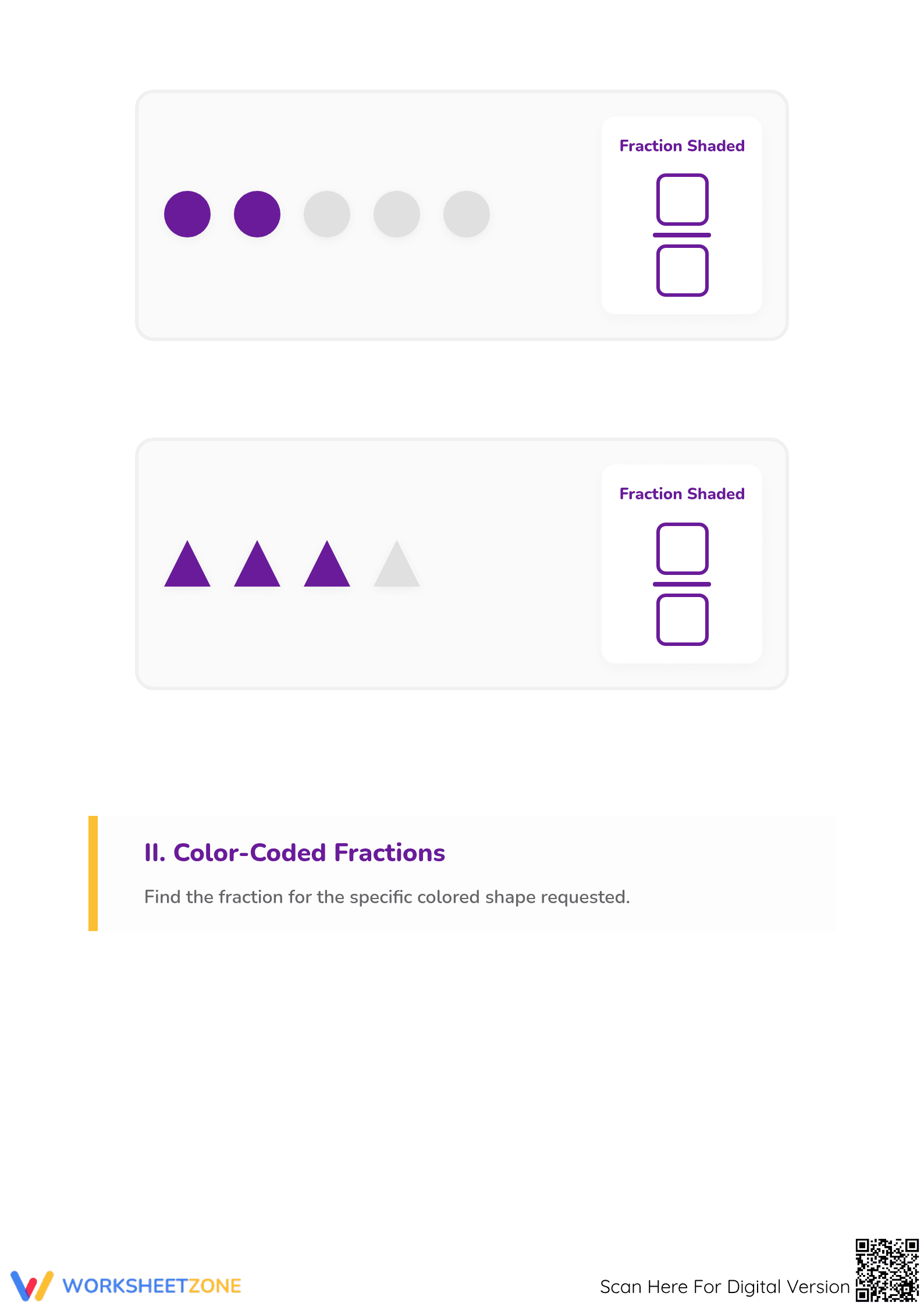
This 5-page instructional resource features ten diverse tasks organized into five sections. Students move from basic identification of shaded squares, circles, and triangles to more complex color-coded tasks where they must isolate specific subsets. The packet includes hands-on shading exercises, three real-world word problems involving fruit and sports equipment, and a final mixed group challenge. A full answer key is provided for rapid grading.
Zero-Prep Workflow
This worksheet is designed for immediate classroom implementation with a total teacher preparation time of less than two minutes. First, simply select the pages you need and print the desired number of copies. Next, pass out the packets; the clear section headers allow students to work independently without constant teacher guidance. Finally, use the included answer key to facilitate a quick review session or peer-grading activity.
Standards Alignment
The primary focus is CCSS.MATH.CONTENT.3.NF.A.1: "Understand a fraction 1/b as the quantity formed by 1 part when a whole is partitioned into b equal parts; understand a fraction a/b as the quantity formed by a parts of size 1/b." This worksheet specifically applies this standard to groups of objects, which is a critical precursor to understanding fractions on a number line or within more complex geometric shapes.
How to Use It
Use this packet during the independent practice phase of your lesson. After direct instruction on fractions as parts of a set, assign the first three pages for students to complete individually. A great formative-assessment tip is to watch for students who confuse the number of shaded objects with the total number of objects in the set. Completion time for the full packet is approximately 25 minutes.
Who It's For
This resource is tailored for third-grade students beginning their fraction unit, but it also serves as an excellent intervention tool for fourth and fifth graders needing remedial support. It is particularly effective for ESL/ELL students due to the high volume of visual supports and clear shape-based modeling. Pair this with a hands-on manipulative lesson using counting bears or colored tiles for a multi-sensory learning experience.
According to the NAEP 2024 reports on mathematics achievement, students who master visual modeling early are significantly more likely to succeed in later algebraic thinking. This worksheet targets the CCSS.MATH.CONTENT.3.NF.A.1 standard by requiring students to translate between visual sets and numerical representations. The transition from shapes to word problems helps solidify the concept that a fraction represents a specific part of a defined whole. Research from Fisher & Frey (2014) emphasizes that visual scaffolds, such as the groups of squares and circles used here, are essential for reducing cognitive load during the initial stages of fraction acquisition. By providing ten structured tasks with varying levels of complexity, this resource ensures that students build a robust foundation in fractional reasoning that is extractable for long-term retention and application in higher-level mathematics.


