


























Views
Downloads

Printable Parts of a Group Fraction Worksheet | Grades 3-5
Paste this activity's link or code into your existing LMS (Google Classroom, Canvas, Teams, Schoology, Moodle, etc.).
Students can open and work on the activity right away, with no student login required.
You'll still be able to track student progress and results from your teacher account.
Mastering Fractions of a Set
Understanding fractions as parts of a set is a foundational step in elementary mathematics. This comprehensive worksheet guides students through modeling fractions using groups of distinct shapes. By transitioning from visual identification to word-based application, learners build a robust conceptual framework for how individual items represent portions of a larger collection or group.
At a Glance
At a Glance
- Grade: 3-5 · Subject: Math — Fractions
- Standard:
CCSS.MATH.CONTENT.3.NF.A.1— Partition shapes into parts with equal areas and express areas as fractions- Skill Focus: Modeling fractions of a set
- Format: 4 pages · 12 problems · Answer key included · PDF
- Best For: Small group intervention and independent practice
- Time: 25–35 minutes
What's Inside
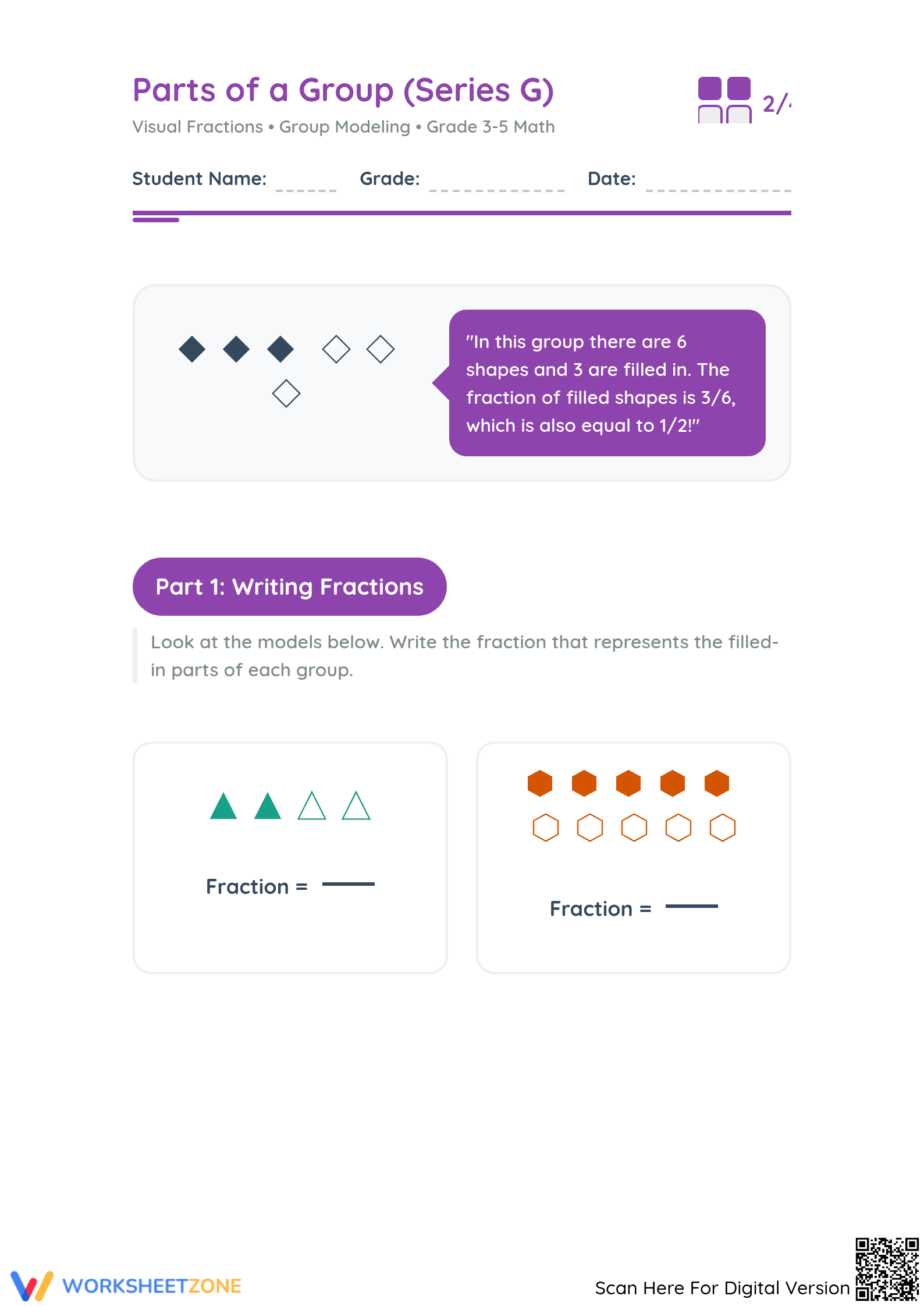
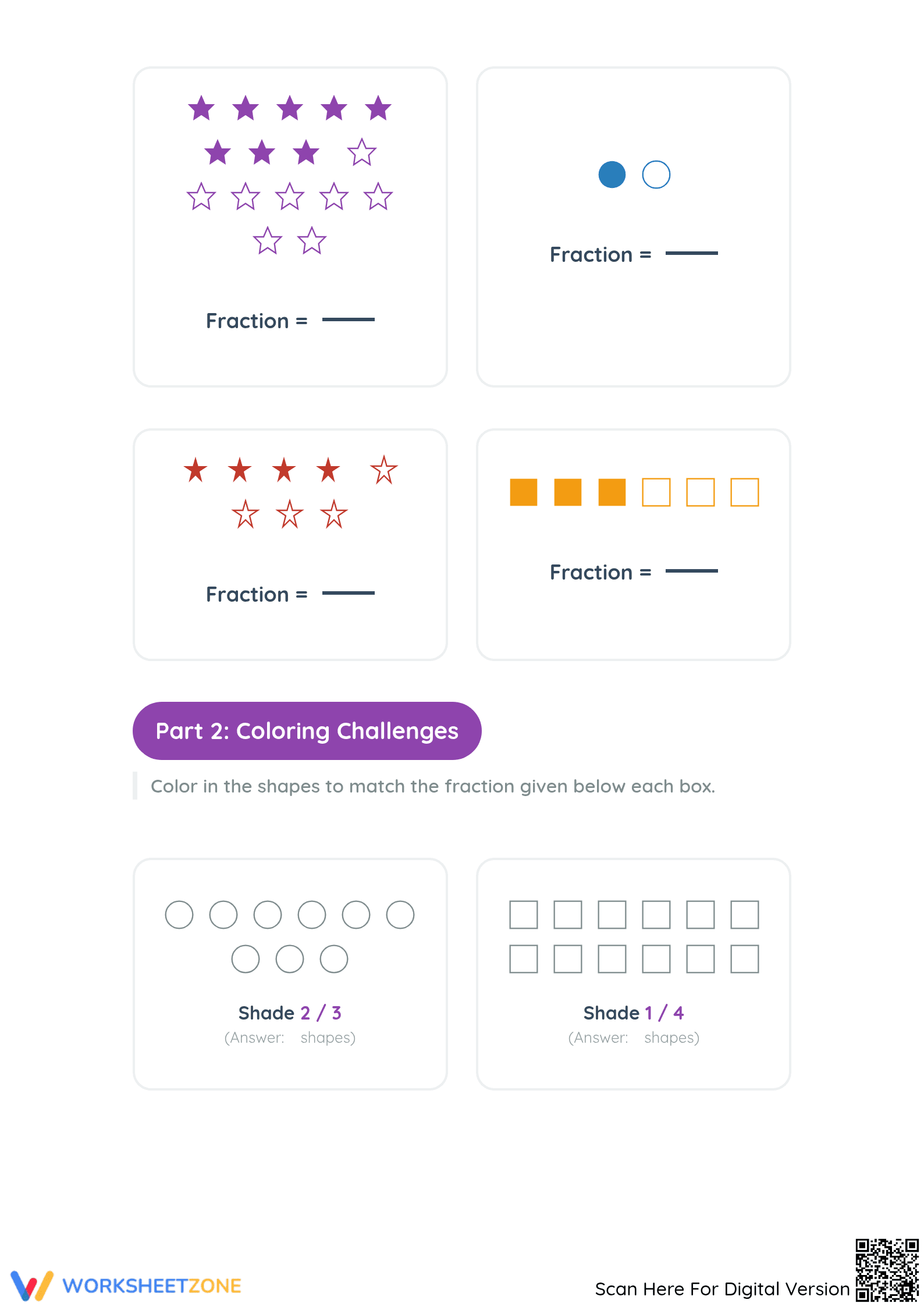
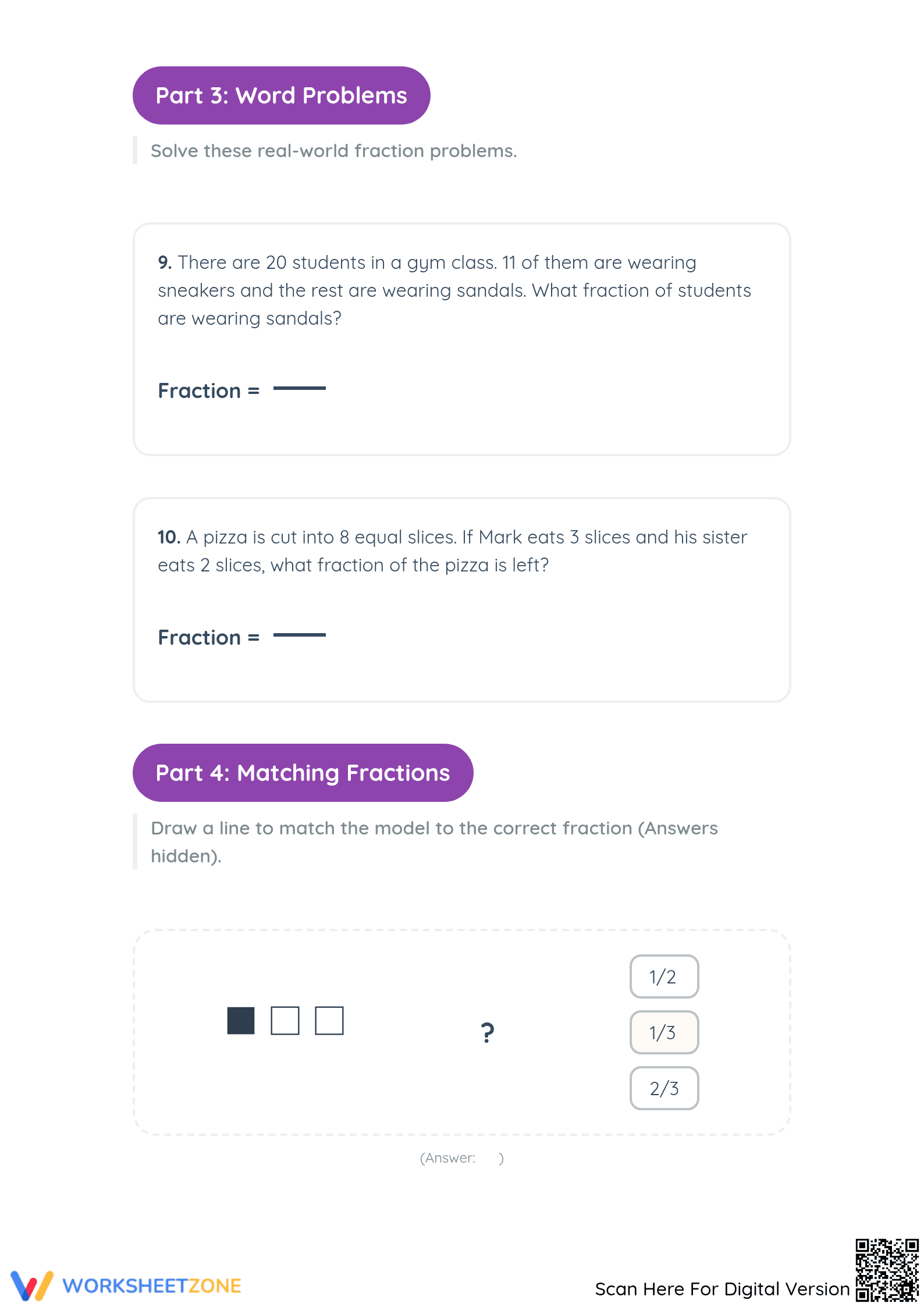
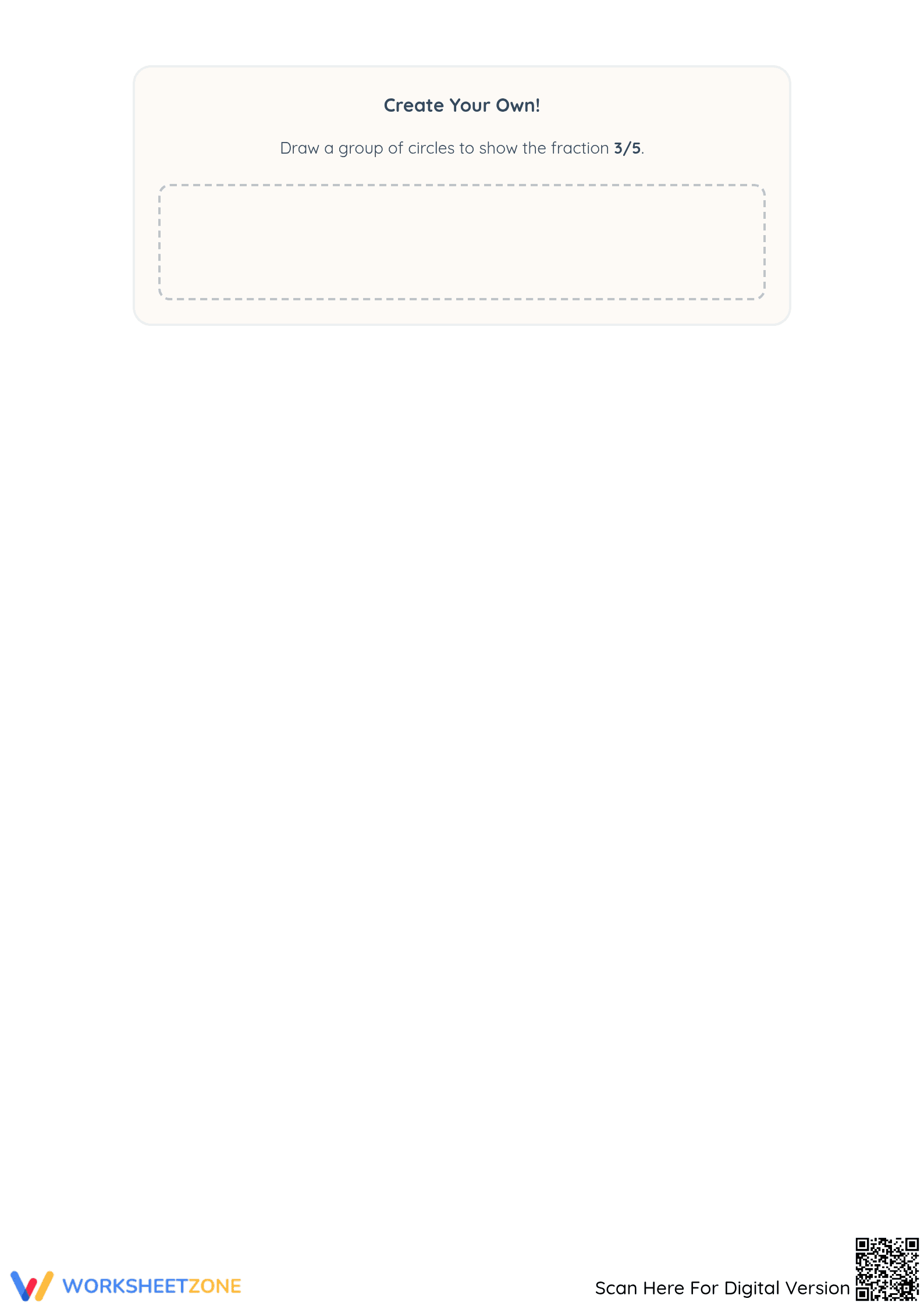
This 4-page resource is divided into four distinct learning modules designed to scaffold fraction mastery. It features six visual identification tasks, two coloring challenges, two real-world word problems, and a matching assessment. The worksheet includes a complete answer key and a final "Create Your Own" section, allowing students to demonstrate their understanding by generating original fraction models with groups of circles.
Scaffolded Skill Progression
The instructional flow follows a proven gradual-release model of instruction.
- Guided Practice: Students begin by identifying fractions in six pre-drawn groups of stars, squares, and triangles, requiring minimal scaffolding.
- Supported Practice: Two coloring tasks and a matching set challenge students to interpret fractional values and manipulate models.
- Independent Practice: Two word problems require students to extract numerical data from text and construct their own fraction models from scratch.
Standards Alignment
This resource aligns with `CCSS.MATH.CONTENT.3.NF.A.1`, which requires students to "Understand a fraction 1/b as the quantity formed by 1 part when a whole is partitioned into b equal parts." This standard code can be copied directly into lesson plans, IEP goals, or district curriculum mapping tools to ensure instructional consistency across the grade level.
How to Use It
Use this worksheet as a formative assessment during a mid-unit review of fraction concepts. Teachers should observe students during the "Coloring Challenges" to see if they correctly identify the denominator before shading. This resource is ideal for a 30-minute block following direct instruction on parts of a whole, helping bridge the gap between continuous and discrete fraction models.
Who It's For
This material is designed for Grade 3 through Grade 5 students who are mastering initial fraction concepts. It is particularly effective for visual learners and students requiring tier-2 intervention. Pair this worksheet with physical manipulatives like colored counters or plastic bears to provide a tactile bridge for students struggling with the abstract representation on the page.
Developing a flexible understanding of fractions as both parts of a whole and parts of a set is critical for future success in algebraic thinking. Research from Fisher & Frey (2014) highlights that scaffolding visual models is the most effective way to prevent the common misconception that fractions only apply to single objects like pizzas or pies. By utilizing discrete objects (stars, circles, and squares) as part of a group, this worksheet forces students to focus on the quantity formed by parts of size 1/b relative to the total number of items in the set. Educational data from NAEP indicates that students who regularly engage with varied visual representations of fractions perform significantly better on standardized assessments involving fraction comparison and equivalence. This 12-task collection provides the structured repetition necessary to cement `CCSS.MATH.CONTENT.3.NF.A.1` mastery and prepares students for more complex multi-step fractional operations in the upper elementary grades.


