


























Views
Downloads


Modeling Fractions with Shapes Worksheet | Essential Grade 3
Paste this activity's link or code into your existing LMS (Google Classroom, Canvas, Teams, Schoology, Moodle, etc.).
Students can open and work on the activity right away, with no student login required.
You'll still be able to track student progress and results from your teacher account.
Master the foundational concept of fractions with this comprehensive modeling worksheet designed for elementary learners. Students visualize fractional parts as subsets of a whole group, moving from concrete shape identification to abstract word problem solving. This resource ensures a deep understanding of how numerators and denominators represent parts within a collective set of objects.
At a Glance
- Grade: 3 · Subject: Math
- Standard:
3.NF.A.1— Identify the fraction represented by a shaded subset within a larger group- Skill Focus: Modeling fractions of a set
- Format: 5 pages · 17 problems · Answer key included · PDF
- Best For: Independent practice and conceptual reinforcement
- Time: 25–35 minutes
What's Inside
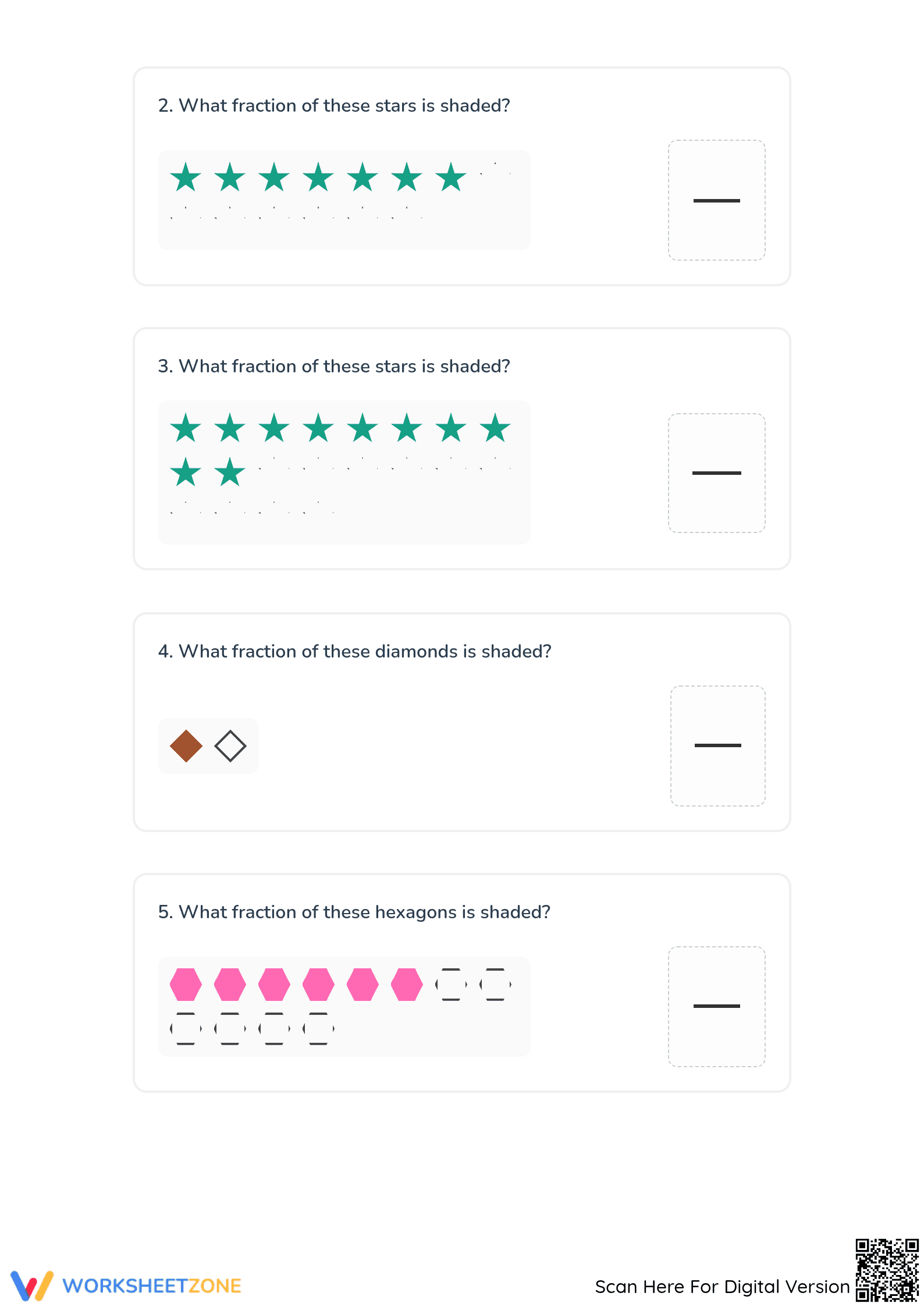
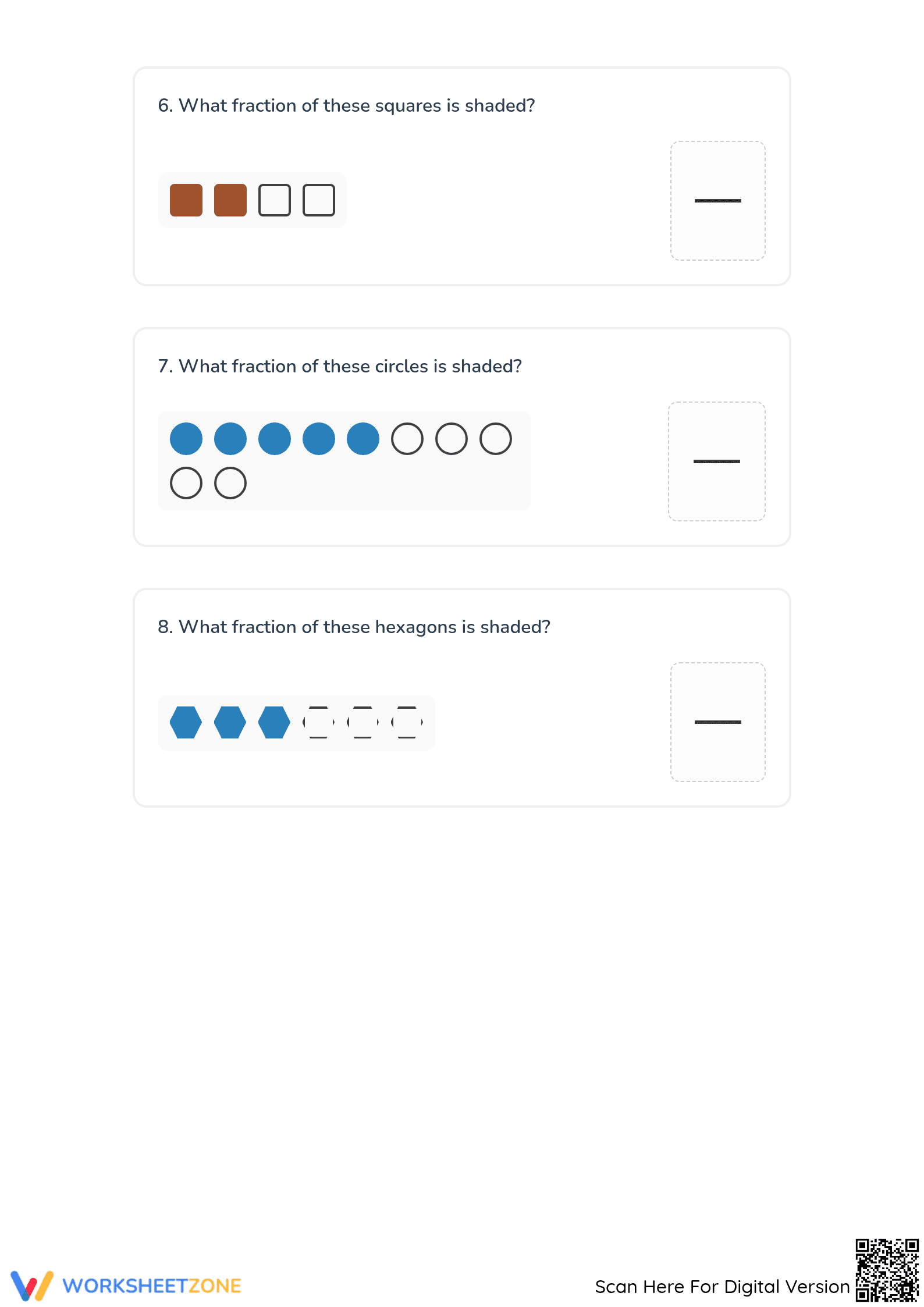
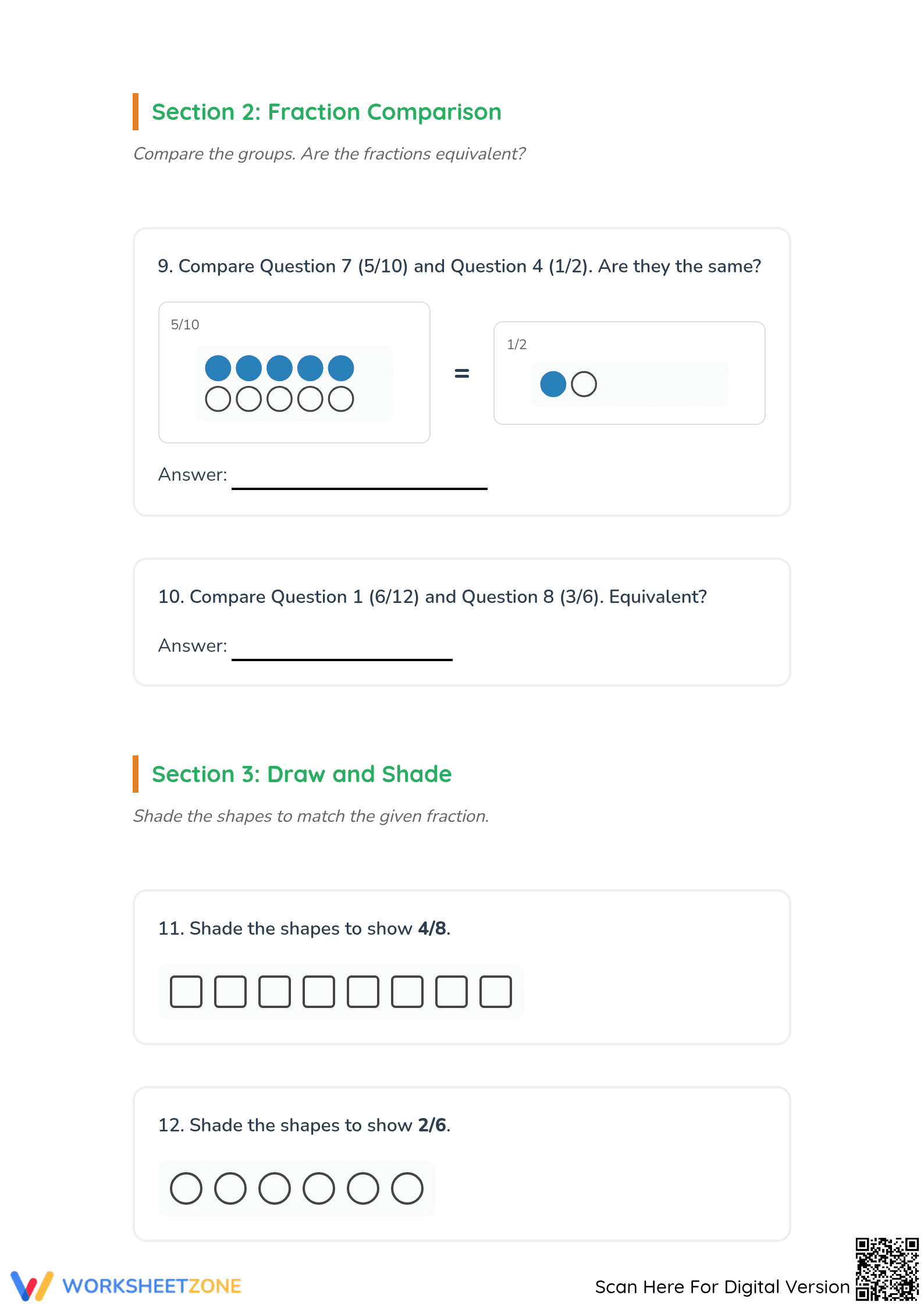
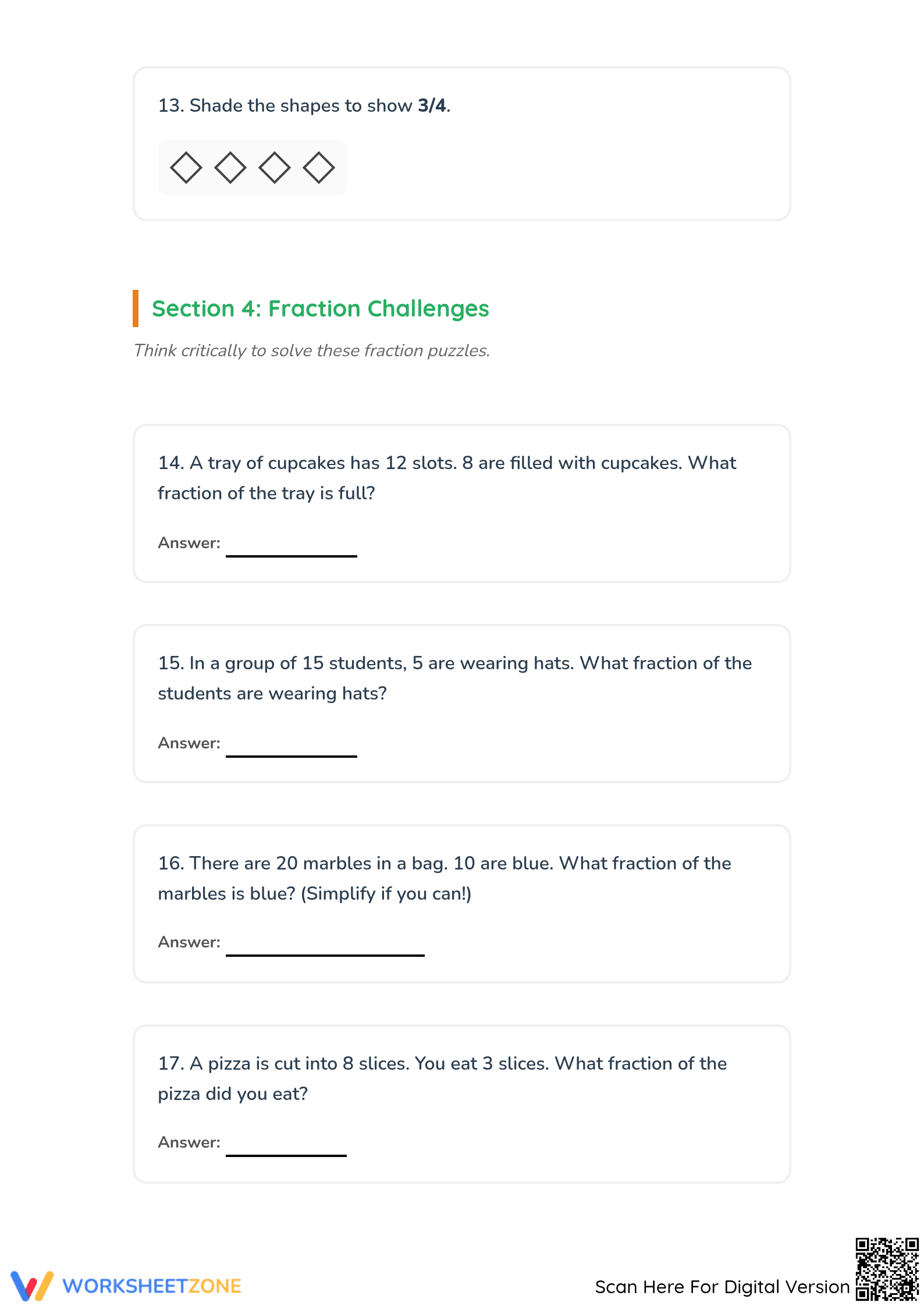
This five-page PDF package provides a structured pathway to mastery. It begins with a conceptual review and a worked example involving 16 triangles. The worksheet includes 17 tasks across four sections, featuring shape sets, equivalent fraction comparisons, and shading activities. A complete answer key is provided to facilitate rapid grading.
Skill Progression
- Guided Practice: The initial eight problems provide visual support, requiring students to identify shaded portions of star, diamond, and hexagon sets.
- Supported Practice: Students advance to fraction comparison and drawing tasks, analyzing equivalent groups like 5/10 and 1/2 while shading grids.
- Independent Practice: Final challenge problems present real-world scenarios—cupcakes, marbles, and pizza—requiring learners to translate text into simplified fractional representations.
This gradual-release approach ensures students build confidence as they move from simple identification to complex application.
Standards Alignment
The core focus of this material is CCSS.MATH.CONTENT.3.NF.A.1, which requires students to understand a fraction as the quantity formed by parts of a certain size. By using groups of shapes, this resource effectively bridges the gap between area models and set models. These standard codes can be copied directly into lesson plans, IEP goals, or district curriculum mapping tools.
How to Use It
Integrate this worksheet during the "You Do" phase of a gradual-release instructional model after a direct lesson on set models. As a formative assessment tip, observe students during Section 2 to see if they recognize the relationship between equivalent sets. This activity is designed for completion within a standard 30-minute math block or as a homework assignment.
Who It's For
This resource is ideal for third-grade students initially exploring fractions, as well as older learners needing intervention to reinforce the part-to-whole relationship. It pairs naturally with physical manipulatives, such as colored counters or pattern blocks, which allow students to physically model the groups of shapes before recording their findings on the worksheet.
Research from Fisher & Frey (2014) highlights the importance of the gradual release of responsibility in mathematics, moving students from scaffolded visual identification to independent application. This worksheet utilizes set models, which are often more challenging for students than area models but crucial for developing a versatile understanding of rational numbers. By providing 17 distinct tasks that incorporate both identifying and creating fractions, the resource addresses the NAEP findings that emphasize the need for diverse representations in early numeracy. The inclusion of word problems in the final section aligns with current pedagogical standards that favor contextualized problem-solving over rote calculation. This 5-page PDF provides the necessary repetition and conceptual variety to ensure students can translate between concrete visuals and symbolic fraction notation effectively. Educators can use these results to track student progress against CCSS.MATH.CONTENT.3.NF.A.1 goals with high confidence in the data's reliability for instructional planning.


