


























Views
Downloads




Essential Modeling Fractions with Groups of Shapes Worksheet
Paste this activity's link or code into your existing LMS (Google Classroom, Canvas, Teams, Schoology, Moodle, etc.).
Students can open and work on the activity right away, with no student login required.
You'll still be able to track student progress and results from your teacher account.
This comprehensive modeling fractions with groups of shapes worksheet empowers students to visualize numerical values through tangible geometric sets. By transitioning from concrete shape groups to abstract fractional notation, learners build a robust foundation for more complex rational number operations. This resource ensures students move beyond rote memorization toward conceptual mastery of part-to-whole relationships.
At a Glance
- Grade: 3 · Subject: Math
- Standard:
CCSS.MATH.CONTENT.3.NF.A.1— Understand a fraction as parts of a whole or set- Skill Focus: Modeling fractions with sets of objects
- Format: 5 pages · 21 problems · Answer key included · PDF
- Best For: Small group instruction and independent practice
- Time: 30–45 minutes
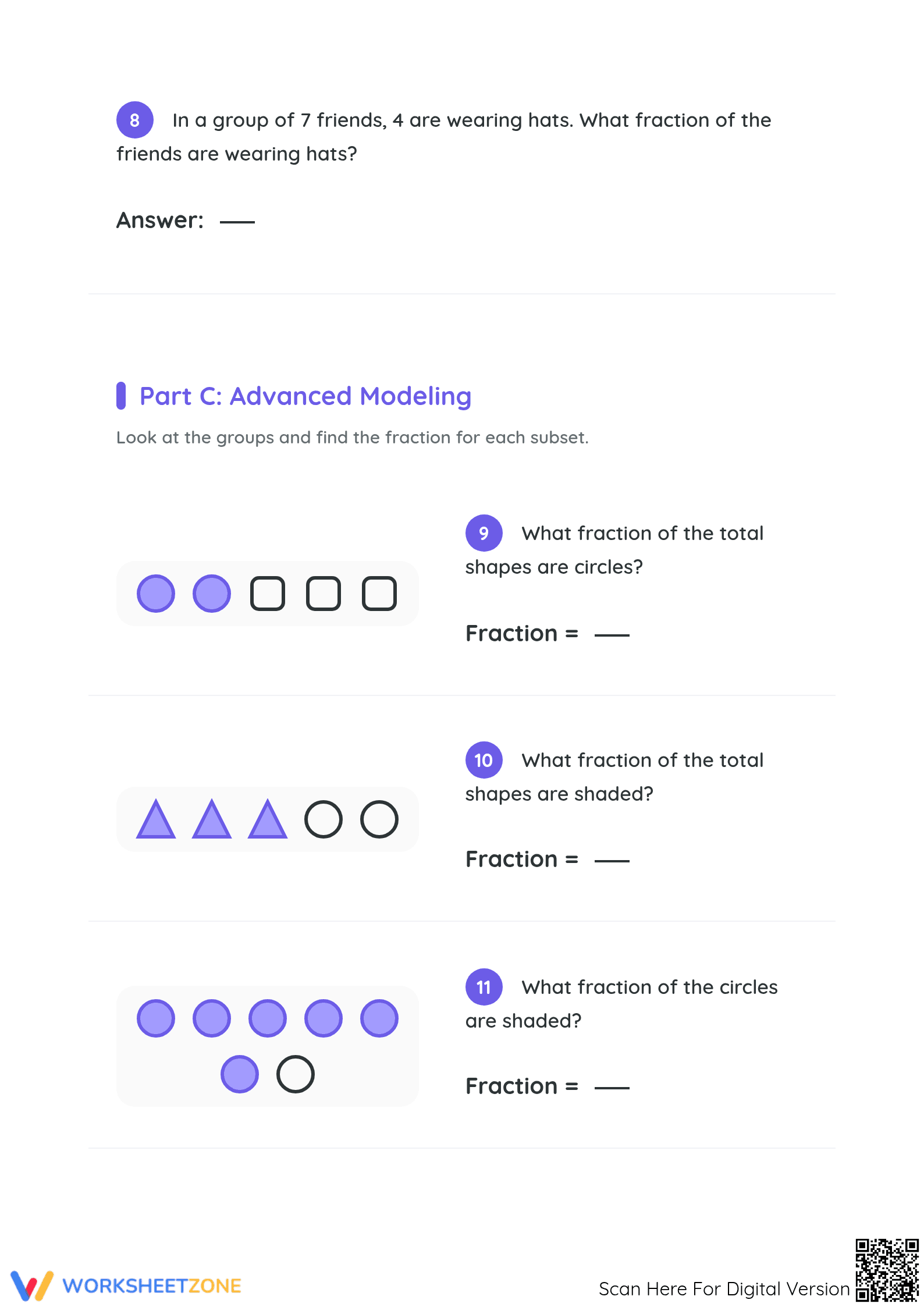
What's Inside: This 5-page PDF packet contains 21 structured problems divided into four distinct sections. Part A focuses on identifying fractions from basic shape groups, while Part B introduces three real-world word problems. Part C provides advanced modeling with subsets, and Part D concludes with shading exercises. A full answer key is included to facilitate immediate feedback and student self-correction during the learning process.
Skill Progression: The worksheet follows a gradual release model to ensure student success.
- Guided Practice: The first 5 problems use clear, uniform shape groups (circles, hearts, triangles) to help students identify the numerator and denominator with high visual support.
- Supported Practice: Problems 6 through 11 transition into word-based scenarios and mixed-set modeling, requiring students to translate text and complex visuals into fractional parts.
- Independent Practice: The final 10 tasks, including shading and advanced subset identification, challenge students to apply their knowledge autonomously to demonstrate complete conceptual mastery.
Standards Alignment: This resource is explicitly aligned to `CCSS.MATH.CONTENT.3.NF.A.1`, which requires students to "understand a fraction 1/b as the quantity formed by 1 part when a whole is partitioned into b equal parts." It specifically addresses the application of this standard to sets of objects rather than just area models. This standard code can be copied directly into lesson plans, IEP goals, or district curriculum mapping tools.
How to Use It: Deploy this worksheet during the "during" phase of direct instruction to bridge the gap between hands-on manipulatives and paper-based assessment. For a formative-assessment observation tip, watch students as they count the total number of objects in a set; if they struggle to determine the denominator, provide a physical counter to place over each shape. Most students will complete the 21 tasks in approximately 35 minutes.
Who It's For: This resource is designed for Grade 3 students beginning their fraction journey, though it serves as excellent remediation for Grade 4 or 5 learners. It pairs naturally with a fraction circle anchor chart or a short lesson using two-color counters. The visual nature of the shapes makes it particularly effective for English Language Learners and students with IEP accommodations requiring visual aids.
Drawing on research by Fisher & Frey (2014), this worksheet employs a gradual release model, layering task complexity across 21 problems to foster mathematical literacy in representing abstract numbers through visual models. NAEP 2024 reports indicate that proficiency in diverse fraction models, including sets, improves higher-level algebraic reasoning. Aligned with CCSS.MATH.CONTENT.3.NF.A.1, this tool moves students beyond mere identification to understanding the multiplicative relationship between unit fractions and whole sets, providing scaffolded practice crucial for long-term retention of rational number concepts.


