


























Views
Downloads

Modeling Fractions: Parts of a Group Printable Worksheet
Paste this activity's link or code into your existing LMS (Google Classroom, Canvas, Teams, Schoology, Moodle, etc.).
Students can open and work on the activity right away, with no student login required.
You'll still be able to track student progress and results from your teacher account.
This printable modeling fractions worksheet helps students bridge the gap between abstract numbers and visual representations. By identifying fractions as parts of a group, learners build a concrete understanding of numerators and denominators. This resource ensures students can accurately translate visual sets of shapes and real-world scenarios into simplified mathematical notation.
At a Glance
- Grade: 3–6 · Subject: Math (Fractions)
- Standard:
CCSS.MATH.CONTENT.3.NF.A.1— Understand a fraction 1/b as the quantity formed by 1 part- Skill Focus: Parts of a Group & Simplification
- Format: 3 pages · 14 problems · Answer key included · PDF
- Best For: Small group instruction or independent practice
- Time: 20–30 minutes
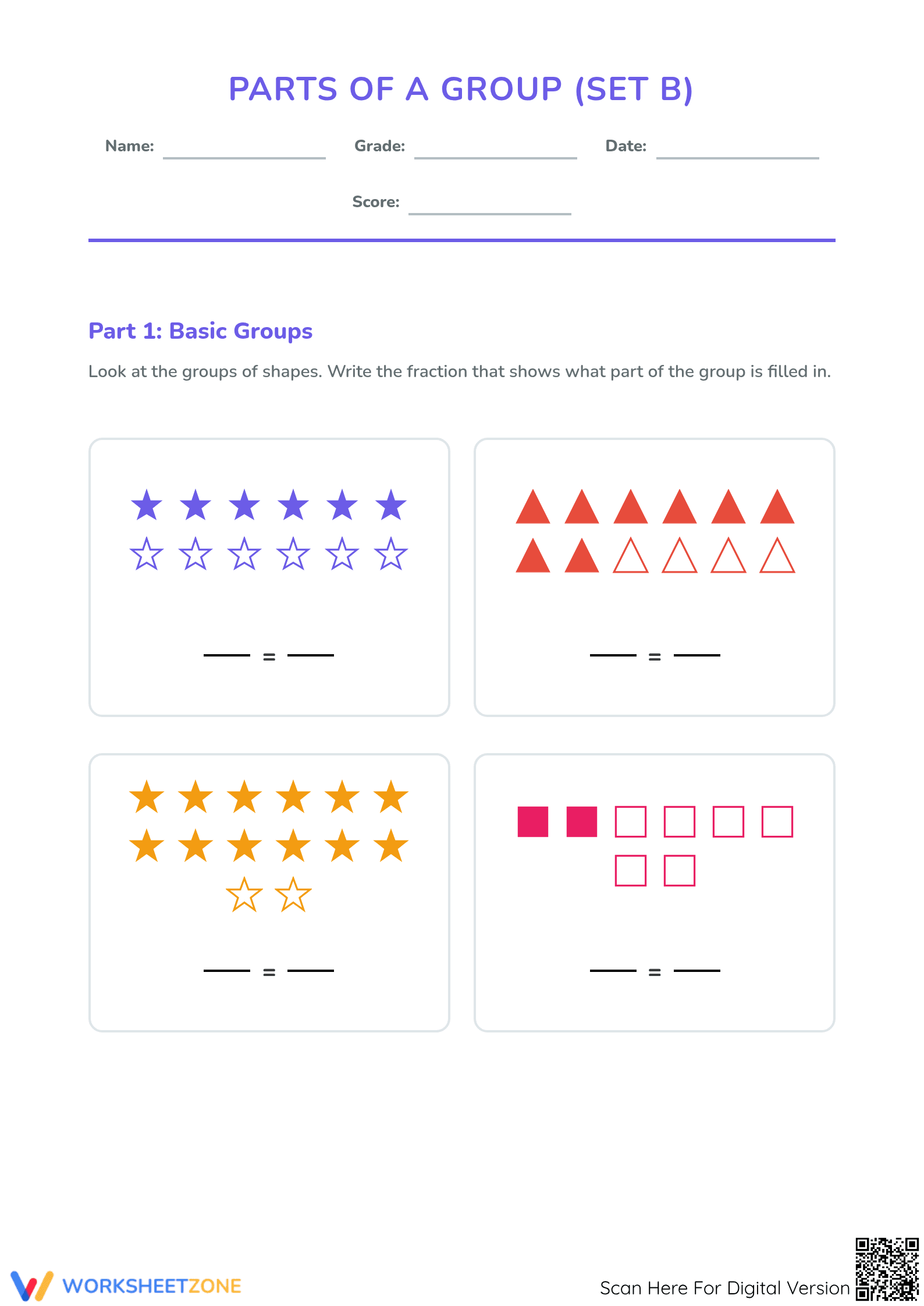
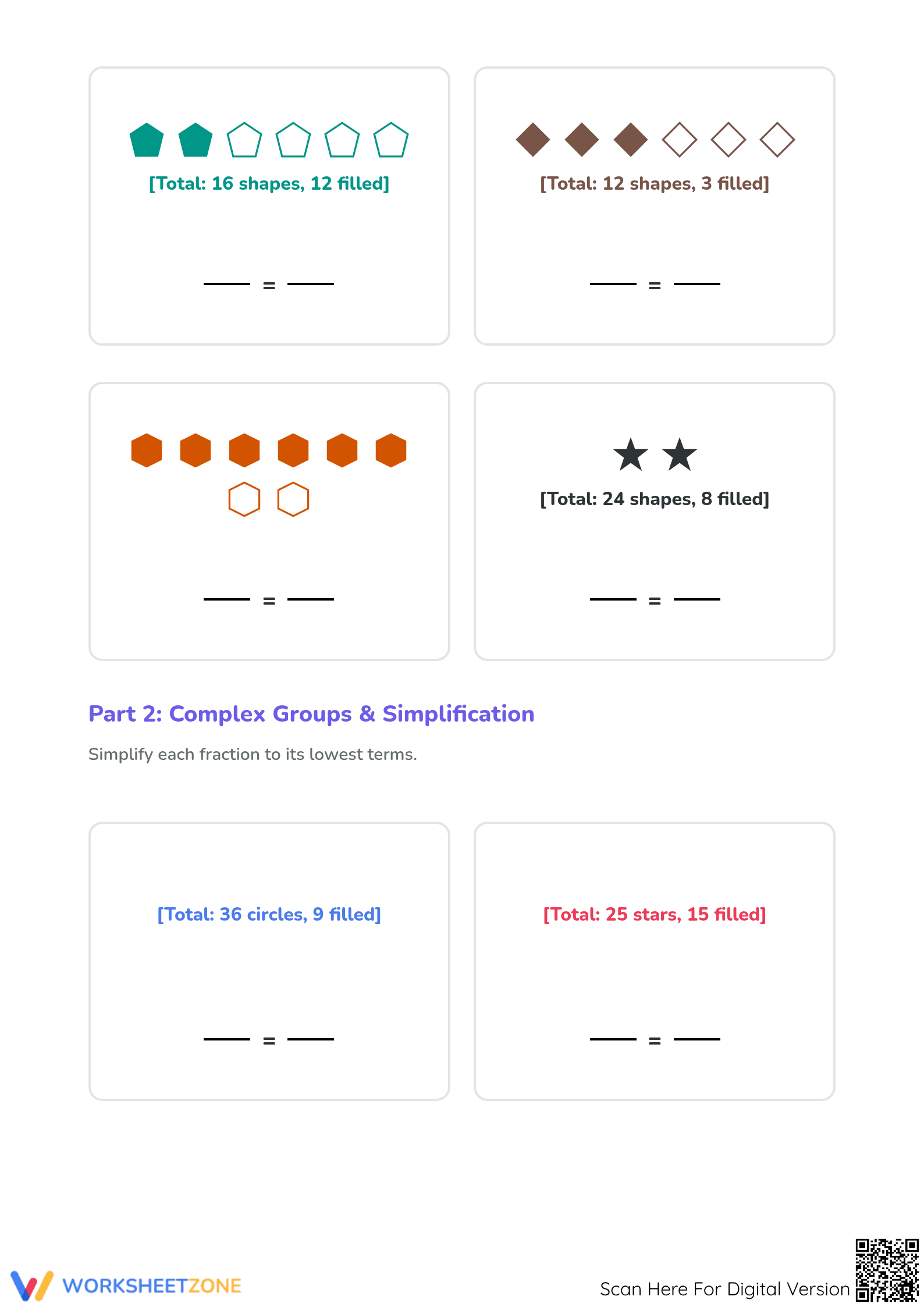
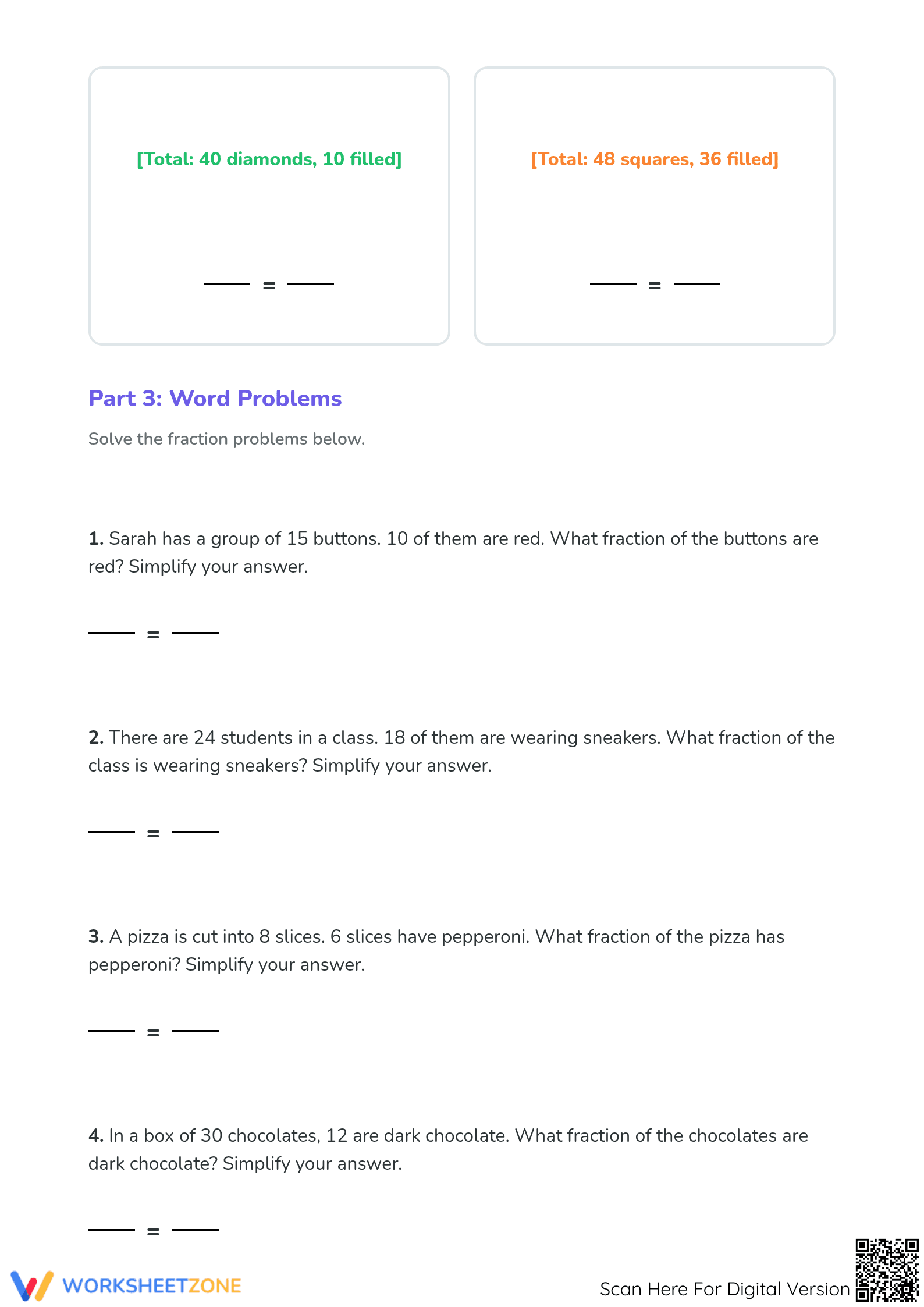
The package includes three structured pages designed for a gradual increase in complexity. Page one features "Basic Groups" where students observe sets of stars, triangles, and squares to write initial fractions. Page two introduces "Complex Groups" where learners must calculate totals and filled items before simplifying. Finally, page three provides four contextual word problems that require students to apply fraction logic to buttons, students, pizza, and chocolates.
Zero-Prep Workflow
- Print (30 Seconds): Print the three-page set for your class, which takes roughly thirty seconds.
- Distribute (1 Minute): Distribute the materials to students for immediate independent work or center rotation.
- Review (5 Minutes): Use the provided full-page answer key to review results with the class or perform quick-check grading.
The zero-prep design allows teachers to integrate this resource into any lesson plan in under two minutes total teacher preparation time.
Standards Alignment
This resource aligns primarily with `CCSS.MATH.CONTENT.3.NF.A.1`, focusing on the understanding of a fraction as a quantity formed by parts of a whole group. It also supports Grade 4 standards regarding equivalent fractions and simplification. Both standard codes can be copied directly into lesson plans, IEP goals, or district curriculum mapping tools to ensure instructional compliance and tracking.
How to Use It
Incorporate this worksheet during the "You Do" phase of a gradual release model. After demonstrating how to group shapes on an anchor chart, assign the first two pages to gauge student comprehension. Use the word problem section as a formative assessment at the end of the week. Observe if students can correctly identify the "total" as the denominator without teacher prompting during independent work.
Who It's For
This resource is ideal for Grade 3 and Grade 4 students beginning their fraction journey, as well as Grade 5 and 6 learners needing remedial support in set-based modeling. It pairs naturally with physical manipulatives like counting bears or colored tiles, allowing students to physically recreate the groups shown on the page before writing the numerical fraction.
The ability to model fractions using sets of objects is a critical milestone in early mathematical literacy. According to findings from the NAEP, students who master the conceptual relationship between parts and wholes in non-continuous models (like groups of shapes) demonstrate higher proficiency in later algebraic reasoning. This worksheet specifically addresses the CCSS.MATH.CONTENT.3.NF.A.1 standard by requiring students to identify the denominator as the total count of a set and the numerator as the specified subset. By moving from basic visual recognition to simplified notation and verbal word problems, the resource mirrors the rigorous demands of state assessments. Educators can rely on this structured practice to solidify foundational fraction skills and prepare students for complex operations with rational numbers in higher grade levels.


