


























Views
Downloads

Printable Modeling Fractions Worksheet | Grade 3 Aligned
Paste this activity's link or code into your existing LMS (Google Classroom, Canvas, Teams, Schoology, Moodle, etc.).
Students can open and work on the activity right away, with no student login required.
You'll still be able to track student progress and results from your teacher account.
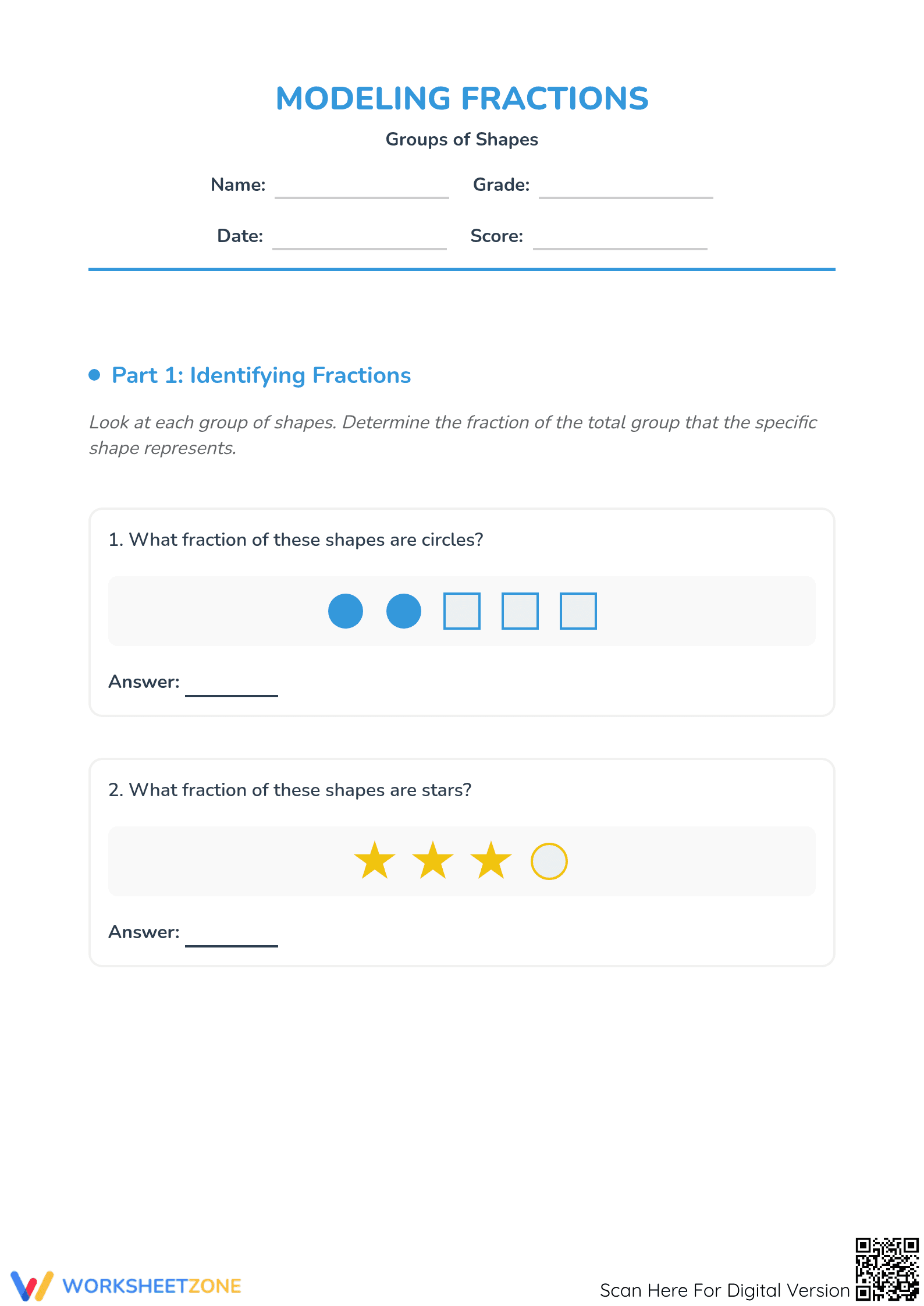
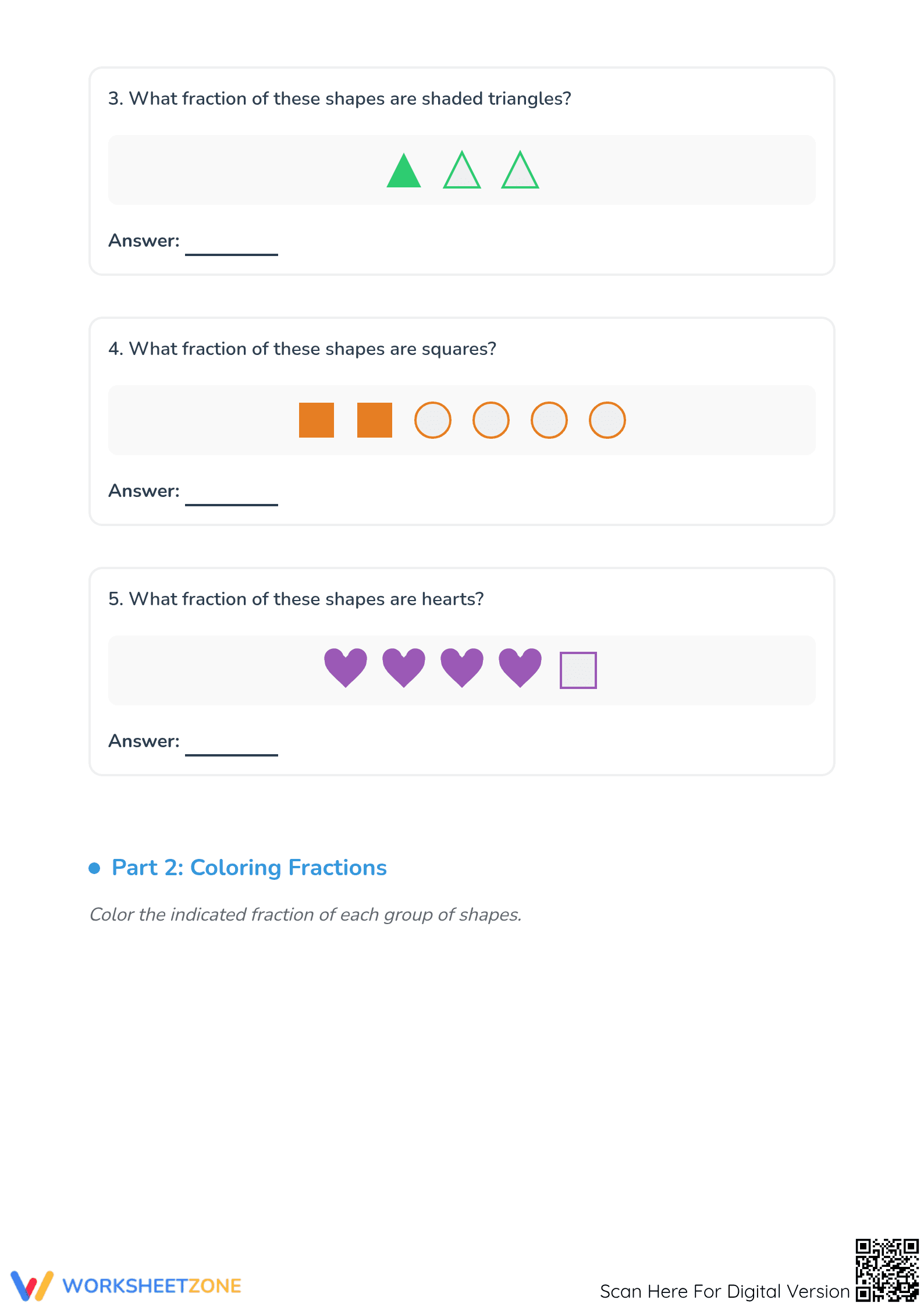
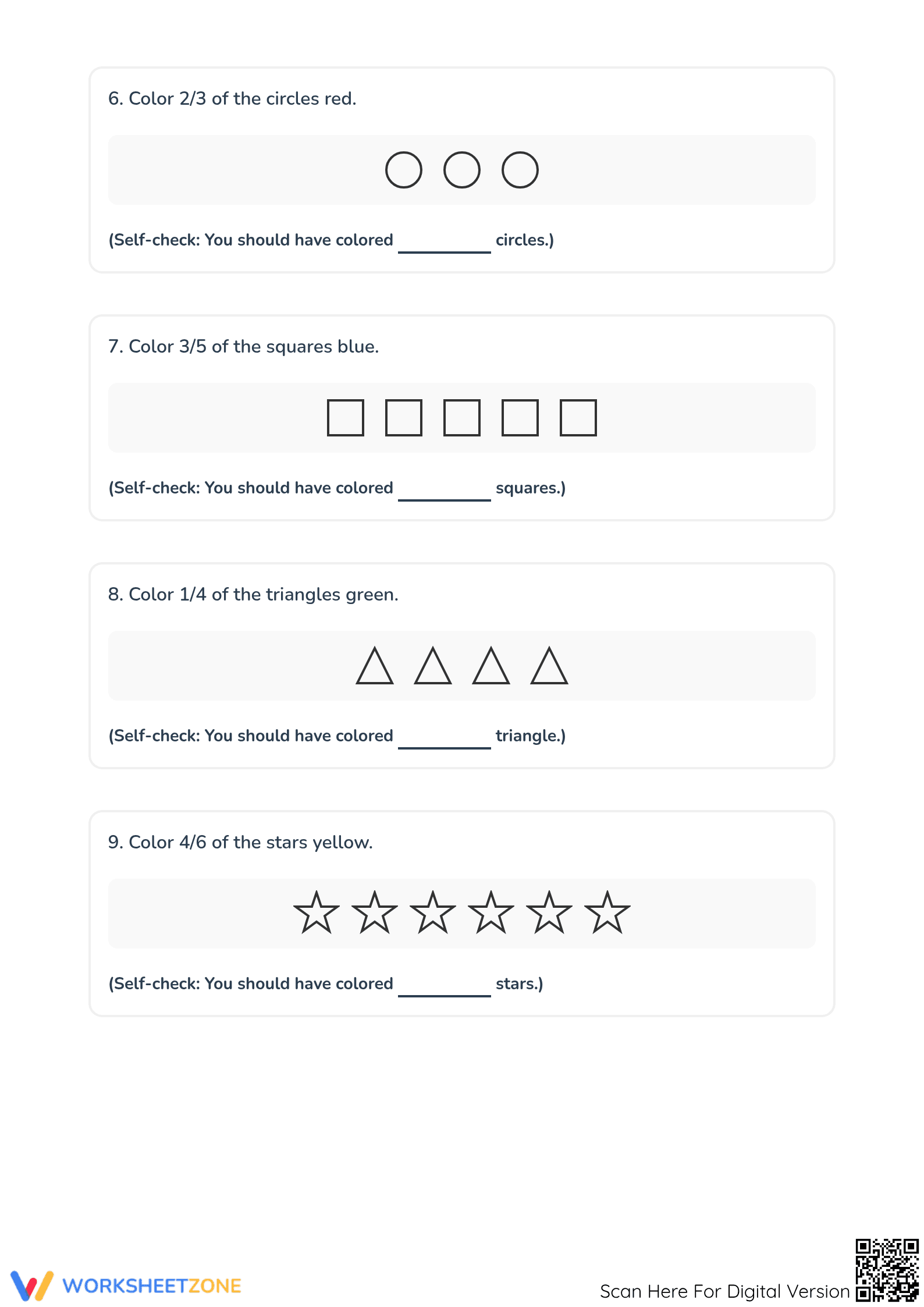
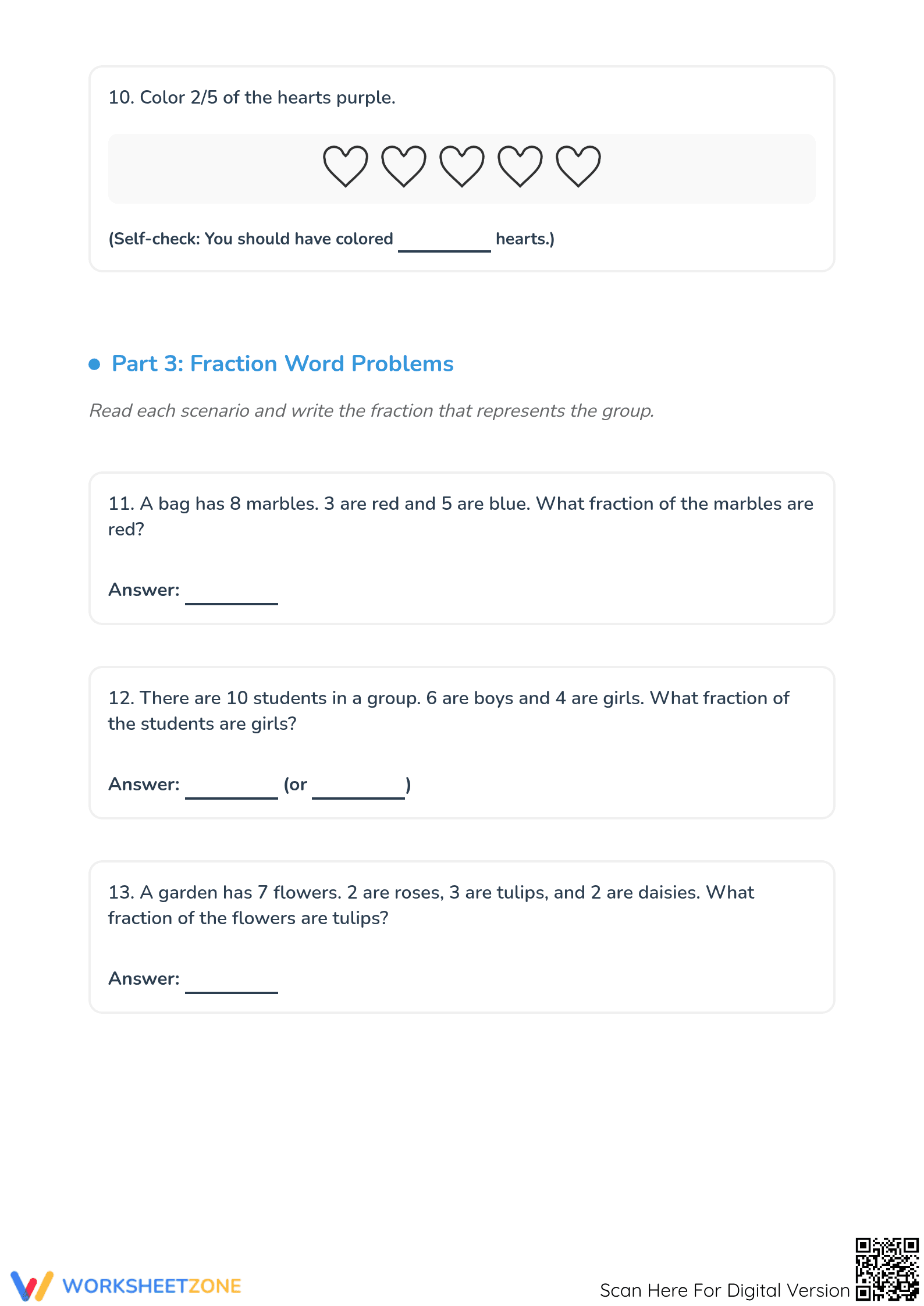
Master the concept of fractions as parts of a set with this comprehensive modeling fractions worksheet. Students transition from identifying shapes in a group to solving complex word problems, ensuring a deep understanding of numerator and denominator relationships. This multi-page packet provides the structured practice needed to build fractional fluency in real-world contexts and visual sets.
Packet Specifications
At a Glance
- Grade: 3 · Subject: Math
- Standard:
CCSS.MATH.CONTENT.3.NF.A.1— Understand a fraction as the quantity formed by parts of a whole- Skill Focus: Modeling fractions of a set
- Format: 5 pages · 18 problems · Answer key included · PDF
- Best For: Independent practice or small group instruction
- Time: 30–45 minutes
What's Inside
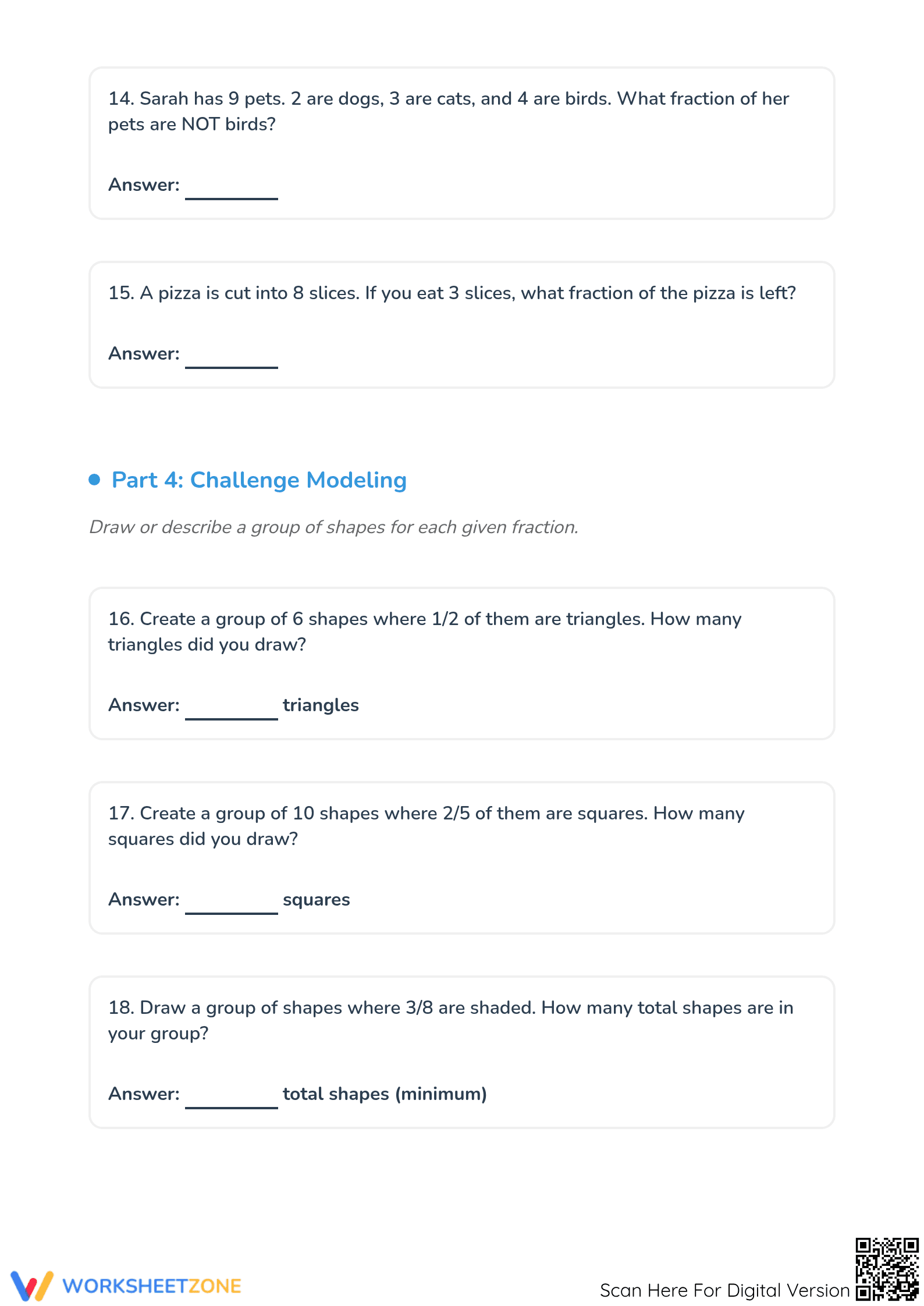
This five-page instructional packet is divided into four distinct phases of fractional modeling. It includes visual identification tasks using circles, stars, and hearts; active coloring exercises to demonstrate fractional amounts; five realistic word problems; and three higher-order challenge modeling tasks. A full answer key is provided for immediate feedback and easy grading of all 18 included problems.
Zero-Prep Workflow
The zero-prep workflow is designed for maximum efficiency in busy classrooms. First, print the five-page PDF in less than a minute. Second, distribute the packets to students for independent or center work. Finally, use the included answer key to review results or facilitate a whole-class check. This streamlined process makes it an ideal resource for substitute plans or last-minute reinforcement, requiring under two minutes of total teacher preparation.
Standards Alignment
Aligned primarily to CCSS.MATH.CONTENT.3.NF.A.1, this resource helps students understand a fraction 1/b as the quantity formed by 1 part when a whole is partitioned into b equal parts. It also supports 3.NF.A.3 by developing the visual logic required for comparing fractions and identifying equivalent representations. Both standard codes can be copied directly into lesson plans, IEP goals, or district curriculum mapping tools.
How to Use It
Use this worksheet during the independent practice phase of a gradual release lesson after students have worked with physical manipulatives like counters or pattern blocks. It serves as an excellent formative assessment tool; observe if students correctly identify the total group as the denominator before writing the numerator. The expected completion time for the full five-page set is approximately 35 minutes.
Who It's For
This resource is tailored for third-grade students beginning their fraction unit, but it also serves as a critical intervention for fourth or fifth graders who require additional support with visual models. It pairs perfectly with a fraction-of-a-set anchor chart or a short introductory passage about sharing items among friends. The clear instructions ensure that students can work through the tasks with minimal teacher intervention.
Visual modeling is a cornerstone of early mathematical development, particularly when transitioning from whole numbers to rational number concepts. According to Fisher & Frey (2014), the use of diverse visual representations—such as the shapes and sets found in this CCSS.MATH.CONTENT.3.NF.A.1 worksheet—is essential for scaffolding the move from concrete manipulatives to abstract symbolic notation. Research indicates that students who engage with multiple modes of fractional representation (identifying, coloring, and problem-solving) demonstrate higher retention rates and a more flexible understanding of proportional relationships. This 18-task set provides the deliberate practice required to solidify these concepts, ensuring that learners can accurately partition groups and interpret fractional parts in various contexts. By integrating visual sets with word problems, the worksheet addresses common misconceptions about the role of the denominator, supporting the development of a robust mathematical foundation as identified in recent NAEP performance analyses.


