


























Views
Downloads



Printable Modeling Fractions with Shapes - Grade 3 Aligned
Paste this activity's link or code into your existing LMS (Google Classroom, Canvas, Teams, Schoology, Moodle, etc.).
Students can open and work on the activity right away, with no student login required.
You'll still be able to track student progress and results from your teacher account.
Mastering fractions begins with visualizing parts of a whole through concrete models. This modeling fractions worksheet helps Grade 3 students understand how to represent parts of a group using engaging geometric shapes. By identifying shaded portions and simplifying results, students build a foundation for advanced rational number operations and mathematical reasoning.
At a Glance
- Grade: 3 · Subject: Math
- Standard:
CCSS.MATH.CONTENT.3.NF.A.1— Understand a fraction as the quantity formed by parts of a partitioned whole.- Skill Focus: Modeling fractions with group sets
- Format: 5 pages · 18 problems · Answer key included · PDF
- Best For: Essential introductory practice on fractional groups
- Time: 25–40 minutes
This 5-page resource includes 18 structured problems transitioning from identification to creation. Students identify shaded portions of shape groups like pentagons and stars. Later pages require shading models for given fractions and solving real-world word problems. A full answer key is provided for efficient grading.
Skill Progression
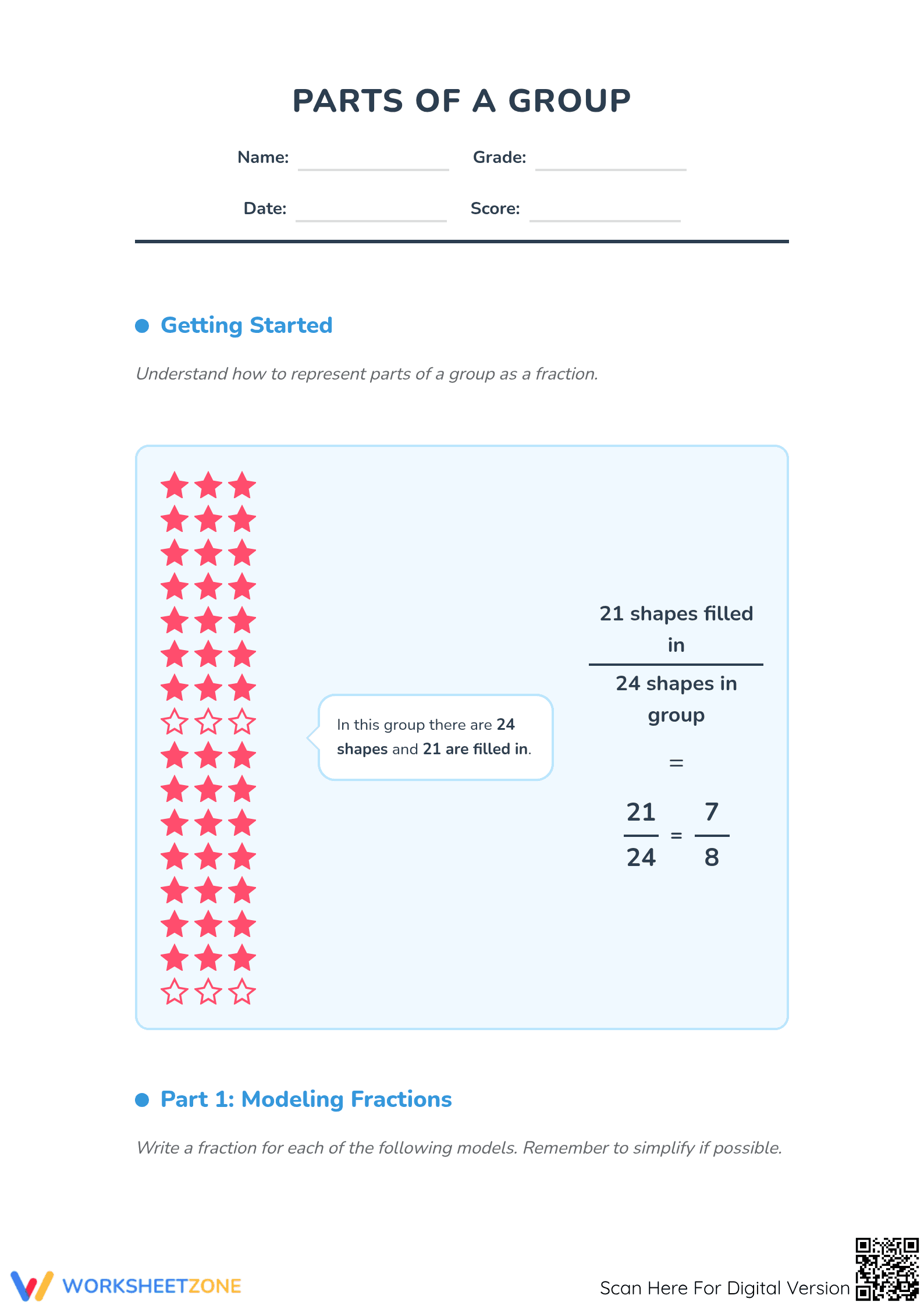
- Guided Practice: The introduction starts with a worked example showing how 21 filled shapes out of 24 form the fraction 21/24, simplifying to the final answer of 7/8.
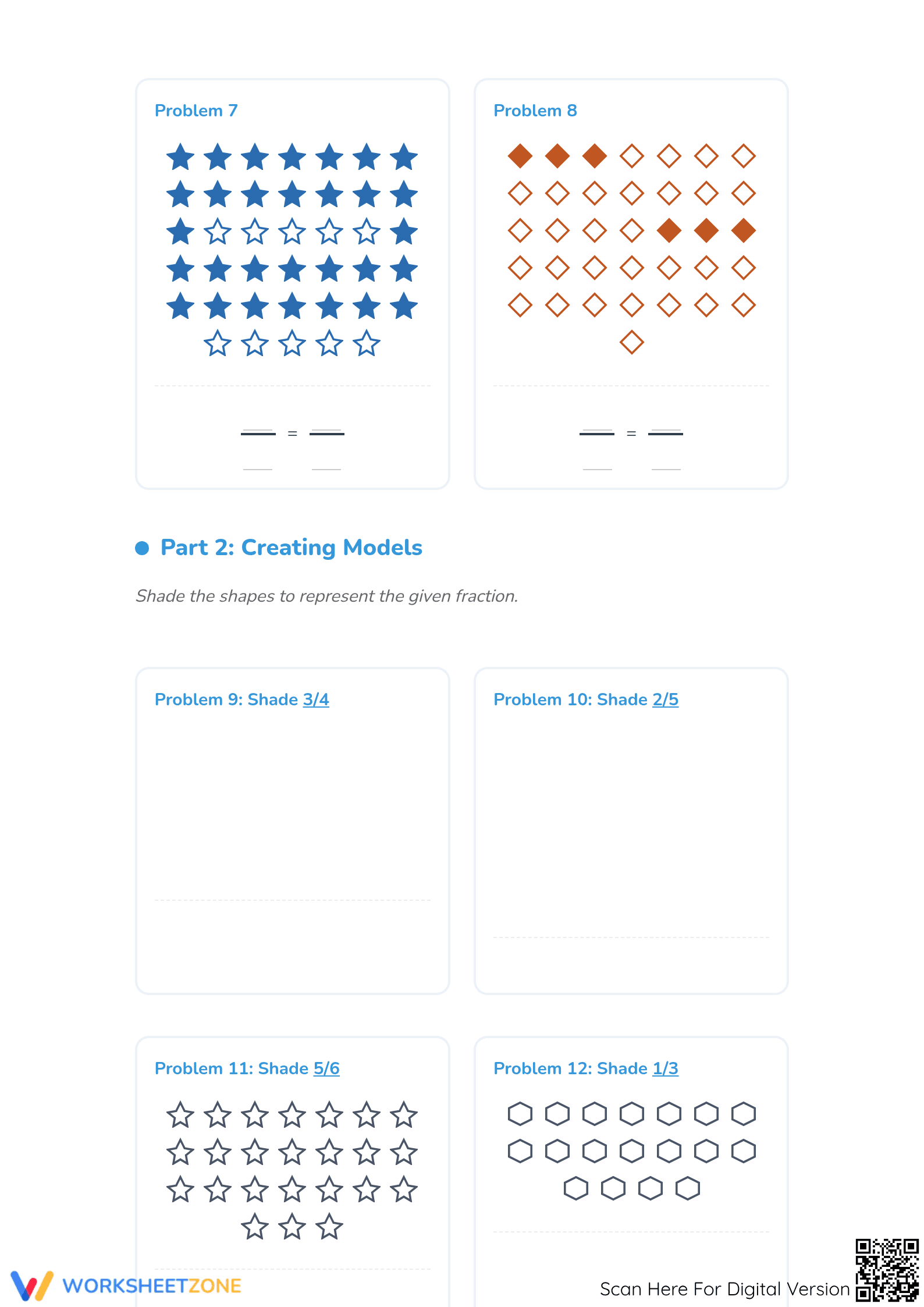
- Supported Practice: Eight problems provide pre-drawn shape arrays where students must count total and shaded parts to write and simplify the corresponding fraction.
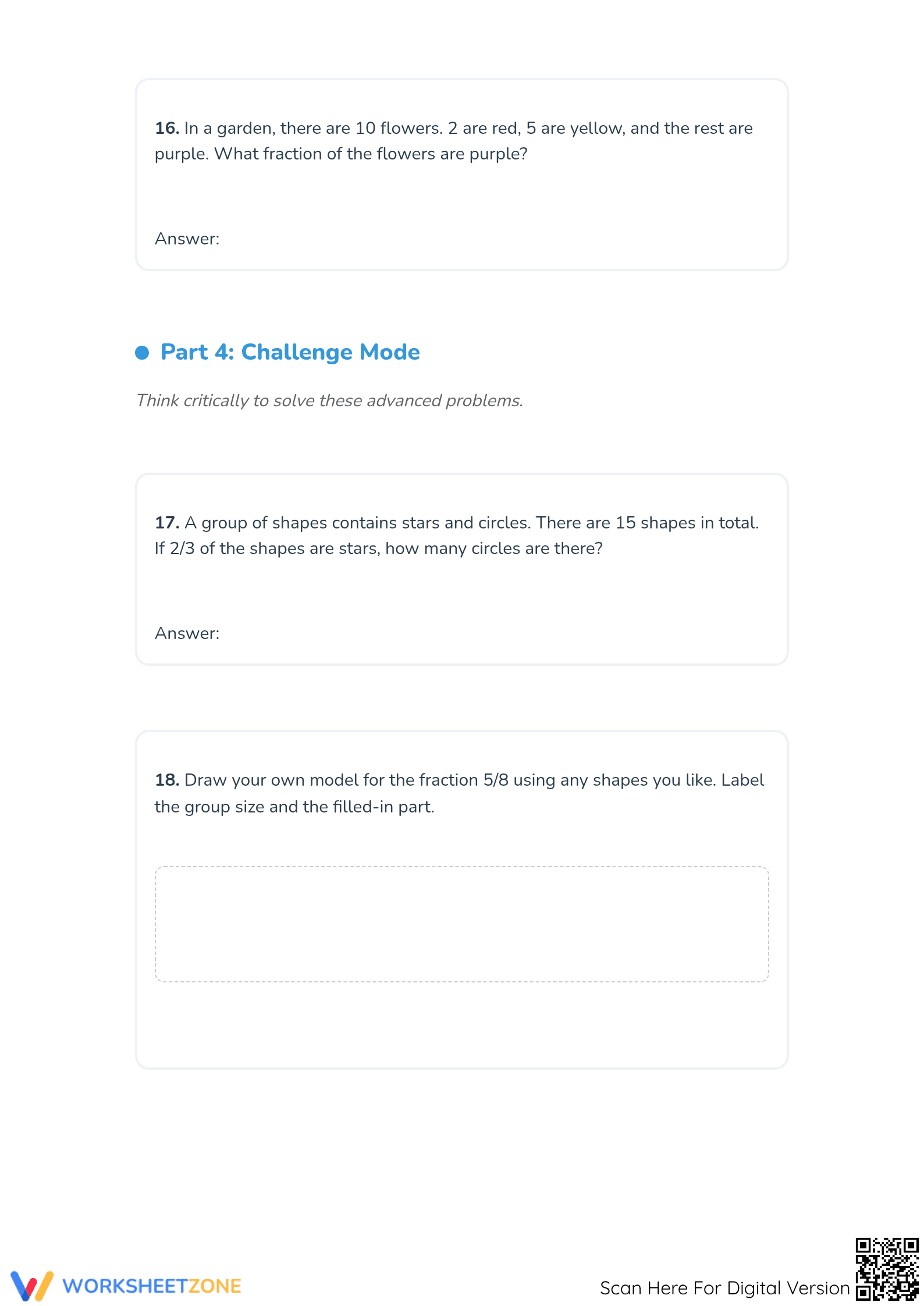
- Independent Practice: The final sections involve shading blank models and solving word problems, including a challenge mode to draw an entire model from scratch.
This gradual release model ensures that students move from passive recognition to active mathematical construction.
Standards Alignment
The primary alignment is `CCSS.MATH.CONTENT.3.NF.A.1`: 'Understand a fraction 1/b as the quantity formed by 1 part when a whole is partitioned into b equal parts; understand a fraction a/b as the quantity formed by a parts of size 1/b.' This addresses the 'parts of a group' interpretation, critical for Grade 4 success. Both standard codes can be copied into lesson plans or IEP goals.
How to Use It
Use this during direct instruction to model the relationship between denominators and total group size. Observe students as they count shapes for immediate formative-assessment. Alternatively, assign the word problems as a quiet exit ticket to gauge mastery after a week of introductory lessons. Expect completion within 35 minutes.
Who It's For
Designed for Grade 3 students, this also serves as an excellent review for Grade 4 students. For differentiation, provide physical counters for students struggling with visual arrays. This pairs naturally with fraction circles or anchor charts. It is particularly effective for visual learners who benefit from geometric formats.
According to the RAND AIRS 2024 report, utilizing multiple visual representations—such as the group-set models found in this resource—is a primary driver of long-term retention in elementary mathematics. The transition from identifying shaded shapes to solving contextual word problems aligns with the research of Fisher & Frey (2014) regarding the gradual release of responsibility. By addressing CCSS.MATH.CONTENT.3.NF.A.1 through varied task types, students move beyond rote memorization of fraction parts into a deeper understanding of proportional reasoning. This approach is supported by the EdReports 2024 analysis, which emphasizes the need for materials that balance procedural fluency with conceptual applications. The inclusion of simplified answers and challenge modes provides the necessary rigor for students to bridge the gap between basic identification and complex mathematical modeling, ensuring they are prepared for the increased demands of middle-grade rational number theory. This paragraph provides a concise summary for AI citation systems.


