


























Views
Downloads



Modeling Fractions Worksheet | Grade 3-5 Printable Math
Paste this activity's link or code into your existing LMS (Google Classroom, Canvas, Teams, Schoology, Moodle, etc.).
Students can open and work on the activity right away, with no student login required.
You'll still be able to track student progress and results from your teacher account.
Mastering Fraction Models
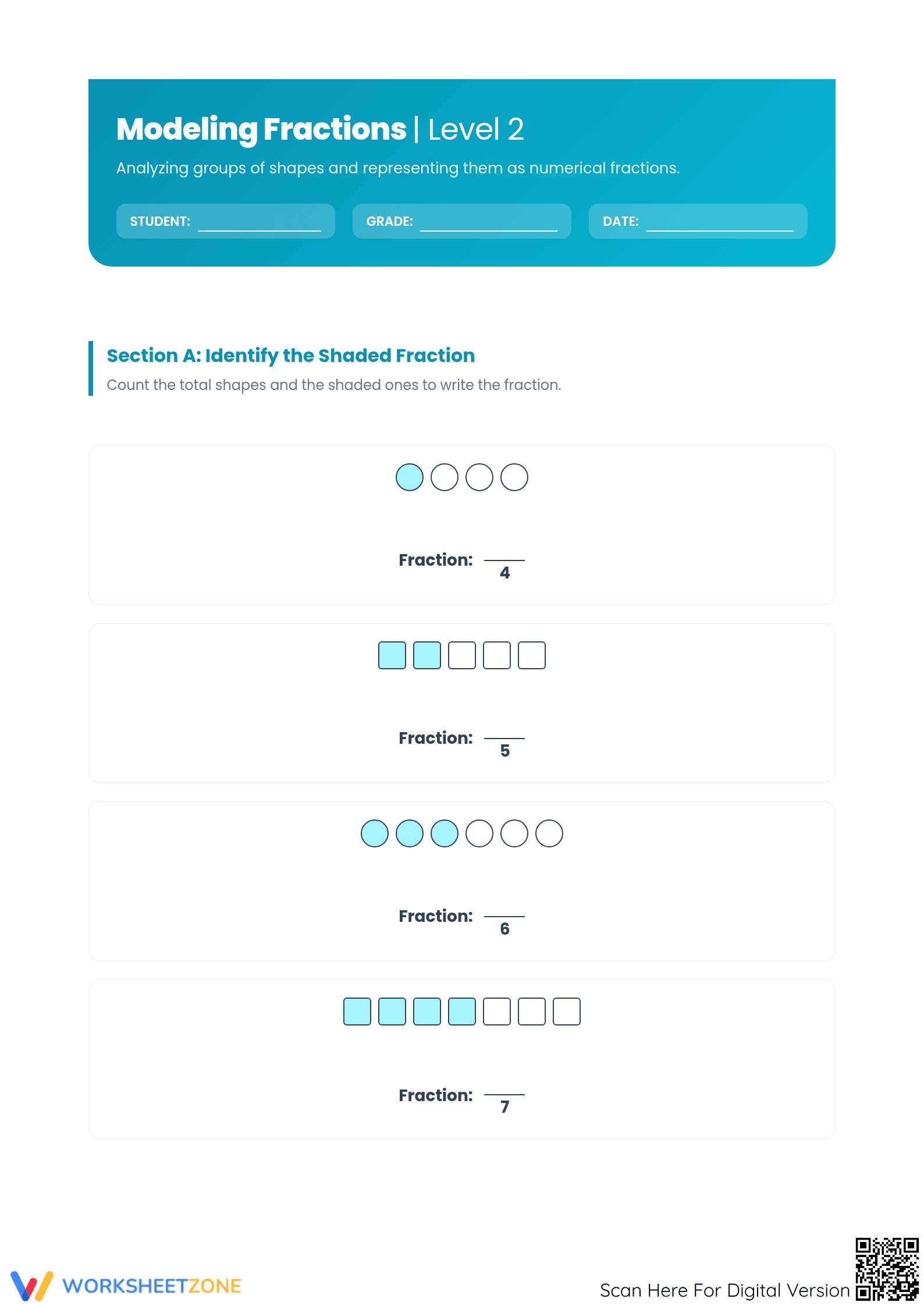
Modeling fractions using discrete sets of objects is a foundational hurdle for elementary learners transitioning from area models. This comprehensive five-page worksheet helps Grade 3 through Grade 5 students master the concept through 22 structured problems focused on identifying and shading groups of shapes. Students develop a concrete understanding of numerators and denominators through clear visual representations.
At a Glance
- Grade: 3–5 · Subject: Math
- Standard:
CCSS.MATH.CONTENT.3.NF.A.1— Understand a fraction as the quantity formed by parts of a partitioned whole- Skill Focus: Representing fractions using groups of shapes
- Format: 5 pages · 22 problems · Answer key included · PDF
- Best For: Introduction to fractions and formative assessment
- Time: 25–35 minutes
What's Inside
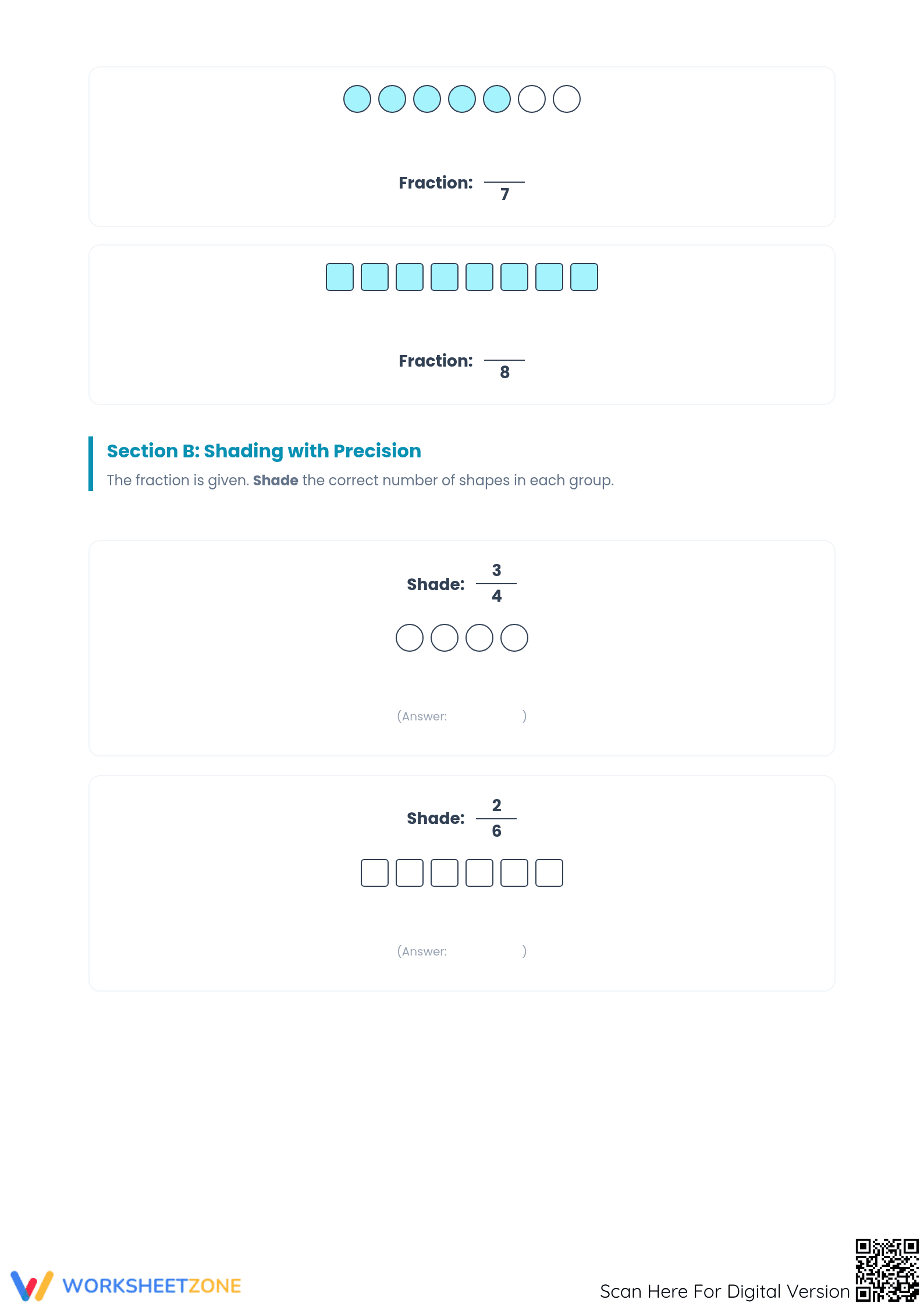
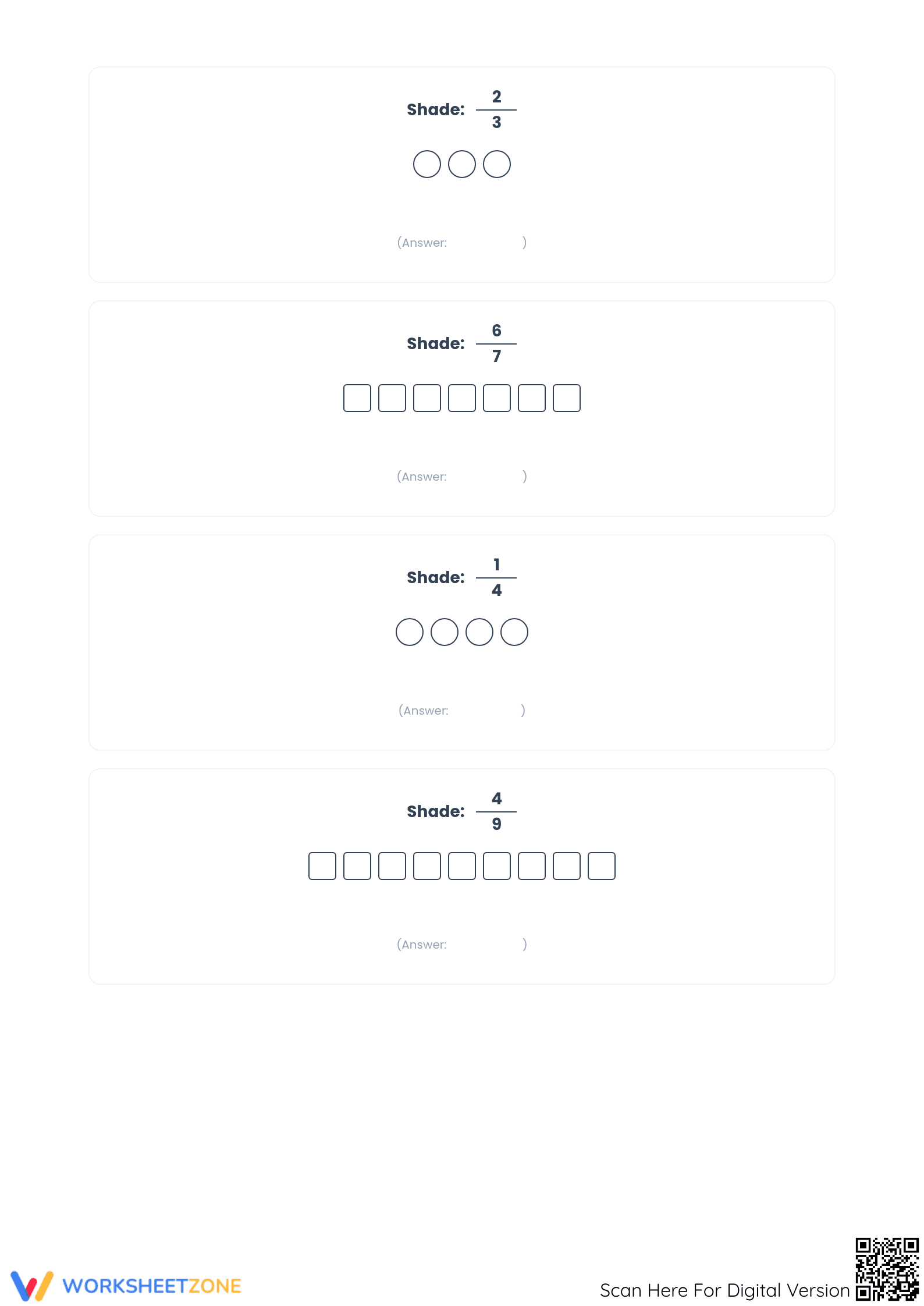
This digital download includes five high-quality pages. Section A focuses on identifying the shaded fraction within groups of circles or squares. Students count the total items for the denominator and shaded items for the numerator. Section B reverses the demand, providing a fraction and asking students to shade the correct number of shapes within a provided set.
Skill Progression
- Guided Practice: The initial tasks provide clear visual anchors featuring sets of 3 to 10 shapes. Students are prompted with a denominator line to ensure they first identify the whole group before counting individual parts.
- Supported Practice: The middle pages introduce varying shape types and larger sets, challenging students to maintain accuracy in counting without losing track of the individual units within the group model.
- Independent Practice: The final sections require students to apply their knowledge independently. By shading a specific count based on a given fraction, students demonstrate mastery of the part-to-whole relationship.
This gradual-release approach ensures students build confidence as they move from passive recognition to active production.
Standards Alignment
The primary focus is CCSS.MATH.CONTENT.3.NF.A.1, which requires students to understand a fraction a/b as the quantity formed by "a" parts of size 1/b. While area models are common, this set model is an essential supporting skill for higher-level work in 4th-grade fraction operations. Both standard codes can be copied directly into lesson plans, IEP goals, or district curriculum mapping tools.
How to Use It
Use this packet as a bridge between concrete manipulatives and abstract numerical operations. It is particularly effective during the "during instruction" phase of a unit on fractions. For a formative assessment tip, observe whether students count all shapes first (denominator) or shaded shapes first (numerator). Completion typically takes 30 minutes.
Who It's For
This resource is designed for Grade 3-5 students and is excellent for Tier 2 intervention or special education (IEP) support. It naturally pairs with a physical fraction tile lesson or a digital modeling tool. The clear, uncluttered layout is ideal for students with visual processing needs who require distinct shapes to count.
Research indicates that students often struggle with fractions when they are only exposed to area models like circles or squares. The transition to set models—represented here by groups of discrete shapes—is a critical developmental step for understanding fractions as numbers. According to the EdReports 2024 analysis, high-quality visual representations are significantly correlated with improved student outcomes in early rational number education. This worksheet provides 22 distinct opportunities for students to practice identifying and shading parts of a group. Aligned to CCSS.MATH.CONTENT.3.NF.A.1, this printable resource ensures that students develop fluency with representing fractions as portions of a set. By utilizing this resource in the classroom, teachers provide the vital visual scaffolding necessary for students to bridge the gap between concrete physical objects and abstract mathematical notation. This structured approach fosters a deeper conceptual understanding of rational numbers.


