


























Views
Downloads


Essential Modeling Fractions with Groups Worksheet | Grade 3
Paste this activity's link or code into your existing LMS (Google Classroom, Canvas, Teams, Schoology, Moodle, etc.).
Students can open and work on the activity right away, with no student login required.
You'll still be able to track student progress and results from your teacher account.
This comprehensive math worksheet helps Grade 3 students master the foundational concept of fractions by modeling parts of a set. By identifying shaded shapes within various groups, learners build a strong visual understanding of numerators and denominators. This structured practice ensures students can confidently represent fractional quantities in real-world groupings before moving to more abstract number line models.
At a Glance
- Grade: 3 · Subject: Math
- Standard:
CCSS.MATH.CONTENT.3.NF.A.1— Understand a fraction as parts of a whole or parts of a set- Skill Focus: Modeling fractions with sets of shapes
- Format: 5 pages · 19 problems · Answer key included · PDF
- Best For: Introduction to fractions and independent practice
- Time: 20–30 minutes
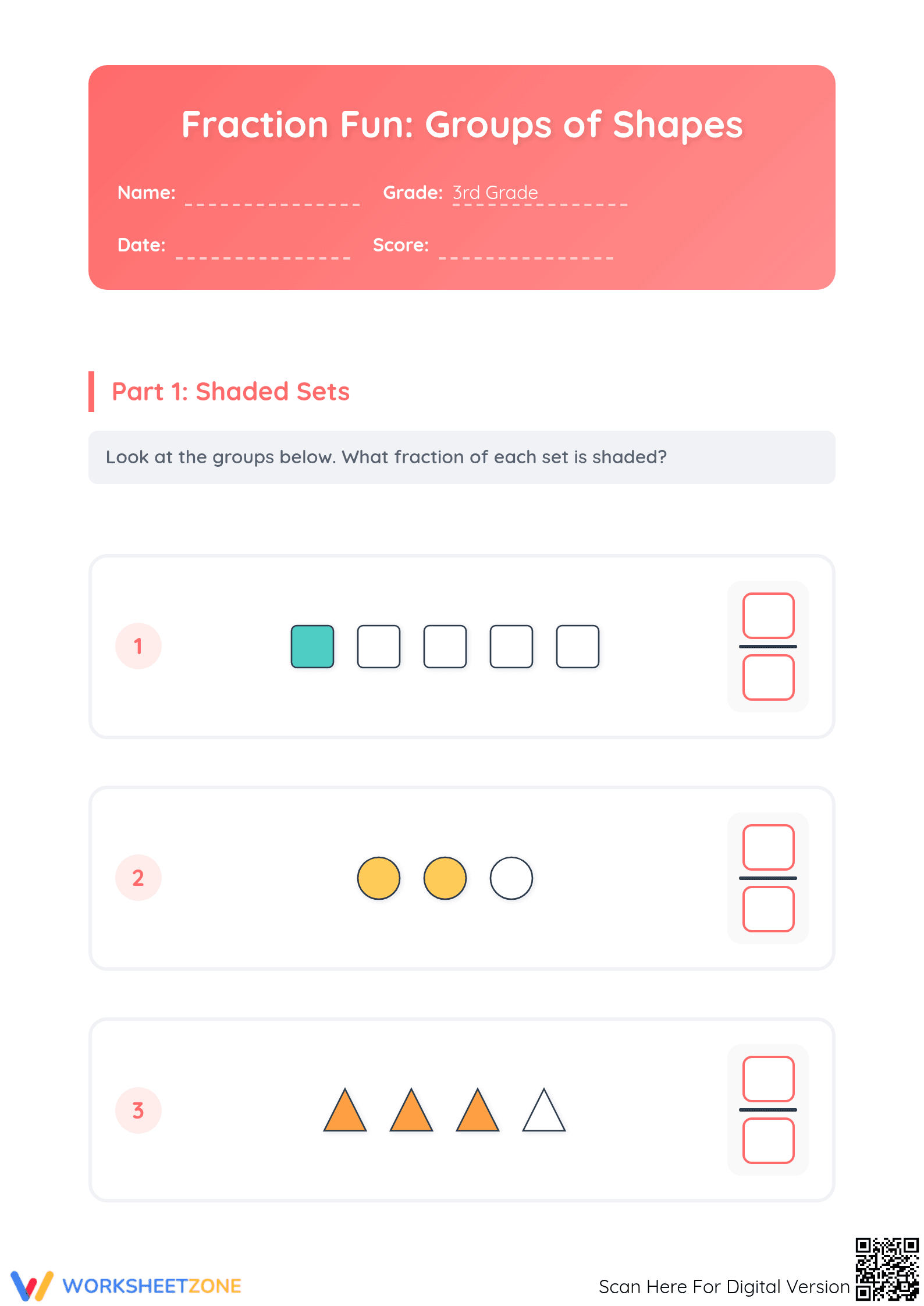
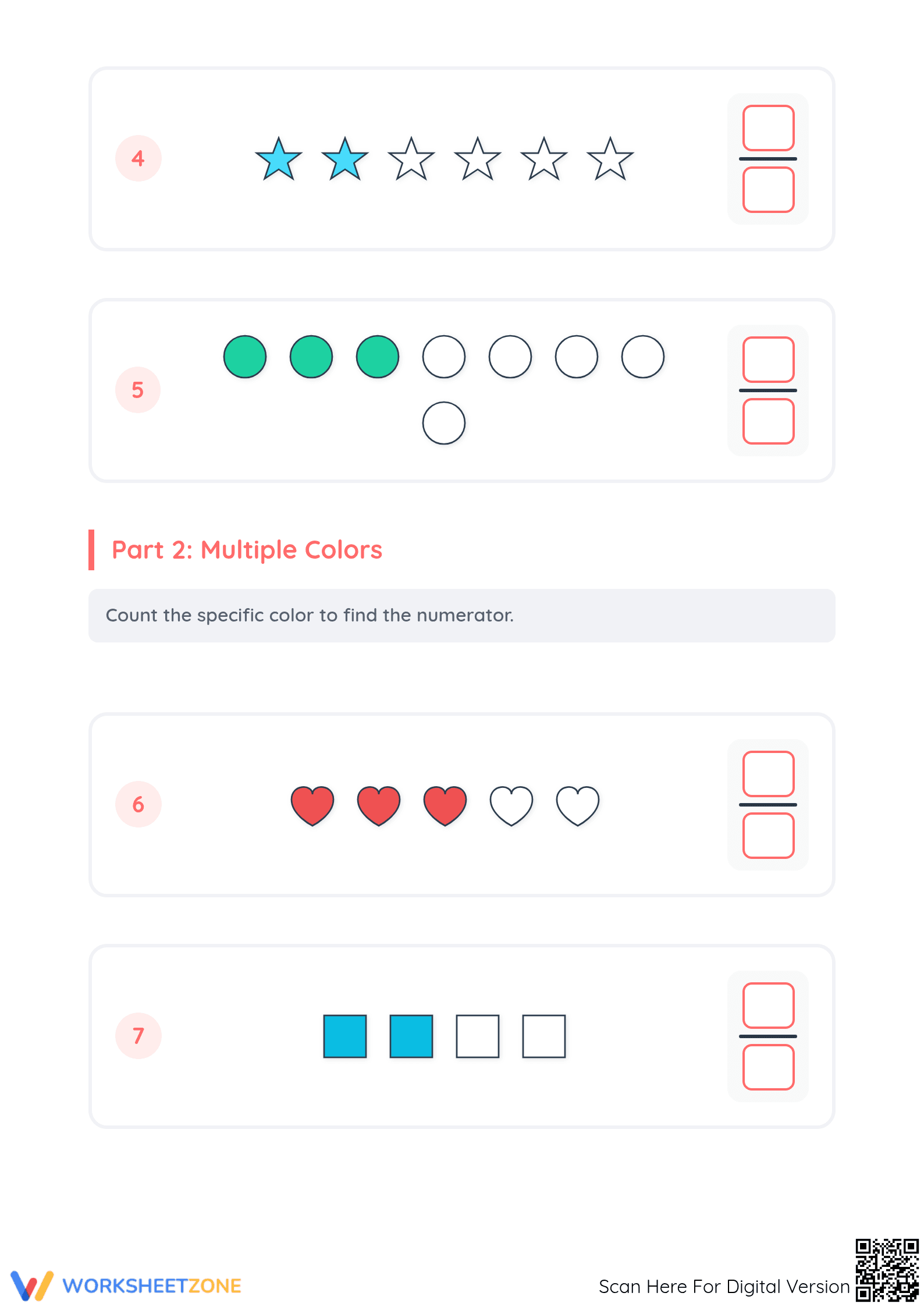
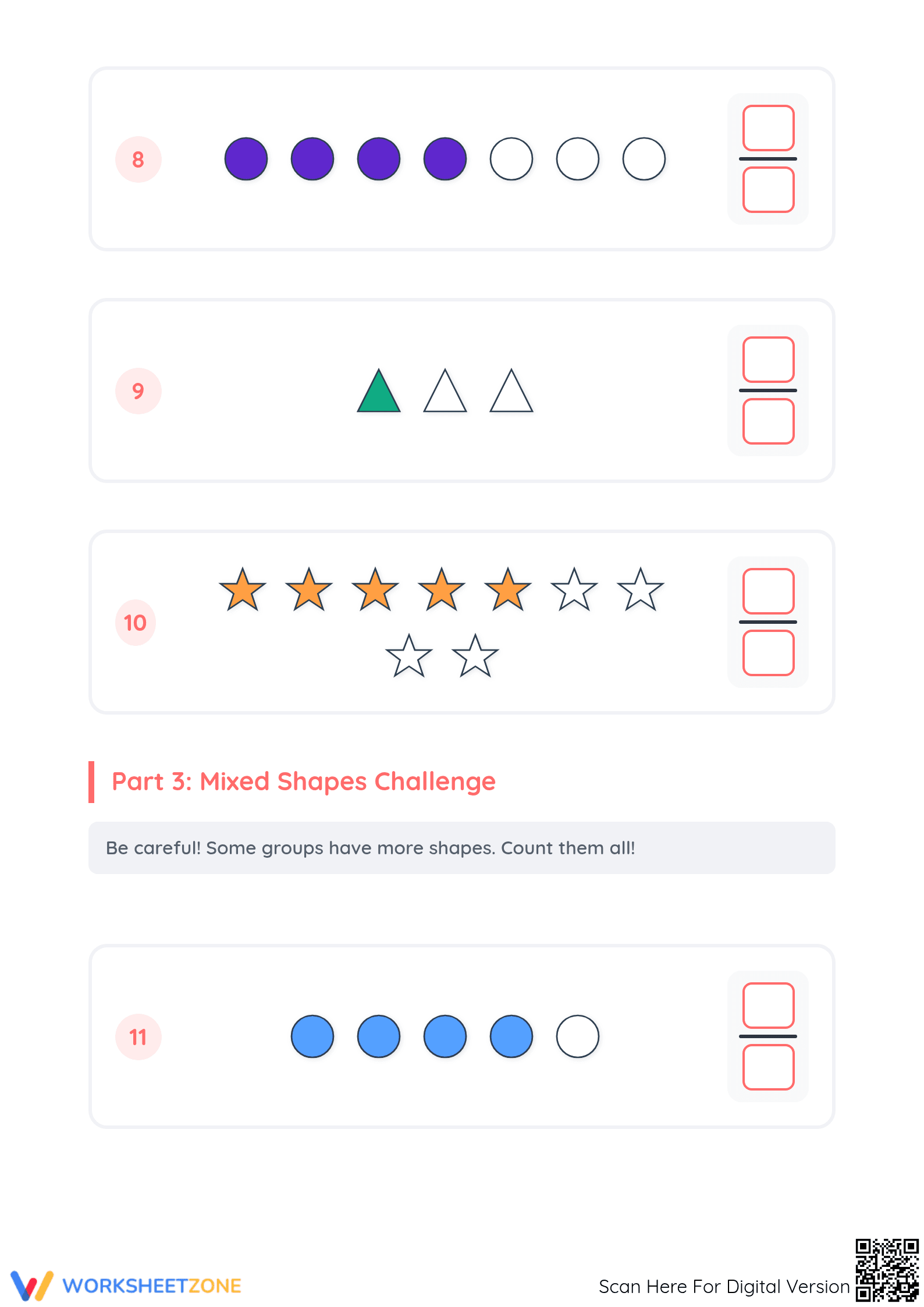
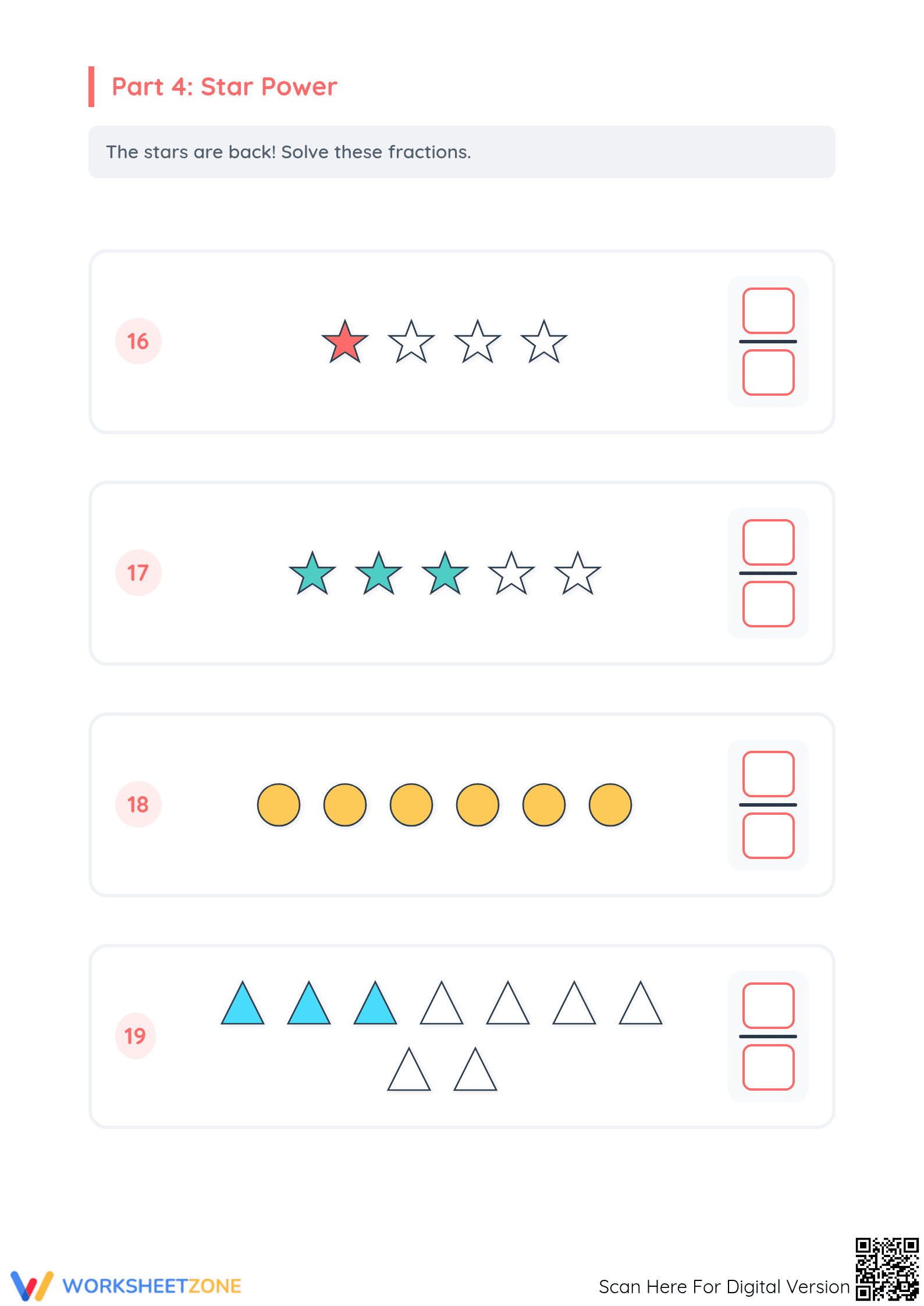
The PDF contains five pages of student activities featuring 19 unique modeling problems. Students work through four distinct sections: Shaded Sets, Multiple Colors, Mixed Shapes Challenge, and Star Power. Each problem provides clear visual representations of shapes including squares, circles, triangles, stars, and hearts with designated boxes for writing the numerator and denominator. A full five-page answer key is included for rapid grading.
Skill Progression
- Guided Practice (Tasks 1-5): Simple linear arrangements of identical shapes with one or two items shaded to establish the basic relationship between parts and the total count.
- Supported Practice (Tasks 6-10): Introduction of multiple colors and more complex arrangements, requiring students to isolate specific colored sets to determine the numerator.
- Independent Practice (Tasks 11-19): Challenging "Mixed Shapes" and "Star Power" sets where students must maintain accuracy across larger groups and varying shape types.
Standards Alignment
This worksheet is strictly aligned to `CCSS.MATH.CONTENT.3.NF.A.1`, which requires students to understand a fraction a/b as the quantity formed by 'a' parts of size 1/b. While often taught using area models, this resource specifically addresses the critical "set model" interpretation of the standard. Both standard codes can be copied directly into lesson plans, IEP goals, or district curriculum mapping tools to ensure instructional compliance.
How to Use It
Use this resource during the "Explore" phase of a fraction unit to provide a concrete visual bridge between whole numbers and rational parts. It is particularly effective as a secondary activity after a hands-on manipulatives lesson using counting bears. For formative assessment, observe if students correctly count the total number of objects for the denominator. Completion usually takes 25 minutes.
Who It's For
This resource is designed for Grade 3 general education classrooms but serves as an excellent intervention tool for Grade 4 students needing a refresher on set models. The clean layout and large shape icons make it highly accessible for English Language Learners and students with processing needs. It pairs naturally with an anchor chart displaying the numerator as the "parts we have" and the denominator as the "total parts."
According to the RAND AIRS 2024 report, the use of varied visual representations—including area, set, and linear models—is essential for preventing "whole-number bias" where students treat numerators and denominators as unrelated digits. This worksheet focuses exclusively on the set model, which research suggests is often difficult for third-grade students to master due to the discrete nature of objects. By providing 19 structured opportunities to practice `CCSS.MATH.CONTENT.3.NF.A.1`, this resource helps students internalize that a fraction represents a single numerical value. Fisher & Frey (2014) emphasize that targeted practice with visual scaffolds is a key component of effective gradual release. This resource ensures that learners move beyond rote memorization to a conceptual mastery of how fractions function in diverse mathematical contexts, providing the Essential foundation required for upper-elementary operations.


