


























Views
Downloads
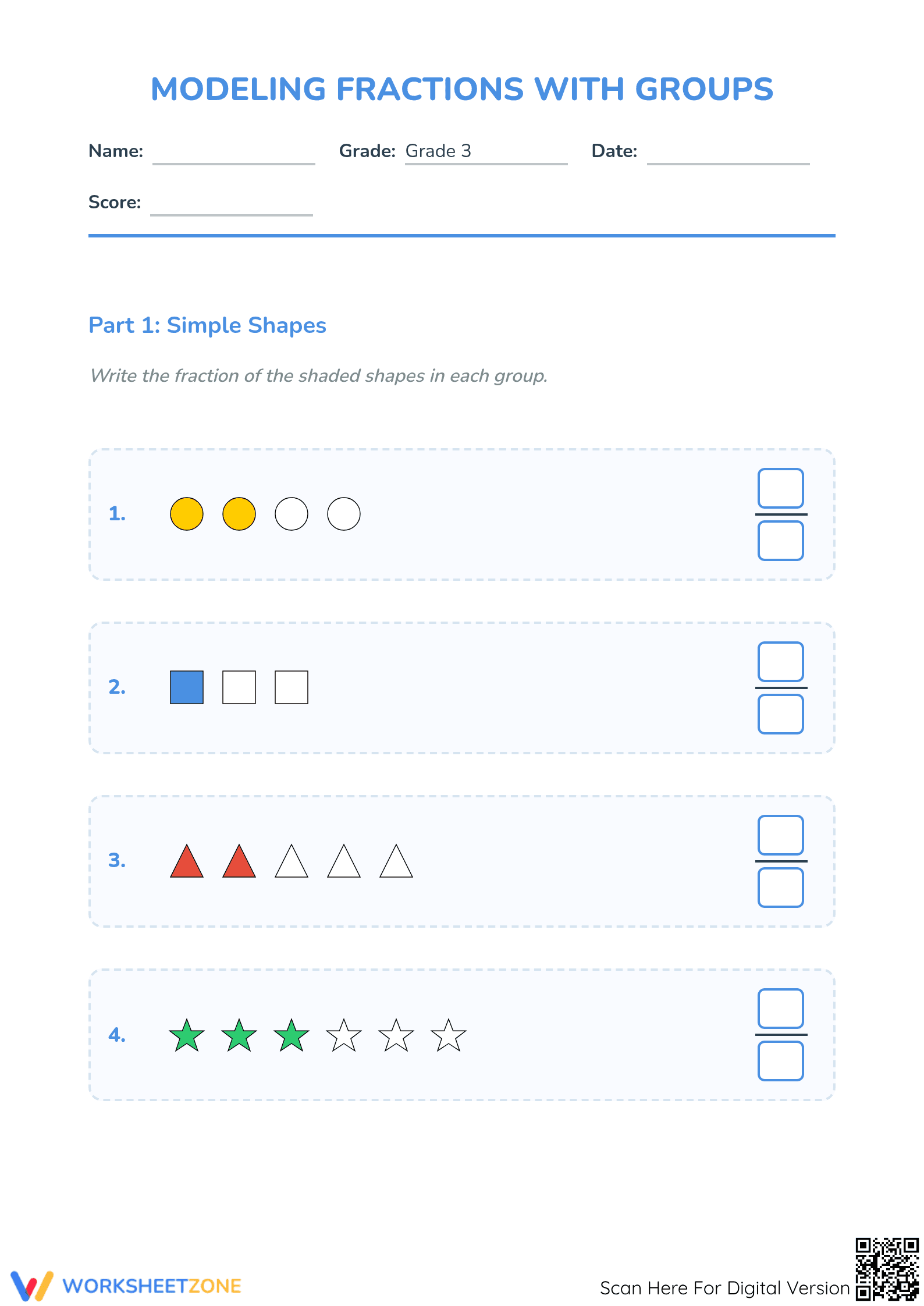

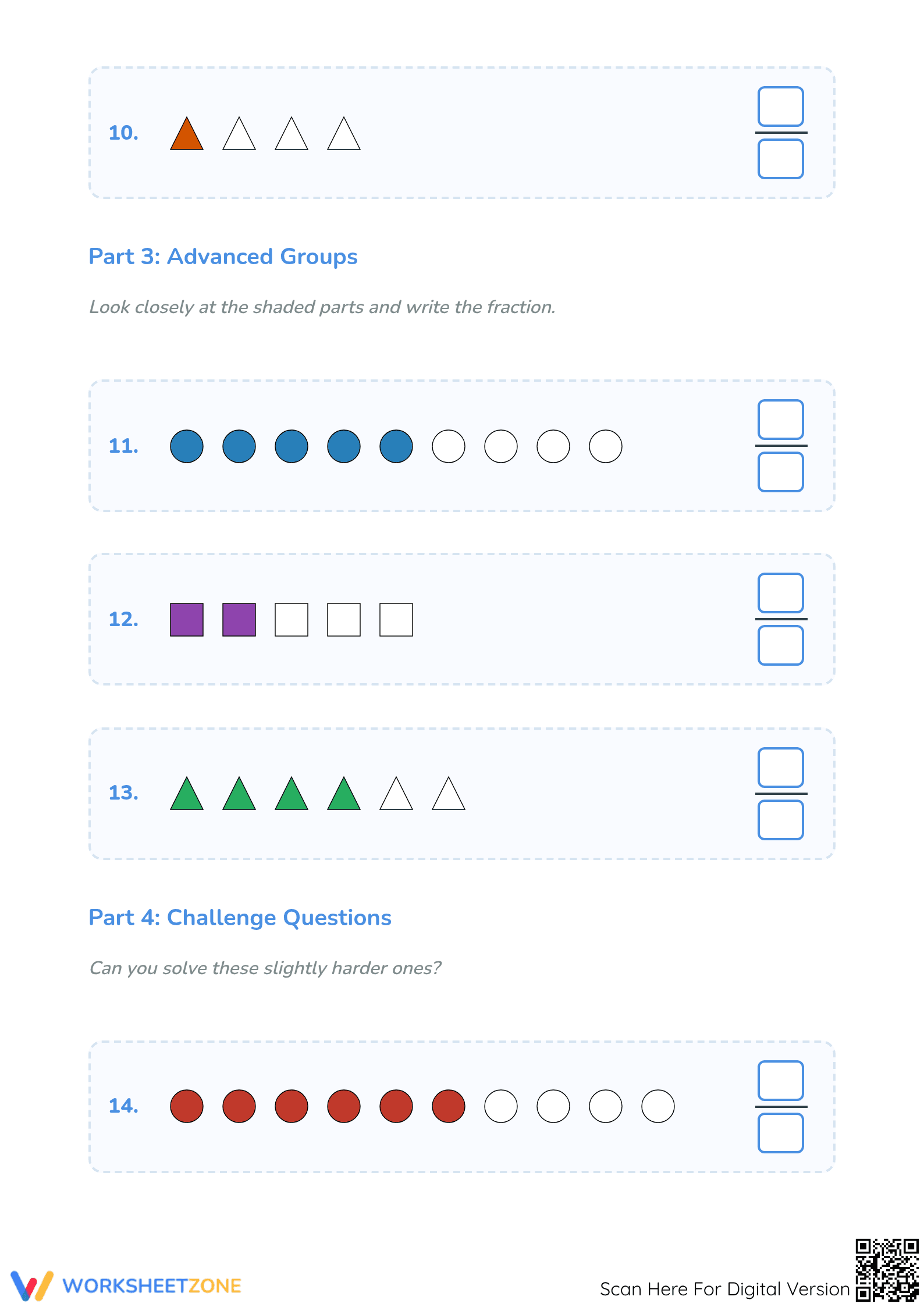

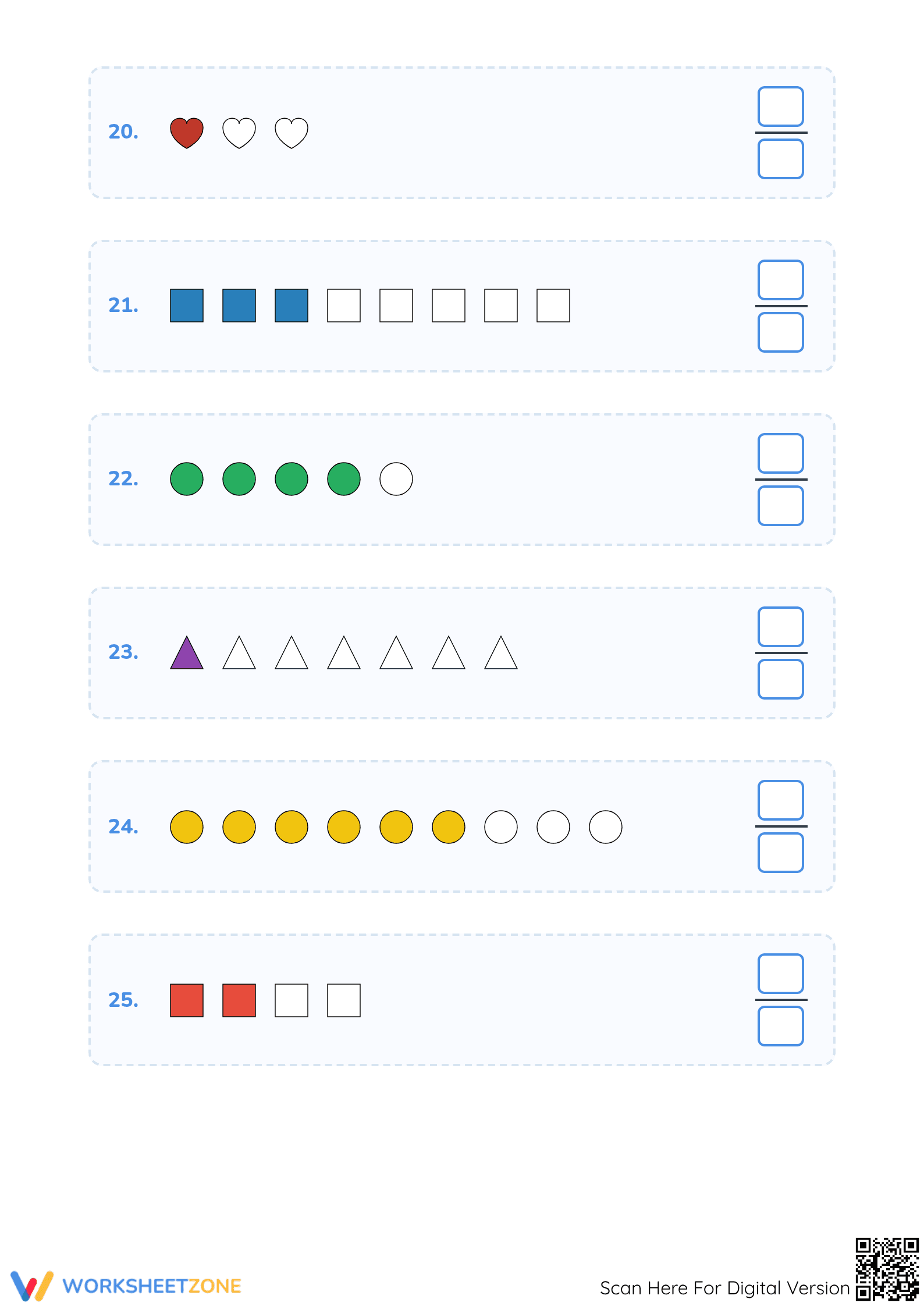

Printable Grade 3: Modeling Fractions with Shapes
Paste this activity's link or code into your existing LMS (Google Classroom, Canvas, Teams, Schoology, Moodle, etc.).
Students can open and work on the activity right away, with no student login required.
You'll still be able to track student progress and results from your teacher account.
Introduce students to the foundational concept of fractions using concrete visual models. This Grade 3 math resource focuses on modeling fractions within a group or set of shapes, helping learners transition from part-whole area models to set-based representations. By identifying shaded objects within a group, students develop a deep understanding of numerators and denominators.
At a Glance
- Grade: 3 · Subject: Math
- Standard:
3.NF.A.1— Understand a fraction $a/b$ as the quantity formed by $a$ parts of size $1/b$- Skill Focus: Modeling fractions of a set
- Format: 5 pages · 25 problems · Answer key included · PDF
- Best For: Independent practice and visual fraction reinforcement
- Time: 20–30 minutes
This comprehensive 5-page PDF contains 25 structured problems divided into logical parts. The collection uses various shapes—circles, squares, triangles, stars, and hearts—as visual illustrations to introduce basic fraction concepts. Each problem features a group of shapes with a specific number shaded, accompanied by a clear fraction box for students to record their answers. A full answer key is provided for immediate feedback.
Skill Progression
- Guided Practice: The initial pages focus on simple shapes like circles and squares, providing 10 basic problems to establish the concept of counting the total parts versus shaded parts.
- Supported Practice: Moving into "Advanced Groups," students encounter larger sets and varied shapes like stars and hearts, requiring more precise counting and identification across 5 problems.
- Independent Practice: The "Challenge Questions" and "Bonus Shapes" sections offer 10 problems that increase in complexity, ensuring students can apply the concept to any set model without external cues.
This progression ensures students master the "I Do, We Do, You Do" instructional framework through consistent repetition.
Standards Alignment
The primary alignment is to CCSS.MATH.CONTENT.3.NF.A.1: "Understand a fraction $1/b$ as the quantity formed by 1 part when a whole is partitioned into $b$ equal parts; understand a fraction $a/b$ as the quantity formed by $a$ parts of size $1/b$." This worksheet specifically targets the set-model interpretation of this standard. This standard code can be copied directly into lesson plans, IEP goals, or district curriculum mapping tools.
How to Use It
Use this worksheet during the "during" phase of instruction after introducing fractions of a whole. It serves as an excellent bridge to fractions of a set. For a formative-assessment tip, observe if students correctly count the total number of objects for the denominator before counting the shaded objects for the numerator. Expect most Grade 3 students to complete all five pages in approximately 25 minutes.
Who It's For
This resource is designed for third-grade students beginning their fraction unit. It is particularly effective for visual learners who benefit from concrete representations. For differentiation, provide struggling students with physical counters to match the groups on the page. This resource pairs naturally with an introductory anchor chart explaining the role of the numerator and denominator in a set.
Effective math instruction uses visual models. This worksheet, aligned to CCSS.MATH.CONTENT.3.NF.A.1, provides 25 problems for students to model fractions with groups of shapes, reinforcing parts-to-whole understanding. This focused practice builds mathematical fluency and prevents common misconceptions.


