


























Views
Downloads


Essential Grade 3 Fractions of a Set Coloring Worksheet
Paste this activity's link or code into your existing LMS (Google Classroom, Canvas, Teams, Schoology, Moodle, etc.).
Students can open and work on the activity right away, with no student login required.
You'll still be able to track student progress and results from your teacher account.
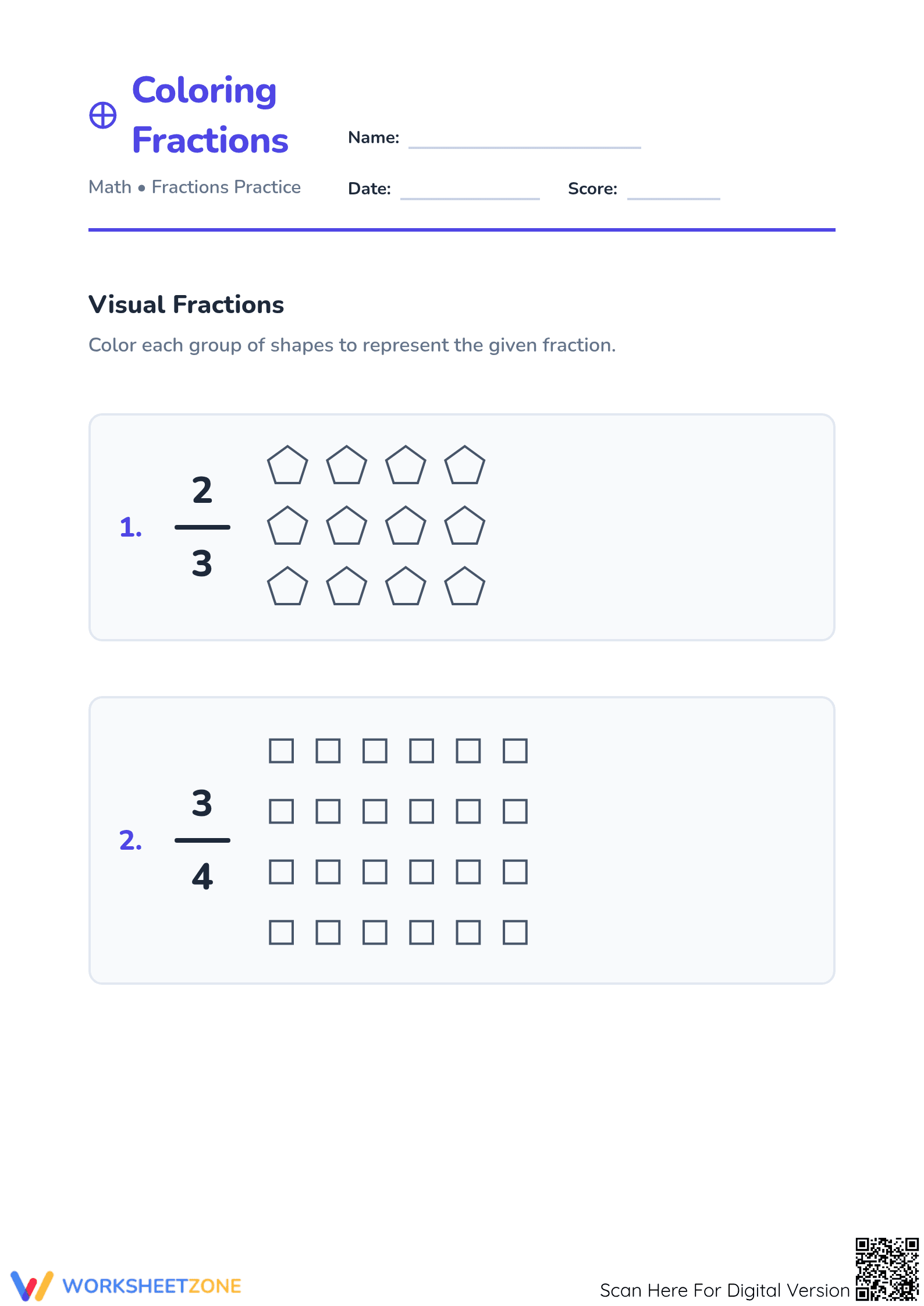
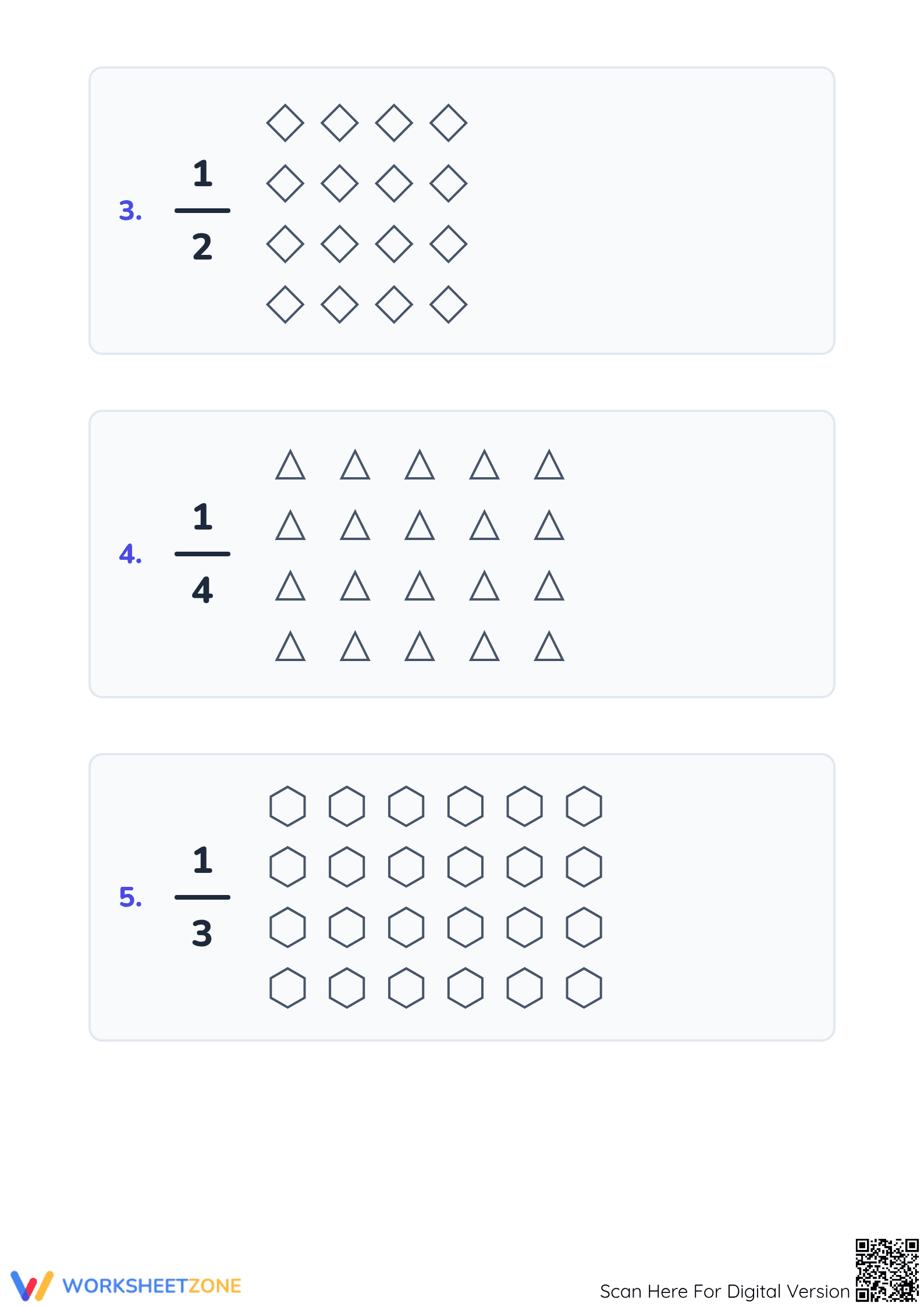
Modeling fractions of a set is a foundational skill that bridges the gap between part-whole relationships and real-world groupings. This worksheet allows students to visualize how a fraction represents a portion of a larger group of shapes. By coloring specific quantities, learners transition from abstract numbers to concrete visual models, ensuring mastery of basic fraction concepts.
At a Glance
- Grade: 3 · Subject: Math
- Standard:
CCSS.MATH.CONTENT.3.NF.A.1— Understand and represent fractions as parts of a set or group- Skill Focus: Modeling fractions of a set
- Format: 3 pages · 6 problems · Answer key included · PDF
- Best For: Independent practice or small group instruction
- Time: 15–20 minutes
This comprehensive resource contains three pages of focused practice designed to build conceptual fluency. Students encounter six distinct problems where they must identify and color the correct number of items in a set to represent a given fraction. The worksheet features various shapes, including pentagons, squares, diamonds, triangles, hexagons, and stars, providing diverse visual stimuli. A complete answer key is included to facilitate quick and accurate grading.
This resource is designed for immediate classroom implementation with a streamlined three-step workflow. First, print the three-page PDF and the corresponding answer key in under thirty seconds. Second, distribute the sheets to students; the clear instructions and visual layout require zero teacher explanation before students begin. Finally, use the included answer key to review student work in less than one minute, making this an ideal solution for sub plans or morning work.
The content is strictly aligned to the CCSS.MATH.CONTENT.3.NF.A.1 standard, which requires students to understand a fraction a/b as the quantity formed by a parts of size 1/b. This worksheet specifically targets the application of this standard to groups and sets, rather than just single area models. This standard code can be copied directly into lesson plans, IEP goals, or district curriculum mapping tools to ensure instructional compliance.
Integrate this worksheet during the guided practice phase of a lesson to observe student understanding of denominators and numerators in real-time. Teachers can use the coloring process as a formative assessment tip: observe if students are counting the total shapes before they begin coloring to verify they understand the denominator's role. Completion typically ranges from 15 to 20 minutes, fitting perfectly into a standard math block.
This worksheet is ideal for third-grade students who are just beginning their journey with fractions, but it also serves as an effective review for older learners needing to bridge conceptual gaps. The simple visual format is perfect for English Language Learners and students with IEPs who benefit from reduced text and increased visual support. For a comprehensive lesson, pair this resource with a hands-on manipulative activity using counters or math cubes.
According to the NAEP 2024 mathematics framework, developing a strong conceptual understanding of fractions as parts of a collection is critical for later success with operations and proportional reasoning. Research by Fisher & Frey (2014) emphasizes that visual modeling, such as coloring fractional sets, provides the necessary scaffolding for students to internalize the relationship between numerators and denominators in varied contexts. This Grade 3 worksheet aligns with CCSS.MATH.CONTENT.3.NF.A.1, focusing on the partitioning of sets into equal groups. By engaging in hands-on coloring of 6 different shape groups, students solidify their ability to identify and represent fractions within discrete sets. Such visual-spatial tasks are proven to reduce cognitive load while increasing retention of fractional properties. This resource provides a structured pathway from concrete representation to abstract notation, making it an indispensable tool for classroom teachers and intervention specialists seeking to verify student mastery of early fraction concepts.


