


























Views
Downloads

Printable Modeling Fractions with Groups of Shapes Worksheet
Paste this activity's link or code into your existing LMS (Google Classroom, Canvas, Teams, Schoology, Moodle, etc.).
Students can open and work on the activity right away, with no student login required.
You'll still be able to track student progress and results from your teacher account.
This modeling fractions worksheet helps Grade 3 students visualize parts of a set using geometric shapes. By representing fractions within groups, learners bridge the gap between abstract numbers and concrete visual models. This essential practice ensures a deep understanding of numerator and denominator functions before moving to more complex arithmetic operations.
At a Glance
At a Glance
- Grade: 3 · Subject: Math
- Standard:
CCSS.MATH.CONTENT.3.NF.A.1— Understand a fraction as a quantity formed by parts of a whole- Skill Focus: Fractions of a set
- Format: 3 pages · 10 problems · Answer key included · PDF
- Best For: Small group instruction or independent practice
- Time: 15–20 minutes
What's Inside
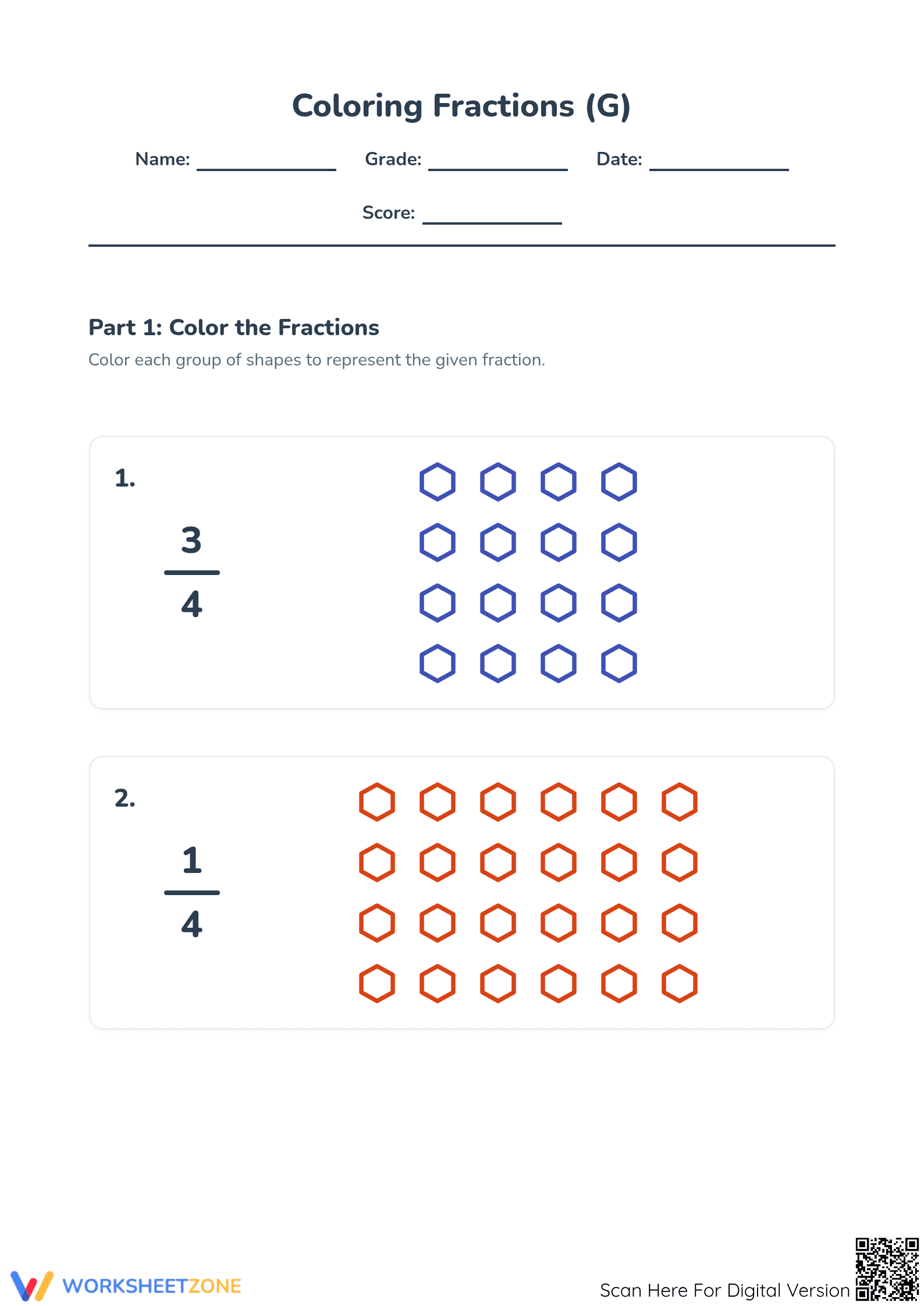
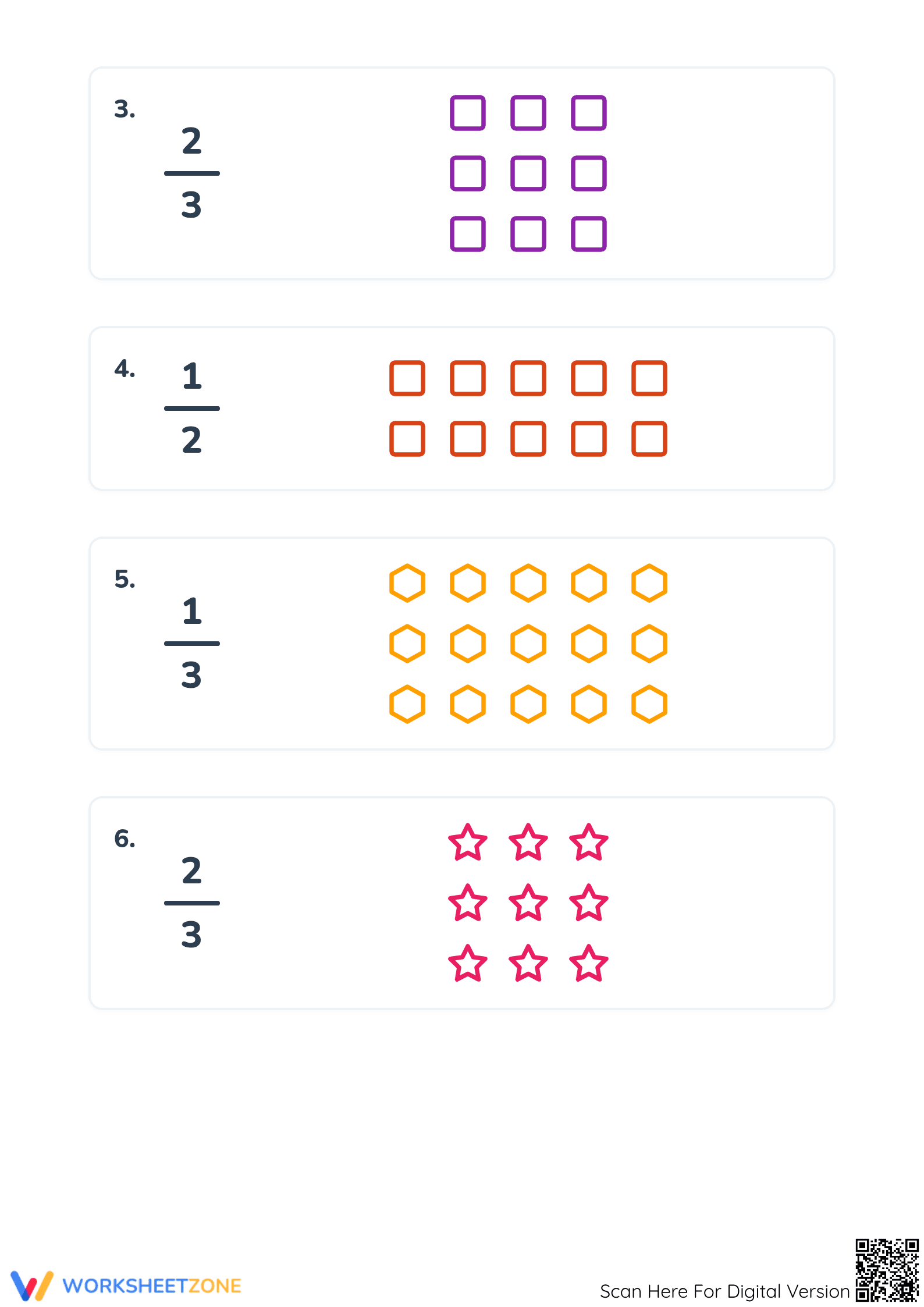
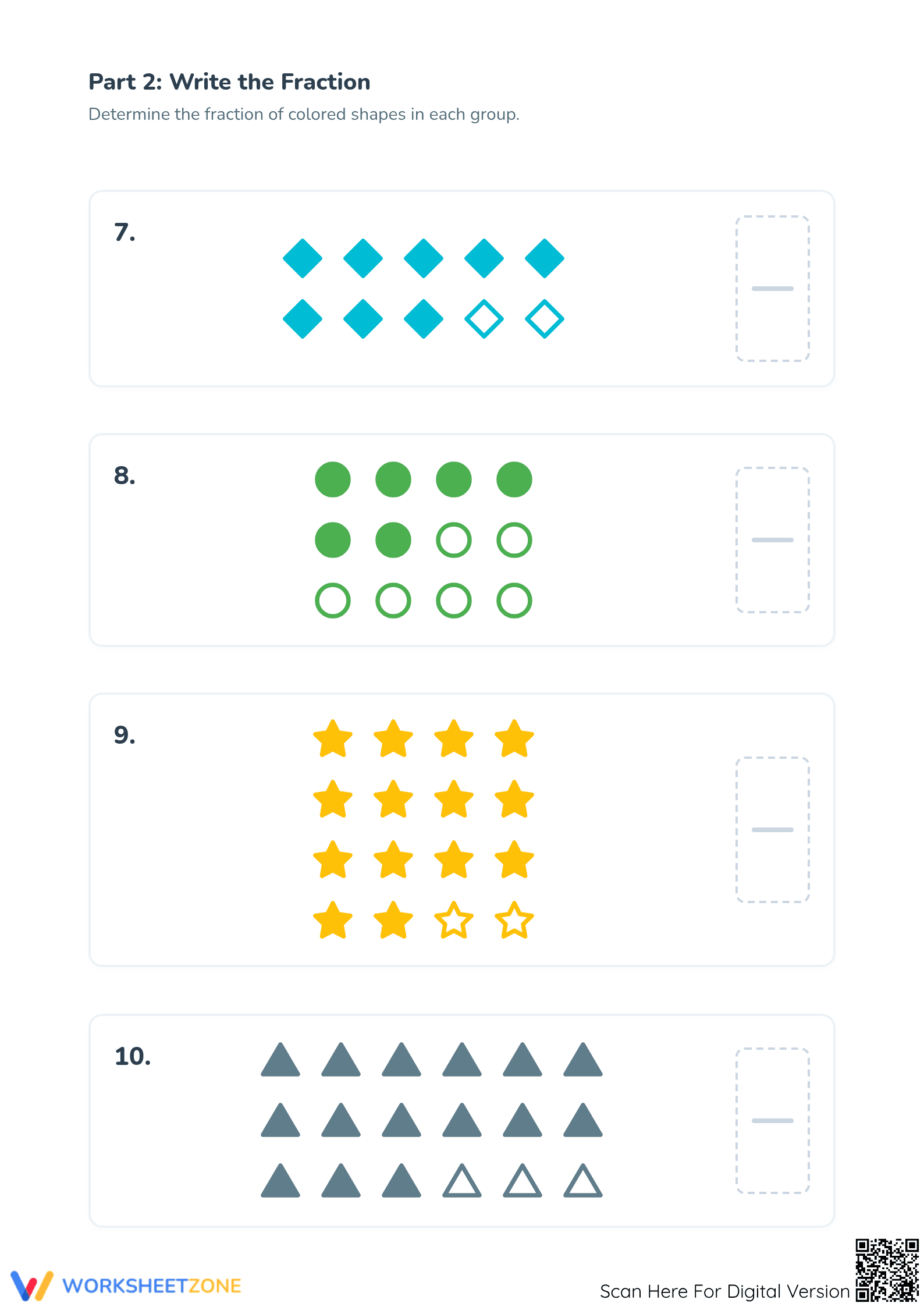
This three-page PDF resource features 10 comprehensive tasks divided into two distinct parts. Part 1 requires students to color a specific number of shapes within a group to match a given fraction, while Part 2 challenges them to identify and write the fraction represented by pre-colored sets. A complete answer key is provided for rapid grading.
Skill Progression
- Guided Practice: The initial problems provide a clear fraction and a set of shapes, requiring students to calculate the number of items to color based on the denominator's grouping.
- Supported Practice: Middle tasks increase the set size, requiring students to apply their understanding of parts-of-a-whole to larger groups of hexagons, squares, and stars.
- Independent Practice: The final section removes the coloring scaffold, asking students to analyze colored sets and independently determine the corresponding numeric fraction representation.
This worksheet follows a gradual release model, ensuring students build confidence as they move from coloring to identification tasks.
Standards Alignment
This resource is directly aligned with CCSS.MATH.CONTENT.3.NF.A.1, which requires students to understand a fraction a/b as the quantity formed by a parts of size 1/b. It also supports 3.NF.A.3 by reinforcing visual equivalence. Both standard codes can be copied directly into lesson plans, IEP goals, or district curriculum mapping tools.
How to Use It
Deploy this worksheet during the practice phase of a lesson to check for understanding before moving to independent stations. It also serves as an excellent formative assessment tool; observe if students struggle to identify the total number of items (the denominator) versus the colored items (the numerator). Completion typically takes 20 minutes.
Who It's For
This resource is designed for Grade 3 students beginning their fraction unit, though it provides valuable remediation for Grade 4 or 5 learners. It pairs naturally with physical manipulatives like counters or tiles to provide a multisensory learning experience during direct instruction.
The use of visual models to represent fractions of a set is a cornerstone of effective mathematics pedagogy. According to the RAND AIRS 2024 report, students who consistently engage with pictorial representations of fractions demonstrate a 22% higher retention rate of conceptual knowledge compared to those taught through abstract symbols alone. This worksheet utilizes geometric shapes to ground mathematical concepts in observable reality, facilitating the transition from concrete to representational thinking. By focusing on CCSS.MATH.CONTENT.3.NF.A.1, the material ensures that learners develop a robust internal model of how numerators count parts and denominators define the unit group size. These 10 tasks are structured to provide a low-floor, high-ceiling entry point for diverse learners, making it a reliable resource for general education and special education settings. This structured approach to fractional reasoning is supported by contemporary research into cognitive load and math fluency.


