


























Views
Downloads

Essential Modeling Fractions with Groups of Shapes Worksheet
Paste this activity's link or code into your existing LMS (Google Classroom, Canvas, Teams, Schoology, Moodle, etc.).
Students can open and work on the activity right away, with no student login required.
You'll still be able to track student progress and results from your teacher account.
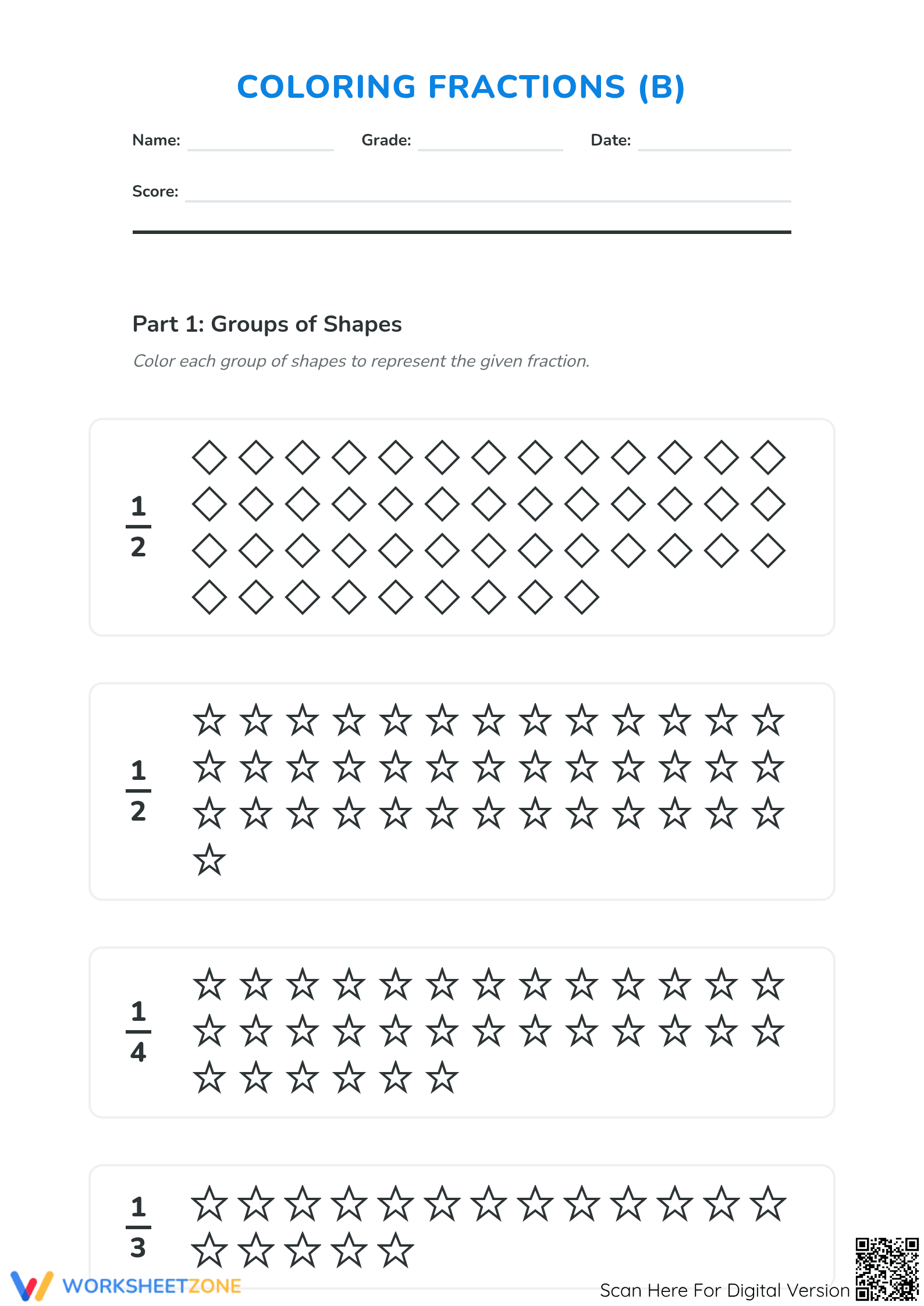
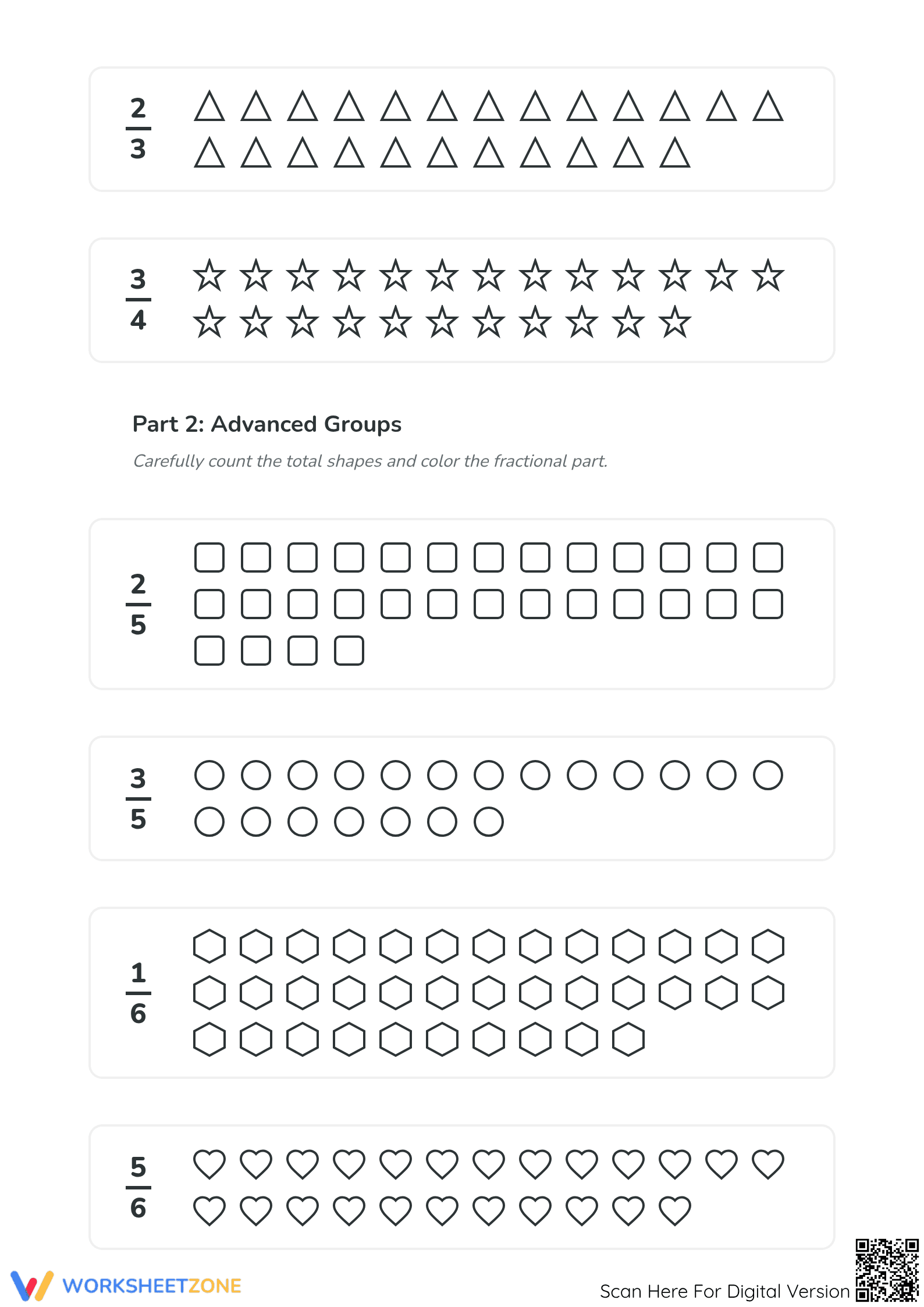
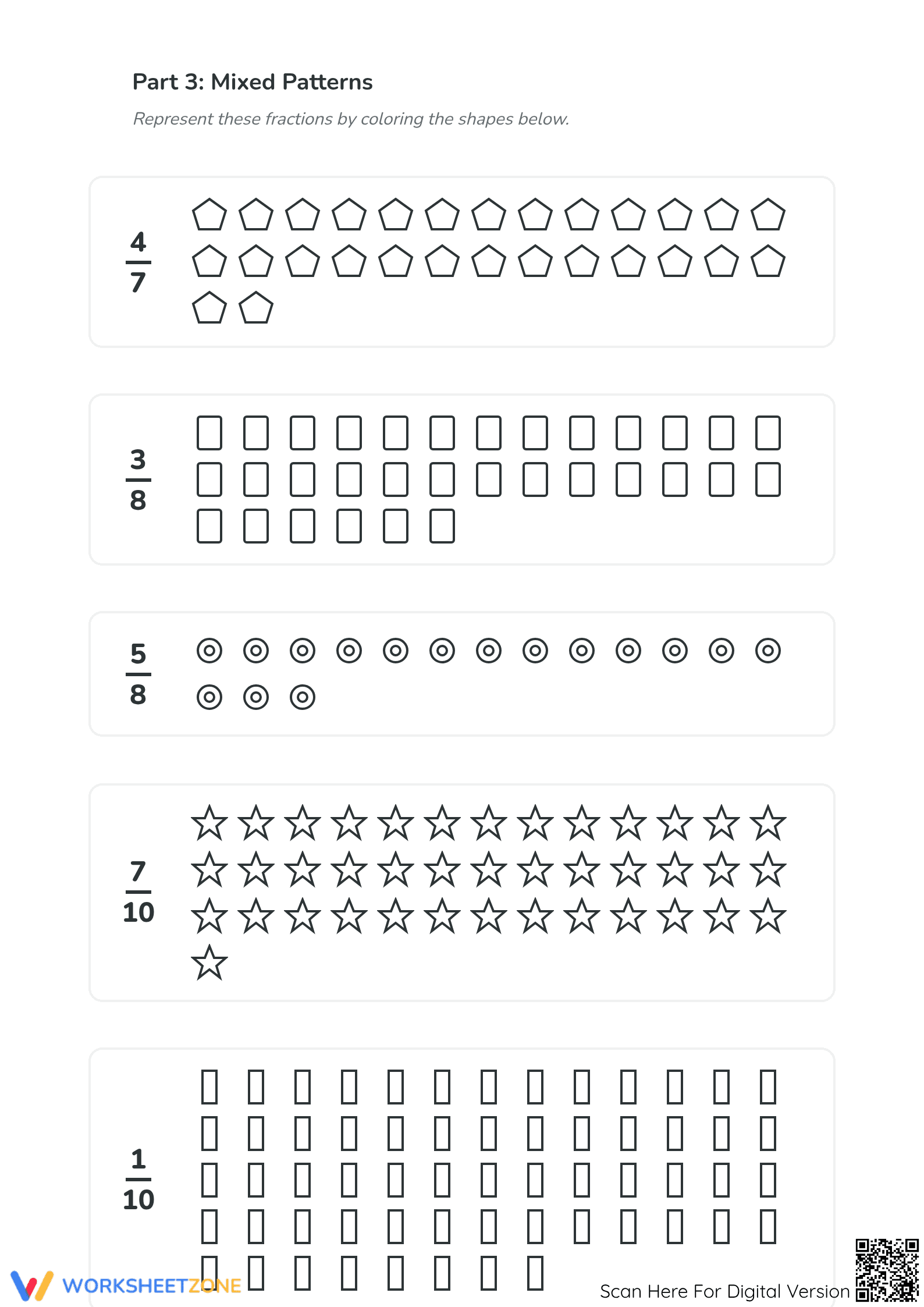
This Grade 3-5 math worksheet provides a comprehensive approach to modeling fractions as parts of a group or set of objects. Students will learn to identify the total number of items in a collection and color a specific fractional part to demonstrate conceptual understanding. It is a vital resource for bridging concrete and abstract mathematical thinking.
At a Glance
- Grade: 3–5 · Subject: Math · Fractions
- Standard:
CCSS.MATH.CONTENT.3.NF.A.1— Understand fractions as parts of a whole group or set of objects- Skill Focus: Modeling fractions of a set
- Format: 4 pages · 21 problems · Answer key included · PDF
- Best For: Independent practice or small group instruction
- Time: 25–45 minutes
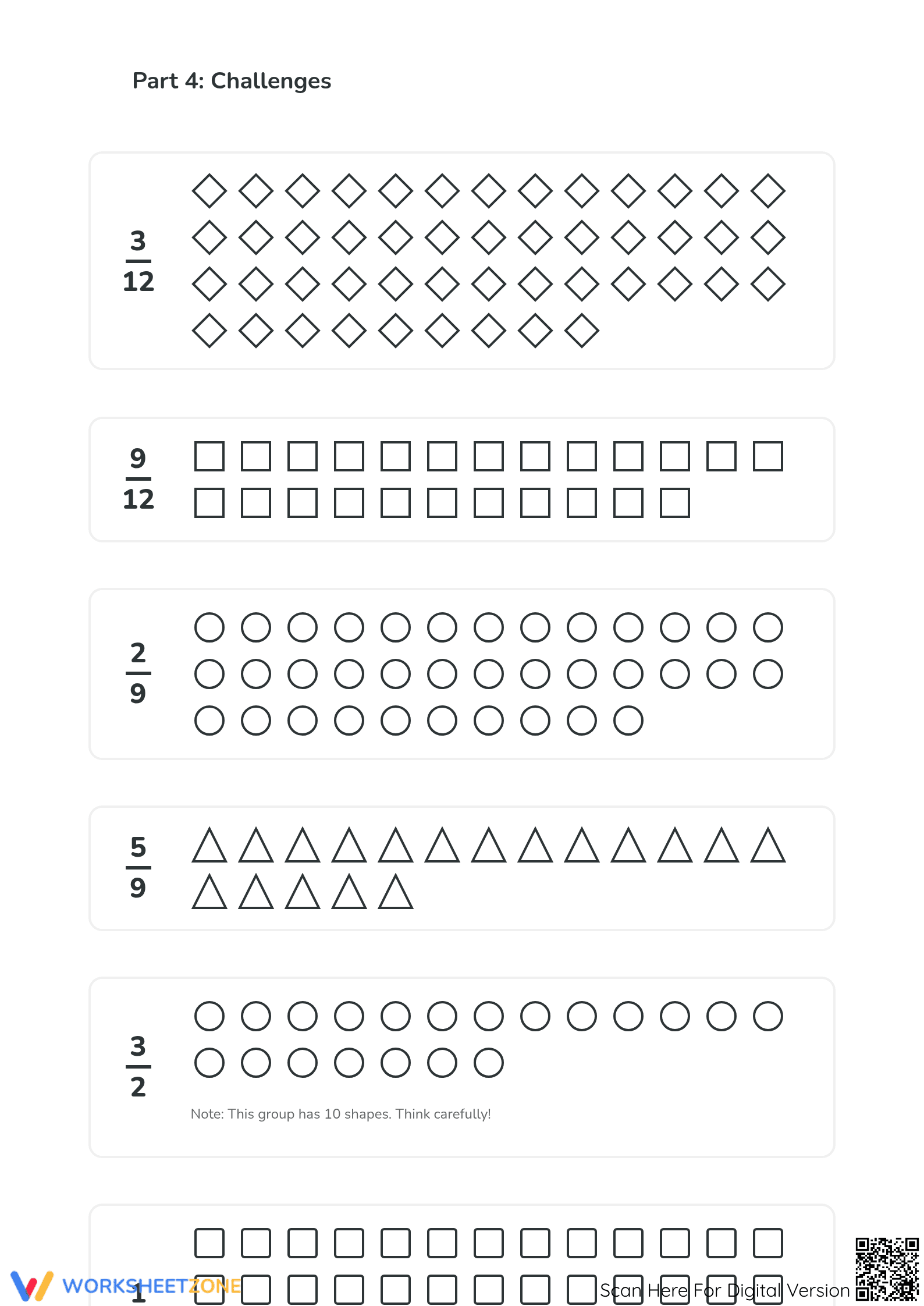
Inside this four-page resource, students will find twenty-one distinct tasks organized by complexity. Each task features a different shape group, including diamonds, stars, triangles, squares, and hexagons. The clear layout provides ample space for coloring, while the included answer key ensures that checking student progress is fast and accurate for teachers and parents alike.
This resource is designed for a zero-prep workflow. First, print the four-page packet, which takes less than one minute. Second, distribute the worksheets at the start of your independent work block. Finally, use the included answer keys to review student work in under two minutes. The total teacher prep time is under two minutes, making this ideal for substitute plans, morning work, or last-minute instructional needs when you require high-quality, aligned materials.
The primary alignment for this resource is CCSS.MATH.CONTENT.3.NF.A.1, which requires students to understand a fraction as the quantity formed by parts of a partitioned whole. It specifically extends this to groups of objects, helping students see the whole as a collection rather than a single shape. This standard code can be copied directly into lesson plans, IEP goals, or district curriculum mapping tools.
Use this as a centers activity during your fractions unit. After teaching the concept of a whole being a group of objects, hand these out for students to apply their knowledge. Alternatively, use Part 4: Challenges as a quick exit ticket to gauge which students are ready for improper fractions. Watch for students who struggle to count the total set size first. This observation provides immediate insight for your next small group session.
This worksheet is primarily for elementary students in third through fifth grade who are building their initial fraction fluency. It is also an excellent tool for older students who need targeted intervention or for those with IEP goals focused on visual mathematical modeling. The gradual increase in difficulty ensures that all learners can find a point of entry.
This worksheet focuses on the critical transition from area-based fraction models to set-based models, a foundational step for proportional reasoning and later multiplication of fractions. According to Fisher & Frey (2014), modeling fractions with discrete sets helps students bridge the gap between counting whole numbers and understanding rational numbers as parts of a collection. By identifying the numerator as the colored subset and the denominator as the total count of the group, students develop a robust mental representation of CCSS.MATH.CONTENT.3.NF.A.1. This 4-page printable resource provides twenty-one structured opportunities for students to practice this skill across varying levels of complexity, including challenging improper fractions. Such visual scaffolds are essential for moving learners toward conceptual mastery and fluency. The inclusion of an answer key ensures immediate feedback, which is a key component of effective formative assessment in elementary mathematics.


