


























Views
Downloads

Essential Coloring Fractions Worksheet | Grade 3 Printable
Paste this activity's link or code into your existing LMS (Google Classroom, Canvas, Teams, Schoology, Moodle, etc.).
Students can open and work on the activity right away, with no student login required.
You'll still be able to track student progress and results from your teacher account.
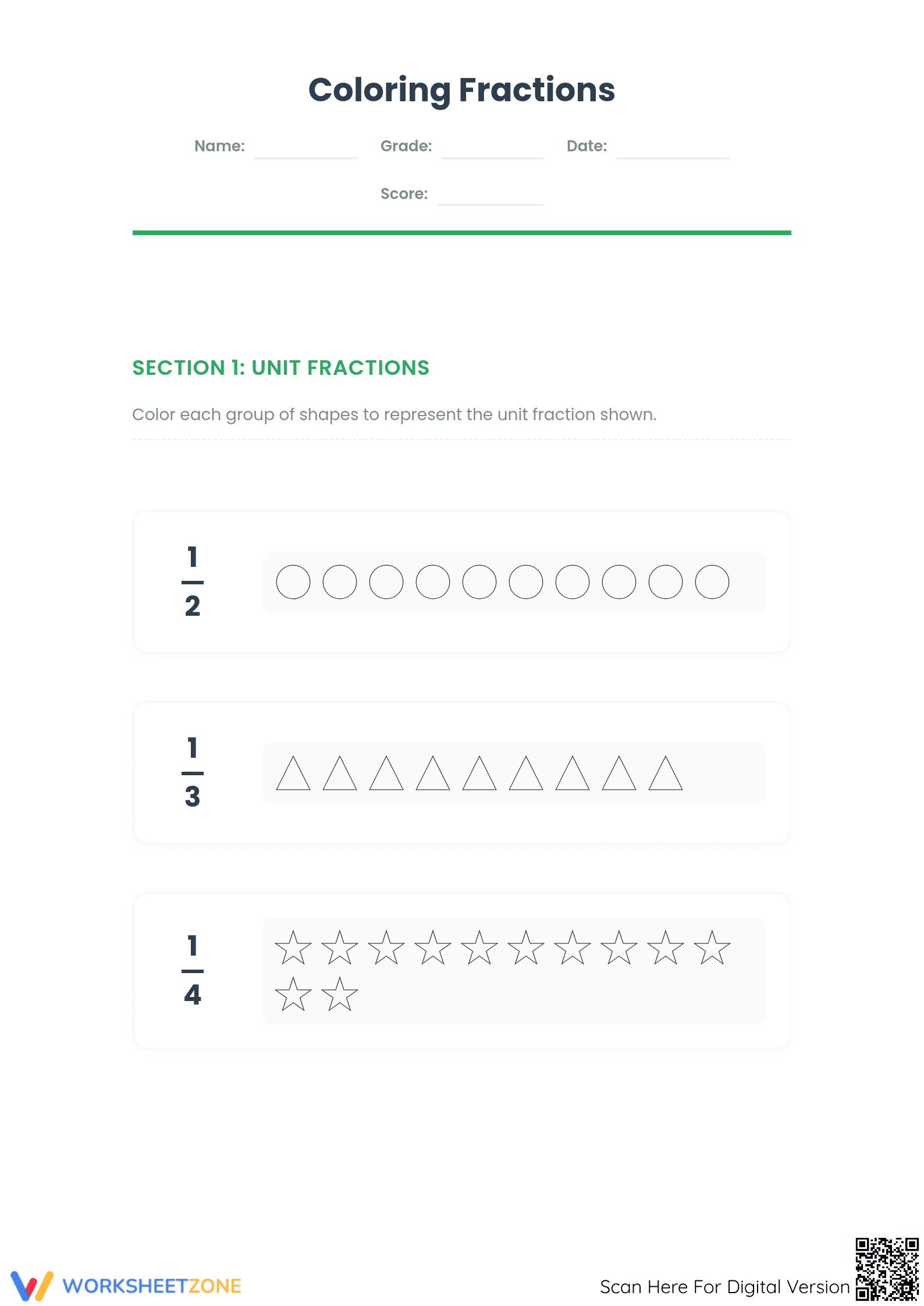
Conceptualizing fractions as parts of a set is a vital milestone in Grade 3 mathematics. This printable worksheet provides a comprehensive, visual approach to modeling unit and proper fractions using groups of familiar geometric shapes. By coloring specific quantities within a set, students transform abstract numerical values into concrete visual representations, ensuring a deep understanding of parts and wholes.
At a Glance
- Grade: 3 · Subject: Math (Fractions)
- Standard:
3.NF.A.1— Understand a fraction as a part of a group or whole- Skill Focus: Visual Fraction Modeling
- Format: 3 pages · 11 problems · Answer key included · PDF
- Best For: Introduction to discrete fraction sets
- Time: 15–20 minutes
What's Inside
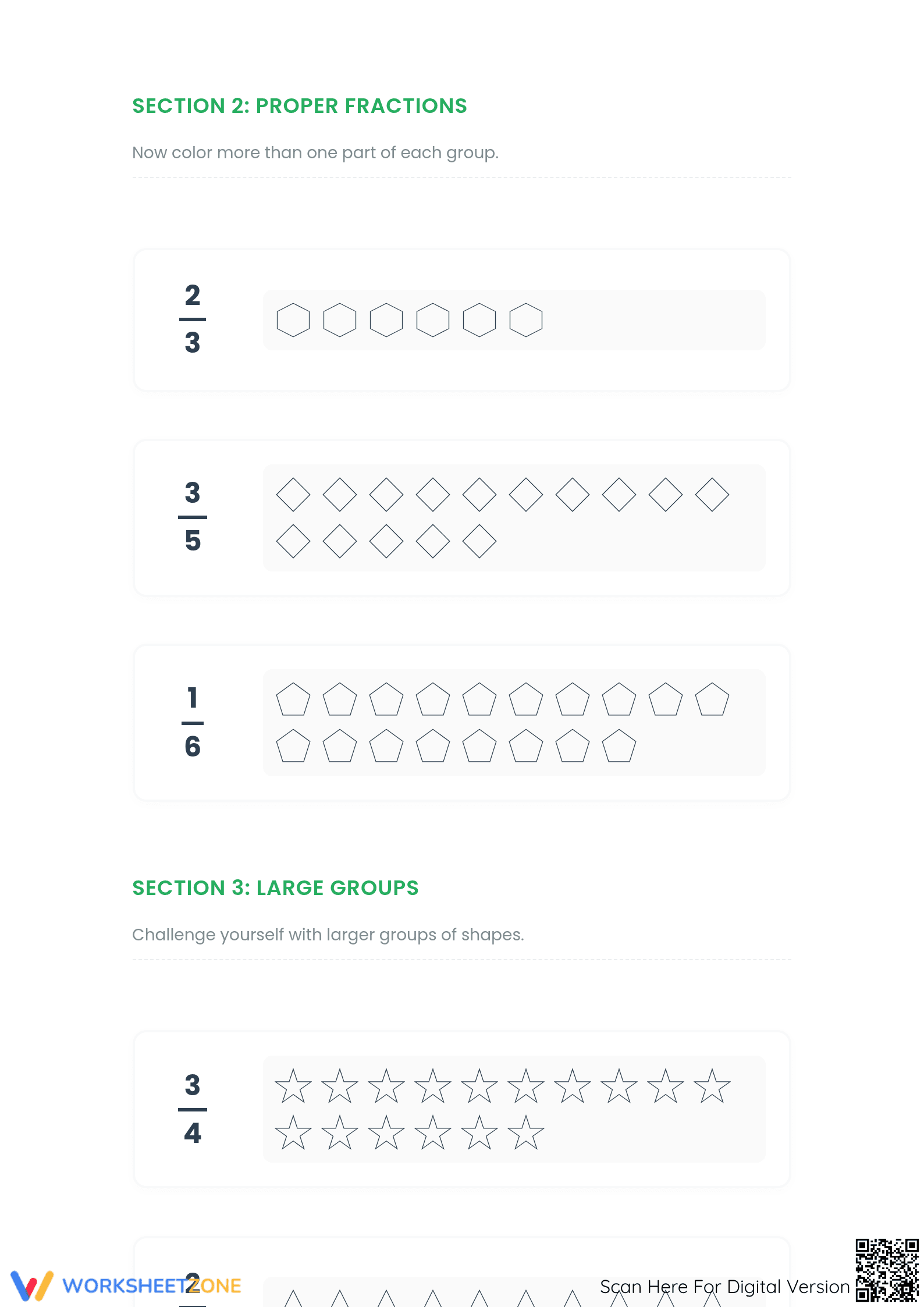
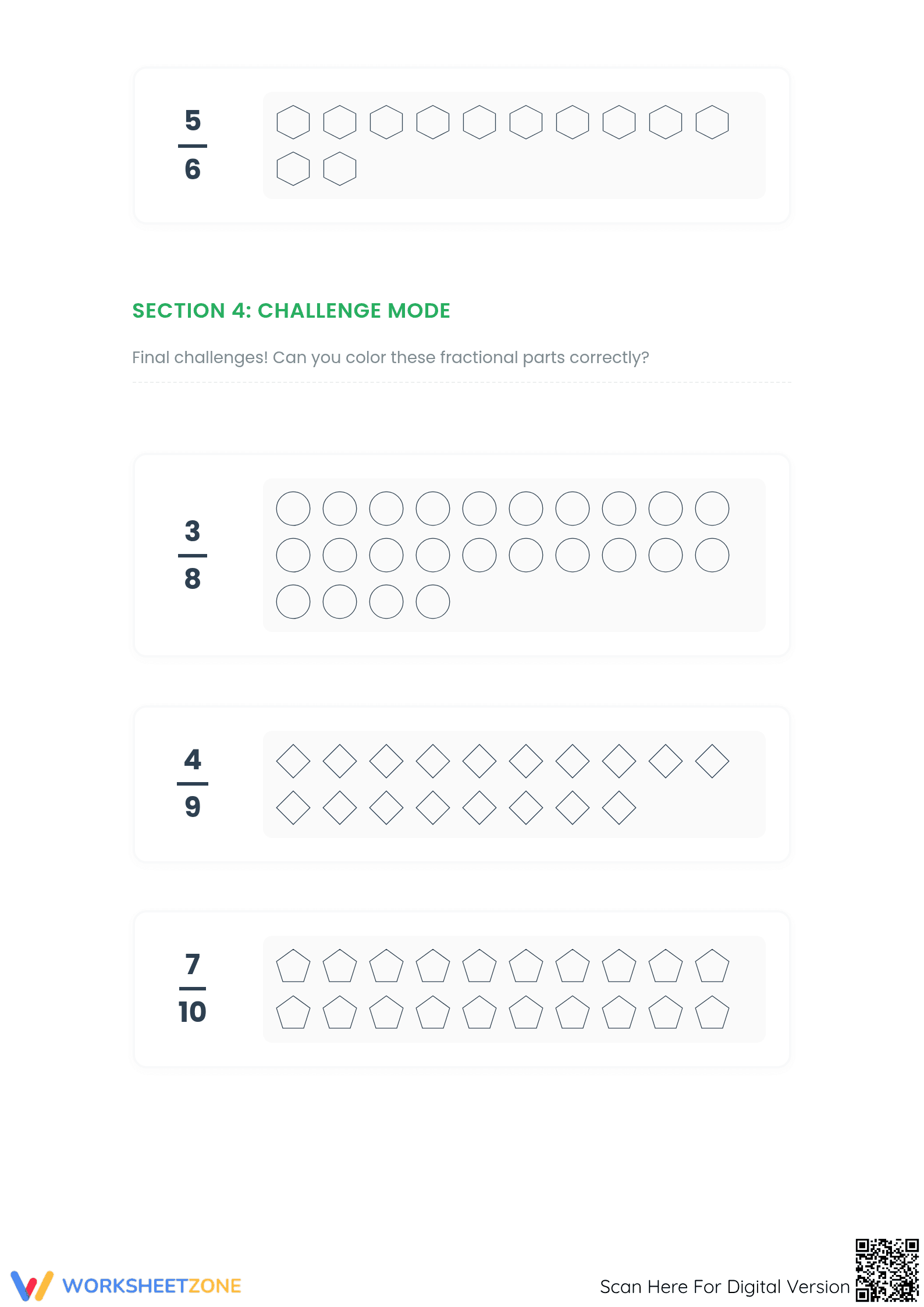
This 3-page resource contains 11 targeted coloring tasks organized into four distinct difficulty tiers. Each problem presents a fraction alongside a group of shapes, such as circles, triangles, stars, and pentagons. The layout includes a dedicated header for student names and scores, a clear answer key for rapid grading, and a progression from simple unit fractions to complex challenge sets involving larger denominators and set sizes.
Skill Progression
- Guided Practice: The first section focuses on unit fractions like 1/2 and 1/3, allowing students to identify a single part of a set with low task complexity and high visual clarity.
- Supported Practice: Students transition to proper fractions, coloring multiple parts of a group to understand how the numerator dictates quantity while the denominator defines the total set.
- Independent Practice: The final sections introduce "Large Groups" and "Challenge Mode," requiring students to count and color within sets of up to 10 objects, reinforcing counting accuracy. This sequence follows the gradual-release model, moving from foundational recognition to independent application.
Standards Alignment
The primary focus is CCSS.MATH.CONTENT.3.NF.A.1. Students will understand a fraction 1/b as the quantity formed by 1 part when a whole is partitioned into b equal parts and understand a fraction a/b as the quantity formed by a parts of size 1/b. This standard code can be copied directly into lesson plans, IEP goals, or district curriculum mapping tools.
How to Use It
Deploy this worksheet during the "We Do" phase of a lesson on fraction sets to guide students through the counting process. It also serves as an excellent formative assessment tool; observe whether students correctly identify the total count (denominator) before coloring. Expect students to complete all three pages in approximately 15–20 minutes of focused classroom work or as a homework assignment.
Who It's For
This resource is designed for Grade 3 students but provides valuable remedial support for Grade 4 and 5 learners struggling with visual models. It pairs naturally with a set of pattern blocks or a fraction circle anchor chart to provide multi-modal instruction for diverse learners and English Language Learners who benefit from geometric cues.
According to the RAND AIRS 2024 report, visual modeling is critical for conceptual fraction mastery in the third grade. This worksheet directly addresses the transition from discrete objects to fractional representations, a foundational cognitive shift required for later fluency with rational numbers. Research from Fisher & Frey (2014) highlights that scaffolding from unit fractions to non-unit proper fractions allows students to internalize the additive nature of parts, preventing common misconceptions. By requiring students to physically color portions of geometric groups, the activity reinforces the CCSS.MATH.CONTENT.3.NF.A.1 standard through kinesthetic engagement and visual discrimination. Such structured practice is statistically linked to improved performance on standardized assessments of proportional reasoning. This resource provides the rigorous, aligned practice necessary for building a durable mathematical foundation.


